. 2013 Nov 26;110(48):19472-7.
doi: 10.1073/pnas.1318172110. Epub 2013 Nov 11.

Human-specific endogenous retroviral insert serves as an enhancer for the schizophrenia-linked gene PRODH

Affiliations

Human-specific endogenous retroviral insert serves as an enhancer for the schizophrenia-linked gene PRODH

Maria Suntsova et al. Proc Natl Acad Sci U S A. .

Abstract

Using a systematic, whole-genome analysis of enhancer activity of human-specific endogenous retroviral inserts (hsERVs), we identified an element, hsERVPRODH, that acts as a tissue-specific enhancer for the PRODH gene, which is required for proper CNS functioning. PRODH is one of the candidate genes for susceptibility to schizophrenia and other neurological disorders. It codes for a proline dehydrogenase enzyme, which catalyses the first step of proline catabolism and most likely is involved in neuromediator synthesis in the CNS. We investigated the mechanisms that regulate hsERVPRODH enhancer activity. We showed that the hsERVPRODH enhancer and the internal CpG island of PRODH synergistically activate its promoter. The enhancer activity of hsERVPRODH is regulated by methylation, and in an undermethylated state it can up-regulate PRODH expression in the hippocampus. The mechanism of hsERVPRODH enhancer activity involves the binding of the transcription factor SOX2, whch is preferentially expressed in hippocampus. We propose that the interaction of hsERVPRODH and PRODH may have contributed to human CNS evolution.

Keywords: DNA methylation; central nervous system; human speciation; human-specific endogenous retrovirus; retroelement.


Conflict of interest statement

The authors declare no conflict of interest.

Figures
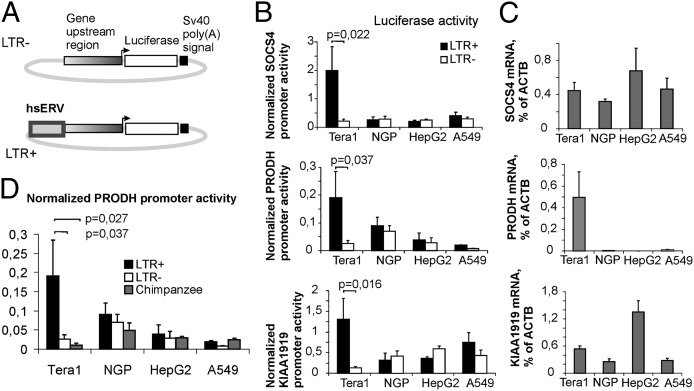
Fig. 1.
Fig. 1.
Comparison of luciferase reporter assay data with transcriptional activities of the endogenous gene copies. (A) Scheme of luciferase reporter constructs. (B) Promoter activities of LTR+ and LTR constructs in Tera-1, NGP127, HepG2, and A549 cell lines (normalized to the SV40 promoter activity). (C) mRNA levels of SOCS4, PRODH, and KIAA1919 genes in cell lines measured by qRT-PCR relative to the endogenous β-actin (ACTB) gene expression. (D) Promoter activities of human and chimpanzee PRODH upstream regions. LTR, human PRODH promoter region; LTR+, human PRODH promoter region including hsERV LTR; Chimpanzee, orthologous chimpanzee PRODH promoter (lacking hsERV). Data show means ± SD of three independent experiments.
Fig. 2.
Fig. 2.
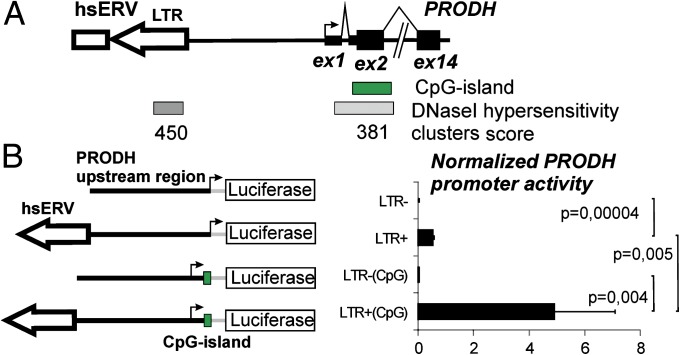
Effect of the PRODH CpG island on hsERVPRODH-enhancer activity. (A) The PRODH gene upstream region. Black bars indicate PRODH exons; black arrow, PRODH transcription start site; open arrow, hsERV LTR; open bar, hsERV internal region; green bar, CpG island; gray bar, DNase I hypersensitive clusters. Numbers under gray bars indicate cluster scores. Data were taken from the University of California Santa Cruz Genome Browser, http://genome.ucsc.edu. (B) (Left) Schematic representation of luciferase reporter constructs. (Right) Relative PRODH promoter activity, normalized to SV40 promoter activity. Data show means ± SD of three independent experiments.
Fig. 3.
Fig. 3.
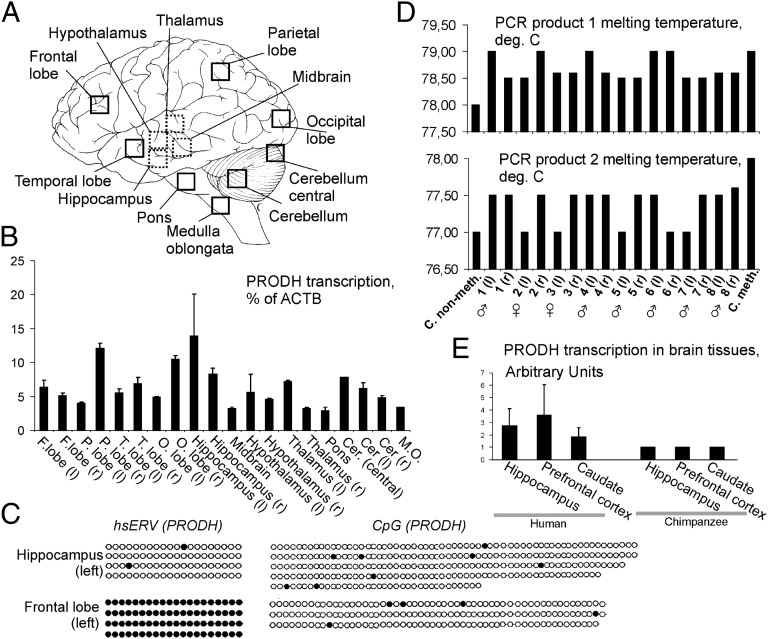
Functional characterization of the PRODH locus in the brain tissues. (A) Schematic view of the brain sections investigated. (B) Expression of PRODH in human brain tissues measured using qRT-PCR relative to ACTB. Data show means ± SD of three independent experiments. (C) Representative methylation patterns of the hsERVPRODH (Left) and CpGPRODH (Right) in the left hippocampus and left hemisphere of the frontal lobe. Black circle, methylated CG dinucleotide; white circle, unmethylated CG dinucleotide. (D) High-resolution melting profiling of bisulfite-treated DNA from the left (l) and right (r) hemisphere of human hippocampi. Data are shown for two PCR-amplified bisulfite-treated CG-rich fragments of the hsERVPRODH. C.meth, methylated sequence control; C non-meth, unmethylated sequence control. (E) Transcriptional activity of PRODH in human and chimpanzee brain tissues. The data were extracted from the NCBI GEO database, and the fold-change differences in gene-expression levels in individual human tissue samples and in the average chimpanzee tissue were calculated. Arbitrary units represent the fold-change difference between the PRODH expression in human samples and the chimpanzee median PRODH expression.
Fig. 4.
Fig. 4.
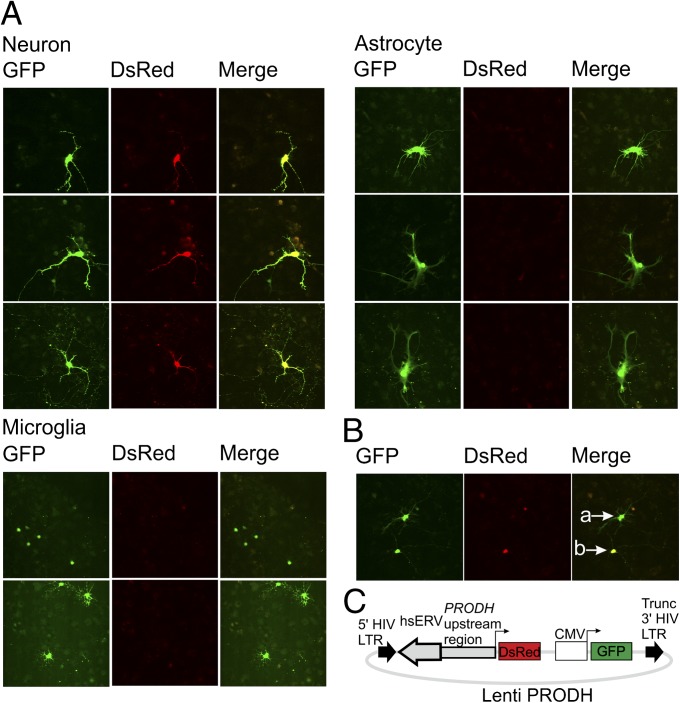
Transformation of rat hippocampal cells with a lentiviral construct carrying the upstream human PRODH region. (A) Schematized structure of the lentiviral construct. Red fluorescent protein (DsRed) was placed under the transcriptional control of the PRODH promoter; the GFP gene was placed under the control of the constitutive CMV promoter (+ control). (B) PRODH promoter activity in different hippocampal cell types. (C) Comparison of DsRed vs. GFP fluorescence in astrocytes (a) and neurons (b).
Fig. 5.
Fig. 5.
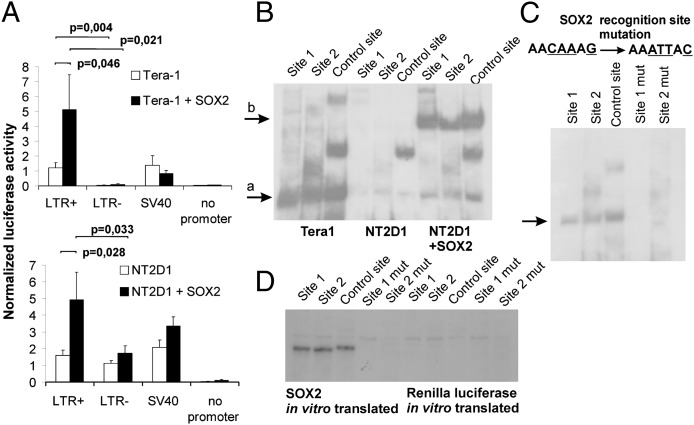
Regulation of hsERVPRODH enhancer activity by the SOX2 transcription factor. (A) Effect of SOX2 overexpression on hsERVPRODH enhancer activity in Tera-1 (Upper) and NT2/D1 (Lower) cells. Data show means ± SD of three independent experiments. (B) EMSA for SOX2-binding sites with nuclear extracts of Tera-1 cells, NT2/D1 cells, and NT2/D1 cells overexpressing SOX2. (C) EMSAwith mutated SOX2-binding sites (mutated nucleotide positions are underlined). (D) EMSA for the SOX2-binding sites with in vitro-produced SOX2 protein. Renilla Luciferase protein was used as a negative control. Sites 1 and 2 SOX2, recognition sites 1 and 2 within hsERVPRODH; sites 1 and 2 mut, respective mutated sites; control site, control recognition sequence.

References

    1. Bannert N, Kurth R. Retroelements and the human genome: New perspectives on an old relation. Proc Natl Acad Sci USA. 2004;101(Suppl 2):14572–14579. - PMC - PubMed
    1. Gogvadze E, Stukacheva E, Buzdin A, Sverdlov E. Human-specific modulation of transcriptional activity provided by endogenous retroviral insertions. J Virol. 2009;83(12):6098–6105. - PMC - PubMed
    1. Mills RE, et al. Recently mobilized transposons in the human and chimpanzee genomes. Am J Hum Genet. 2006;78(4):671–679. - PMC - PubMed
    1. Buzdin A, Kovalskaya-Alexandrova E, Gogvadze E, Sverdlov E. At least 50% of human-specific HERV-K (HML-2) long terminal repeats serve in vivo as active promoters for host nonrepetitive DNA transcription. J Virol. 2006;80(21):10752–10762. - PMC - PubMed
    1. Kowaloff EM, Phang JM, Granger AS, Downing SJ. Regulation of proline oxidase activity by lactate. Proc Natl Acad Sci USA. 1977;74(12):5368–5371. - PMC - PubMed

Publication types

Associated data