Anhedonia, depressed mood, and smoking cessation outcome
- PMID: 24219183
- PMCID: PMC3934823
- DOI: 10.1037/a0035046
Anhedonia, depressed mood, and smoking cessation outcome
Abstract
Objective: Although the relation between lifetime depression and smoking cessation outcome has been well studied, the proposition that different symptomatic expressions of depression exert disparate predictive effects on risk of smoking cessation failure has largely gone uninvestigated. This study analyzed the individual contributions of depression's 2 hallmark affective symptoms, anhedonia (i.e., diminished interest in normally enjoyable activities) and depressed mood (i.e., elevated sadness), to the prediction of smoking cessation outcome.
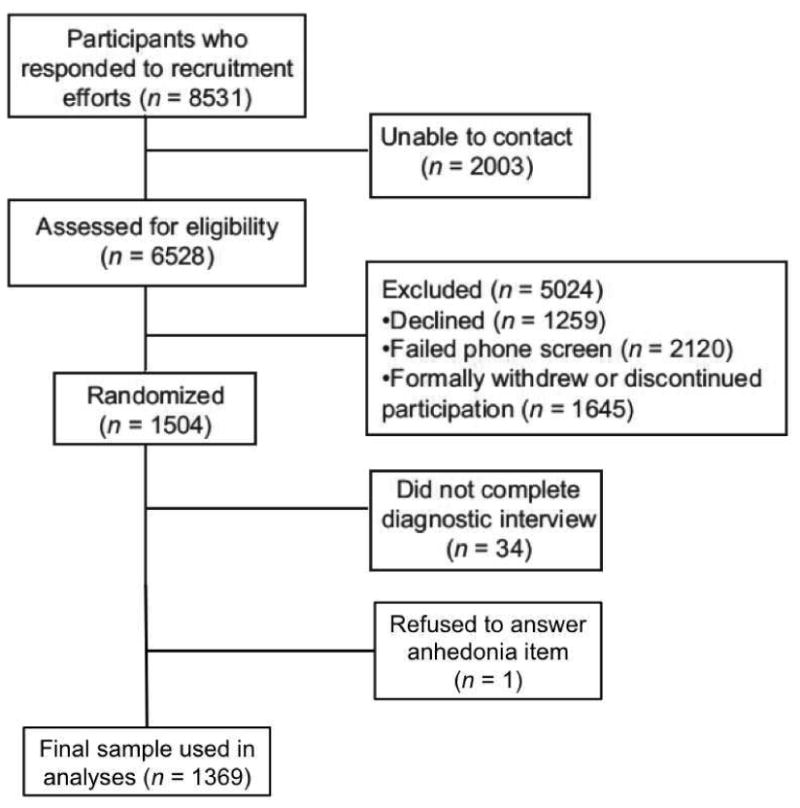
Method: Participants were adult daily smokers (N = 1,469; mean age = 45 years, 58% female, 84% White) enrolled in a smoking cessation treatment study. Lifetime history of anhedonia and depressed mood were classified via structured interview prior to quit day. Seven-day point prevalence smoking abstinence was assessed at 8 weeks and 6 months postquit.
Results: When examined separately, both lifetime anhedonia, OR (95% CI) = 1.42 (1.16, 1.73), p = .004, and depressed mood, OR (95% CI) = 1.35 (1.11, 1.63), p = .002, predicted increased odds of relapse. These relations remained after adjusting for covariates, including lifetime depressive disorder, which did not predict outcome. After controlling for the covariation between lifetime anhedonia and depressed mood, anhedonia predicted cessation outcome, OR (95% CI) = 1.31 (1.05, 1.62), p = .02, while depressed mood did not (p = .19). Symptom duration (>2 weeks), treatment, and substance use disorder did not modify relations of lifetime anhedonia and depressed mood with cessation outcome.
Conclusions: Results suggest that (1) symptoms of affective disturbance capture depression-relevant risk of cessation failure, which is not adequately demarcated by the lifetime depressive disorder diagnosis, and (2) anhedonia is a more sensitive index of this affective disturbance than depressed mood per se. Clinical attention to anhedonia may facilitate smoking cessation.
PsycINFO Database Record (c) 2014 APA, all rights reserved.
References
-
- APA. Diagnostic and statistical manual of mental disorders (fourth edition) American Psychiatric Association; 1994.
Publication types
MeSH terms
Grants and funding
- K05 CA139871/CA/NCI NIH HHS/United States
- UL1 TR000427/TR/NCATS NIH HHS/United States
- P50DA019706/DA/NIDA NIH HHS/United States
- K08DA02504/DA/NIDA NIH HHS/United States
- P50 DA019706/DA/NIDA NIH HHS/United States
- UL1 RR025011/RR/NCRR NIH HHS/United States
- K08 DA025041/DA/NIDA NIH HHS/United States
- R01 CA168676/CA/NCI NIH HHS/United States
- 1K05CA139871/CA/NCI NIH HHS/United States
- 1UL1RR025011 FROM/RR/NCRR NIH HHS/United States
- KL2 RR025012/RR/NCRR NIH HHS/United States
- R01 HL109031/HL/NHLBI NIH HHS/United States
- K08DA021311/DA/NIDA NIH HHS/United States
- P01 CA180945/CA/NCI NIH HHS/United States
- K08 DA021311/DA/NIDA NIH HHS/United States
- 1KL2RR025012-0/RR/NCRR NIH HHS/United States
LinkOut - more resources
Full Text Sources
Other Literature Sources
Medical