Review
. 2013 Nov;33(4):380-8.
doi: 10.1055/s-0033-1358519. Epub 2013 Nov 12.

Lipoprotein metabolism, dyslipidemia, and nonalcoholic fatty liver disease

Affiliations
Review

Lipoprotein metabolism, dyslipidemia, and nonalcoholic fatty liver disease

David E Cohen et al. Semin Liver Dis. 2013 Nov.

Abstract

Cardiovascular disease represents the most common cause of death in patients with nonalcoholic fatty liver disease (NAFLD). Patients with NAFLD exhibit an atherogenic dyslipidemia that is characterized by an increased plasma concentration of triglycerides, reduced concentration of high-density lipoprotein (HDL) cholesterol, and low-density lipoprotein (LDL) particles that are smaller and more dense than normal. The pathogenesis of NAFLD-associated atherogenic dyslipidemia is multifaceted, but many aspects are attributable to manifestations of insulin resistance. Here the authors review the structure, function, and metabolism of lipoproteins, which are macromolecular particles of lipids and proteins that transport otherwise insoluble triglyceride and cholesterol molecules within the plasma. They provide a current explanation of the metabolic perturbations that are observed in the setting of insulin resistance. An improved understanding of the pathophysiology of atherogenic dyslipidemia would be expected to guide therapies aimed at reducing morbidity and mortality in patients with NAFLD.


Figures

Figure 1
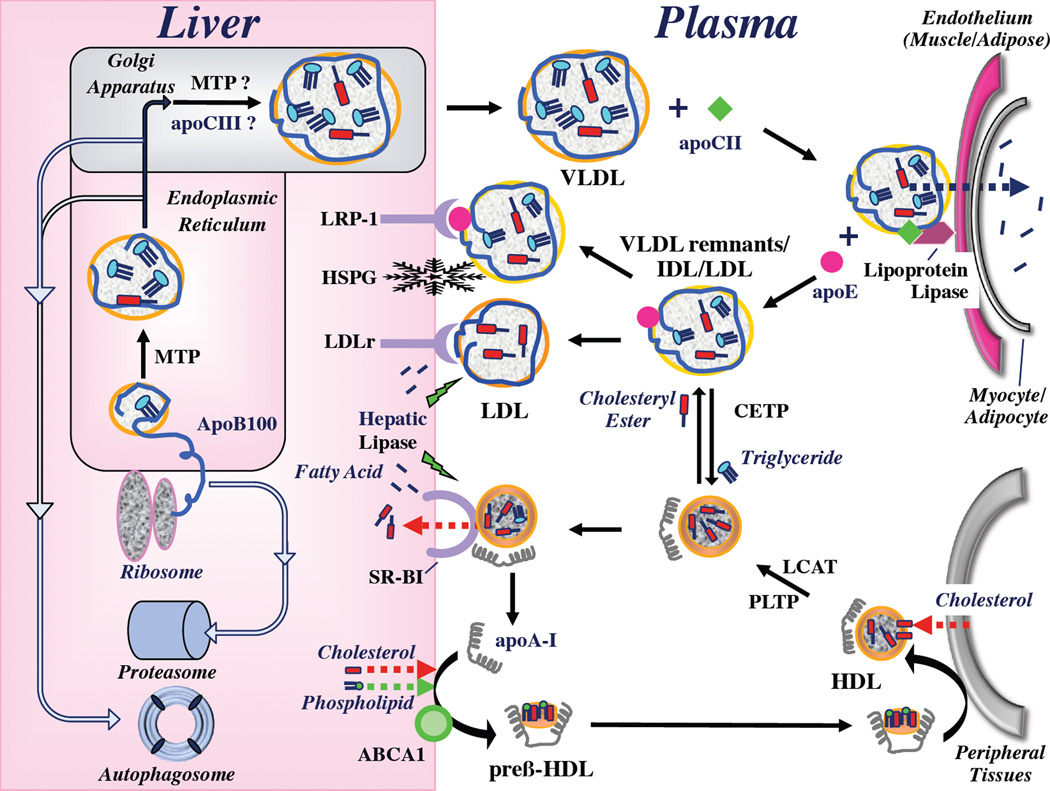
Figure 1. Simplified schematic summary of hepatic lipoprotein metabolism
The liver produces VLDL particles, which transport triglycerides through the plasma to muscle and adipose tissue. Assembly begins when apoB100 protein is translated from its mRNA by ribosomes, crossing the membrane of the ER and entering the lumen. ApoB100 is cotranslationally lipidated with triglycerides by the activity of MTP. Cholesteryl esters are incorporated into the lipoprotein core by unclear mechanisms. VLDL particles transit the Golgi apparatus where there is some evidence that they are further lipidated by MTP, as well as apoC-III, though this has not been definitively established (as indicated by “?”). The matured particle is secreted into the plasma. Hepatic VLDL secretion rates are controlled largely by rates of apoB100 degradation, which is mediated by the proteasome or the autophagosome. For clarity, an additional sortilin-mediated pathway of ApoB100 degradation (described in the text) is not displayed. Within the plasma, VLDL particles become fully activated for tissue targeting and lipolysis by the acquisition apoC-II. This permits binding of VLDL to lipoprotein lipase, which is tethered to the surface of endothelial cells. Lipoprotein lipase hydrolyzes triglycerides within the core of the lipoprotein particles, and the fatty acids are taken up into muscle or fat. When this is complete, VLDL particles detach from lipoprotein lipase, apoC-II dissociates and apoE is acquired. The resulting particles are chylomicron (CM) and VLDL remnants and IDL, which are interact for prolonged periods with LPL to become more dense. Remnant lipoproteins (VLDL or IDL) are either taken up into hepatocytes by multiple mechanisms, which include the LDL receptor (LDLr), the LDL-related protein (LRP)-1, a complex formed between LRP-1 and HSPG or HSPG alone. Formation of LDL occurs when IDL particles interact instead with hepatic lipase. Hydrolysis of additional triglycerides renders the particle more dense and enriched with cholesteryl esters. ApoE and apoCII are lost from the particle, leaving apoB100 as the sole apolipoprotein. LDL particles are taken up exclusively by the LDLr. HDL particles are formed when newly secreted ApoA-I interacts with ATP binding cassette protein AI (ABCA1) on the surface of hepatocytes. This promotes the incorporation of phospholipid and cholesterol from hepatocyte plasma membranes into a discoidal-shaped pre-β-HDL particle, which can accept excess cellular cholesterol through ABCA1. Subsequently, lecithin cholesterol:acyltransferase (LCAT) promotes the formation of spherical HDL, which are much better configured to receive cholesterol from cell membranes of peripheral tissues through ABCG1. The combined activities of LCAT and phospholipid transfer protein (PLTP allow for enlargement of the HDL particle and enable it to take on even more cholesterol. Cholesteryl ester transfer protein (CETP) exchanges cholesteryl esters in the core of HDL for triglycerides from the core of VLDL, VLDL remnants, IDL, and even LDL particles. At the liver, HDL particles bind to scavenger receptor, class B type I (SR-BI), which promotes hepatic uptake of only the cholesteryl esters. Hepatic lipase hydrolyzes triglycerides from the core, which remodels the particle and allows for optimal activity of SR-BI. ApoA-I dissociates from the particle and participates in the formation of new HDL.

References

    1. Ekstedt M, Franzen LE, Mathiesen UL, Thorelius L, Holmqvist M, Bodemar G, Kechagias S. Long-term follow-up of patients with NAFLD and elevated liver enzymes. Hepatology. 2006;44:865–873. - PubMed
    1. Vanwagner LB, Bhave M, Te HS, Feinglass J, Alvarez L, Rinella ME. Patients transplanted for nonalcoholic steatohepatitis are at increased risk for postoperative cardiovascular events. Hepatology. 2012;56:1741–1750. - PubMed
    1. Kim D, Kim WR, Kim HJ, Therneau TM. Association between noninvasive fibrosis markers and mortality among adults with nonalcoholic fatty liver disease in the United States. Hepatology. 2013;57:1357–1365. - PMC - PubMed
    1. Chatrath H, Vuppalanchi R, Chalasani N. Dyslipidemia in patients with nonalcoholic fatty liver disease. Semin. Liver Dis. 2012;32:22–29. - PMC - PubMed
    1. Treeprasertsuk S, Leverage S, Adams LA, Lindor KD, St Sauver J, Angulo P. The Framingham risk score and heart disease in nonalcoholic fatty liver disease. Liver Int. 2012;32:945–950. - PMC - PubMed

Publication types

MeSH terms