


Review
doi: 10.1155/2013/479541.
Epub 2013 Oct 7.
The estrogen receptor joins other cancer biomarkers as a predictor of outcome
Affiliations
- PMID: 24223042
- PMCID: PMC3816067
- DOI: 10.1155/2013/479541
Item in Clipboard
Review
The estrogen receptor joins other cancer biomarkers as a predictor of outcome
Obstet Gynecol Int.
2013.
Abstract
Endometrial cancer, the most common gynecologic malignancy in the United States, is on the rise, and survival is worse today than 40 years ago. In order to improve the outcomes, better biomarkers that direct the choice of therapy are urgently needed. In this review, we explore the estrogen receptor as the most studied biomarker and the best predictor for response for endometrial cancer reported to date.
Figures
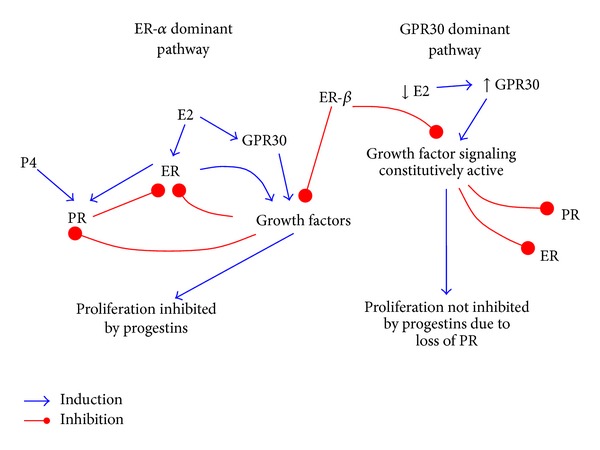
Hormone receptors in endometrial tumors. In ER-α dependent tumors (left side), estrogen induces growth factors and PR through ER-α. This creates a positive feedback loop between ER-α and growth factor signaling. However, progesterone (P4), when bound to PR, downregulates ER and PR. In addition, MAPK activation downstream of growth factor signaling results in phosphorylation of ER and PR and the ligand-dependent loss of PR and ER proteins by ubiquitination-mediated proteasomal degradation. ER-α and PR levels are increased again at the level of transcription by estrogen stimulation. Hence, the growth of these tumors is dependent upon estrogen and is limited by progesterone, suggesting that the patient will respond to progestin hormonal therapy. High expression of ER-β, if present, can inhibit the function of ER-α. For GPR30 dependent tumors (right panel), we hypothesize that proliferation is driven by the constitutive activation of one or more components of a growth factor pathway. Growth does not depend upon the presence of estrogen and is not limited by progesterone. Also, the classical steroid hormone receptors are downregulated as a result of constitutive phosphorylation via MAPK. This is predicted because the phosphorylation of the receptors leads to its targeting the proteasome for degradation. By virtue of the constitutive activation of a growth factor pathway, such tumors grow independently of classical hormonal signaling.
References
-
- Cancer Facts and Figures. 2013, http://www.cancer.org/acs/groups/content/@epidemiologysurveilance/docume....
-
- Huet-Hudson YM, Chakraborty C, De SK, Suzuki Y, Andrews GK, Dey SK. Estrogen regulates the synthesis of epidermal growth factor in mouse uterine epithelial cells. Molecular Endocrinology. 1990;4(3):510–523. - PubMed
-
- Lingham RB, Stancel GM, Loose-Mitchell DS. Estrogen regulation of epidermal growth factor receptor messenger ribonucleic acid. Molecular Endocrinology. 1988;2(3):230–235. - PubMed
-
- Murphy LJ, Murphy LC, Friesen HG. Estrogen induces insulin-like growth factor-I expression in the rat uterus. Molecular Endocrinology. 1987;1(7):445–450. - PubMed
-
- Weisz A, Bresciani F. Estrogen induces expression of c-fos and c-myc protooncogenes in rat uterus. Molecular Endocrinology. 1988;2(9):816–824. - PubMed
Publication types
Grants and funding
LinkOut - more resources
Full Text Sources
Other Literature Sources
