. 2013 Nov 6;8(11):e80074.
doi: 10.1371/journal.pone.0080074. eCollection 2013.

Vaginal pH and microbicidal lactic acid when lactobacilli dominate the microbiota

Affiliations

Vaginal pH and microbicidal lactic acid when lactobacilli dominate the microbiota

Deirdre E O'Hanlon et al. PLoS One. .

Abstract

Lactic acid at sufficiently acidic pH is a potent microbicide, and lactic acid produced by vaginal lactobacilli may help protect against reproductive tract infections. However, previous observations likely underestimated healthy vaginal acidity and total lactate concentration since they failed to exclude women without a lactobacillus-dominated vaginal microbiota, and also did not account for the high carbon dioxide, low oxygen environment of the vagina. Fifty-six women with low (0-3) Nugent scores (indicating a lactobacillus-dominated vaginal microbiota) and no symptoms of reproductive tract disease or infection, provided a total of 64 cervicovaginal fluid samples using a collection method that avoided the need for sample dilution and rigorously minimized aerobic exposure. The pH of samples was measured by microelectrode immediately after collection and under a physiological vaginal concentration of CO2. Commercial enzymatic assays of total lactate and total acetate concentrations were validated for use in CVF, and compared to the more usual HPLC method. The average pH of the CVF samples was 3.5 ± 0.3 (mean ± SD), range 2.8-4.2, and the average total lactate was 1.0% ± 0.2% w/v; this is a five-fold higher average hydrogen ion concentration (lower pH) and a fivefold higher total lactate concentration than in the prior literature. The microbicidal form of lactic acid (protonated lactic acid) was therefore eleven-fold more concentrated, and a markedly more potent microbicide, than indicated by prior research. This suggests that when lactobacilli dominate the vaginal microbiota, women have significantly more lactic acid-mediated protection against infections than currently believed. Our results invite further evaluations of the prophylactic and therapeutic actions of vaginal lactic acid, whether provided in situ by endogenous lactobacilli, by probiotic lactobacilli, or by products that reinforce vaginal lactic acid.


Conflict of interest statement

Competing Interests: DE O’Hanlon, TR Moench, and RA Cone have applied for the following patents: Compositions and Methods for Inactivation of Pathogens at Genital Tract Surfaces (U.S. Patent Application Number 20120070476), and Reusable Intravaginal Delivery Device, System, and Method (U.S. Patent Application Number 20120296315), with patent assignment to ReProtect Inc., Baltimore MD., and John Hopkins University, Baltimore MD. RA Cone and TR Moench are employed by ReProtect Inc. (Chair of the Board, and President/Chief Operating Officer respectively) and hold equity in the company. This does not alter our adherence to all the PLoS One policies on sharing data and materials.

Figures

Figure 1
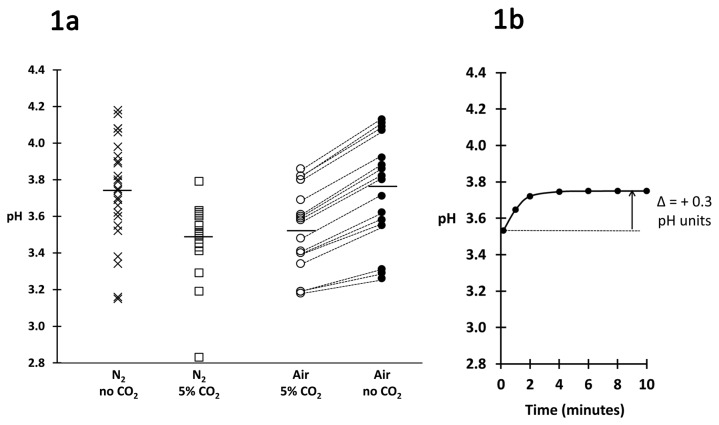
Figure 1. A: Effects of CO2 on pH.
First column: X plot symbols (n = 24) indicate the pH of samples measured in N2 without CO2. Second column: open squares (n = 24) indicate the pH of samples measured in N2 with 5% CO2. Third column: open circles (n = 16) indicate the pH of samples incubated overnight in air with 5% CO2 and measured immediately after exposing to air. Dotted lines link the values of these samples to filled circles in the fourth column, which indicate the pH of the same samples two minutes after exposing to air. A horizontal bar indicates the mean value for each column. B: Time course of increase in mean pH of the 16 samples that had been equilibrated in air with 5% CO2 (shown in Figure 1A, third column) following exposure to air.
Figure 2
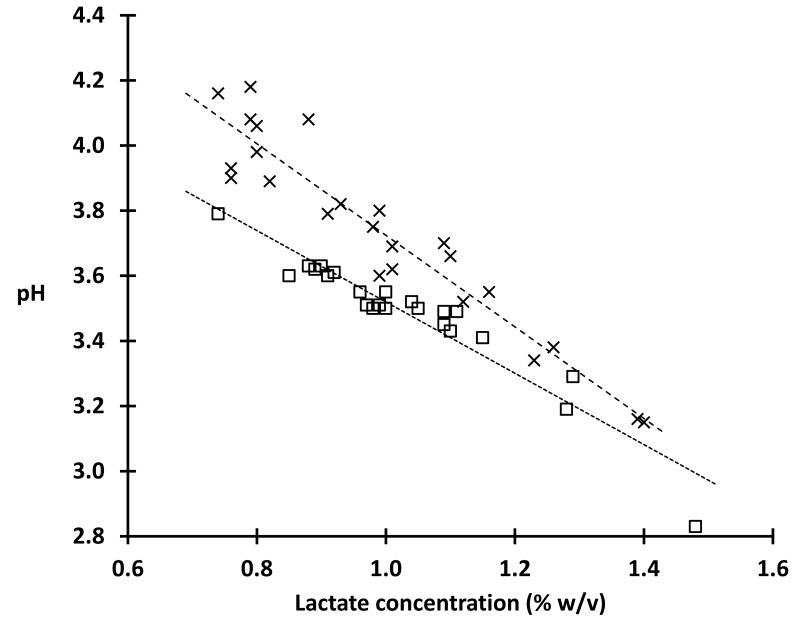
Figure 2. Vaginal pH is tightly correlated with total lactate concentration: total lactate concentration in 48 fresh CVF samples, versus pH measured in 100% N2 (X plot symbols) or 95%N2 with 5% CO2 (open squares); r 2 = 0.91 for both trend lines (least squares fit lines).

References

    1. Nugent RP, Krohn MA, Hillier SL (1991) Reliability of diagnosing bacterial vaginosis is improved by a standardized method of Gram stain interpretation. J Clin Microbiol 29: 297-301. PubMed: 1706728. - PMC - PubMed
    1. Martin HL, Richardson BA, Nyange PM, Lavreys L, Hillier SL et al. (1999) Vaginal lactobacilli, microbial flora, and risk of human immunodeficiency virus type 1 and sexually transmitted disease acquisition. J Infect Dis 1801: 863-868. PubMed: 10558942. - PubMed
    1. Sewankambo N, Gray RH, Wawer MJ, Paxton L, McNaim D et al. (1997) HIV-1 infection associated with abnormal vaginal flora morphology and bacterial vaginosis. Lancet 350: 546-550. Erratum in: Lancet 350: 1036 doi: 10.1016/S0140-6736(97)01063-5. PubMed: 9284776. - DOI - PubMed
    1. Cherpes TL, Meyn LA, Krohn MA, Lurie JG, Hillier SL (2003) Association between acquisition of herpes simplex virus type 2 in women and bacterial vaginosis. Clin Infect Dis 37: 319-325. doi: 10.1086/375819. PubMed: 12884154. - DOI - PubMed
    1. Brotman RM, Bradford LL, Conrad M, Gajer P, Ault K et al. (2012) Association between Trichomonas vaginalis and vaginal bacterial community composition among reproductive-age women. Sex Transm Dis 39: 807-812. doi: 10.1097/OLQ.0b013e3182631c79. PubMed: 23007708. - DOI - PMC - PubMed

Publication types