. 2013 Nov 6:7:150.
doi: 10.3389/fncom.2013.00150. eCollection 2013.

Perspectives for computational modeling of cell replacement for neurological disorders

Affiliations

Perspectives for computational modeling of cell replacement for neurological disorders

James B Aimone et al. Front Comput Neurosci. .

Abstract

Mathematical modeling of anatomically-constrained neural networks has provided significant insights regarding the response of networks to neurological disorders or injury. A logical extension of these models is to incorporate treatment regimens to investigate network responses to intervention. The addition of nascent neurons from stem cell precursors into damaged or diseased tissue has been used as a successful therapeutic tool in recent decades. Interestingly, models have been developed to examine the incorporation of new neurons into intact adult structures, particularly the dentate granule neurons of the hippocampus. These studies suggest that the unique properties of maturing neurons, can impact circuit behavior in unanticipated ways. In this perspective, we review the current status of models used to examine damaged CNS structures with particular focus on cortical damage due to stroke. Secondly, we suggest that computational modeling of cell replacement therapies can be made feasible by implementing approaches taken by current models of adult neurogenesis. The development of these models is critical for generating hypotheses regarding transplant therapies and improving outcomes by tailoring transplants to desired effects.

Keywords: cerebral cortex; dentate gyrus; embryonic stem cells; functional integration; induced pluripotent stem cells; neurogenesis; stroke.


Figures
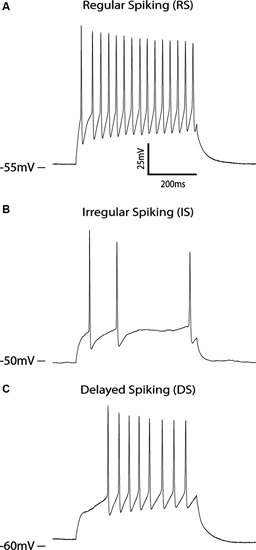
Figure 1
Figure 1
Spiking properties of hPSNs. (A–C) Voltage clamp traces of three different hPSNs during current injection illustrating various spiking capabilities including RS (A), IS (B), and delayed spiking (C).
Figure 2
Figure 2
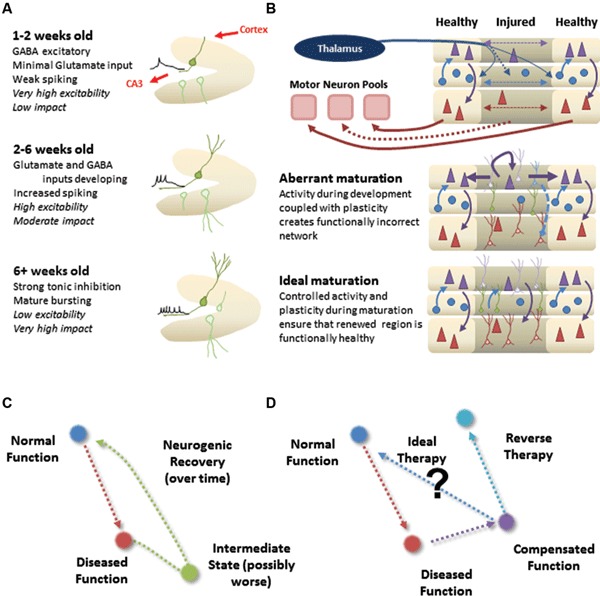
Incorporation of new neurons into normal or damaged circuitry. (A) Natural context for DG neurogenesis. The DG has a roughly feed-forward architecture, allowing a sophisticated maturation process (different panels). Neurons are born continuously, so there is always a mixed population of neurons at different developmental stages (faded green). (B) Therapeutic context for cortical neural replacement. Injured or diseased region may suffer considerable neuronal loss and initiate restructuring of the local network. Proper cell replacement therapy, in which the correct types of new neurons are appropriately positioned in the region, could still suffer from aberrant maturation if the unique properties of developing neurons cause affect the functional wiring of the circuit. Ideal maturation would instead result in not only the proper neuronal layout, but also an appropriate functional circuit as well. (C) Cartoon illustration of how the dynamics of neural maturation can complicate a cell replacement therapy. (D) Cartoon illustration of how compensation makes simple reversal of impairments an insufficient strategy for returning system to normal function.

References

    1. Aimone J. B., Deng W., Gage F. H. (2010). Adult neurogenesis: integrating theories and separating functions. Trends Cogn. Sci. 14, 325–337 10.1016/j.tics.2010.04.003 - DOI - PMC - PubMed
    1. Aimone J. B., Deng W., Gage F. H. (2011). Resolving new memories: a critical look at the dentate gyrus, adult neurogenesis, and pattern separation. Neuron 70, 589–596 10.1016/j.neuron.2011.05.010 - DOI - PMC - PubMed
    1. Aimone J. B., Gage F. H. (2011). Modeling new neuron function: a history of using computational neuroscience to study adult neurogenesis. Eur. J. Neurosci. 33, 1160–1169 10.1111/j.1460-9568.2011.07615.x - DOI - PubMed
    1. Aimone J. B., Wiles J., Gage F. H. (2009). Computational influence of adult neurogenesis on memory encoding. Neuron 61, 187–202 10.1016/j.neuron.2008.11.026 - DOI - PMC - PubMed
    1. Armentrout S. L., Reggia J. A., Weinrich M. (1994). A neural model of cortical map reorganization following a focal lesion. Artif. Intell. Med. 6, 383–400 10.1016/0933-3657(94)90003-5 - DOI - PubMed

LinkOut - more resources