. 2013 Nov 5;8(11):e78582.
doi: 10.1371/journal.pone.0078582. eCollection 2013.

A single nucleotide polymorphism in cBIM is associated with a slower achievement of major molecular response in chronic myeloid leukaemia treated with imatinib

Affiliations

A single nucleotide polymorphism in cBIM is associated with a slower achievement of major molecular response in chronic myeloid leukaemia treated with imatinib

Vanessa Augis et al. PLoS One. .

Abstract

Purpose: BIM is essential for the response to tyrosine-kinase inhibitors (TKI) in chronic myeloid leukaemia (CML) patients. Recently, a deletion polymorphism in intron 2 of the BIM gene was demonstrated to confer an intrinsic TKI resistance in Asian patients. The present study aimed at identifying mutations in the BIM sequence that could lead to imatinib resistance independently of BCR-ABL mutations.

Experimental design: BIM coding sequence analysis was performed in 72 imatinib-treated CML patients from a French population of our centre and in 29 healthy controls (reference population) as a case-control study. Real-time quantitative PCR (RT qPCR) was performed to assess Bim expression in our reference population.

Results: No mutation with amino-acid change was found in the BIM coding sequence. However, we observed a silent single nucleotide polymorphism (SNP) c465C>T (rs724710). A strong statistical link was found between the presence of the T allele and the high Sokal risk group (p = 0.0065). T allele frequency was higher in non responsive patients than in the reference population (p = 0.0049). Similarly, this T allele was associated with the mutation frequency on the tyrosine kinase domain of BCR-ABL (p<0.001) and the presence of the T allele significantly lengthened the time to achieve a major molecular response (MMR). Finally, the presence of the T allele was related to a decreased basal expression of the Bim mRNA in the circulating mononuclear cells of healthy controls.

Conclusion: These results suggest that the analysis of the c465C>T SNP of BIM could be useful for predicting the outcome of imatinib-treated CML patients.


Conflict of interest statement

Competing Interests: The authors have declared that no competing interest exist.

Figures

Figure 1
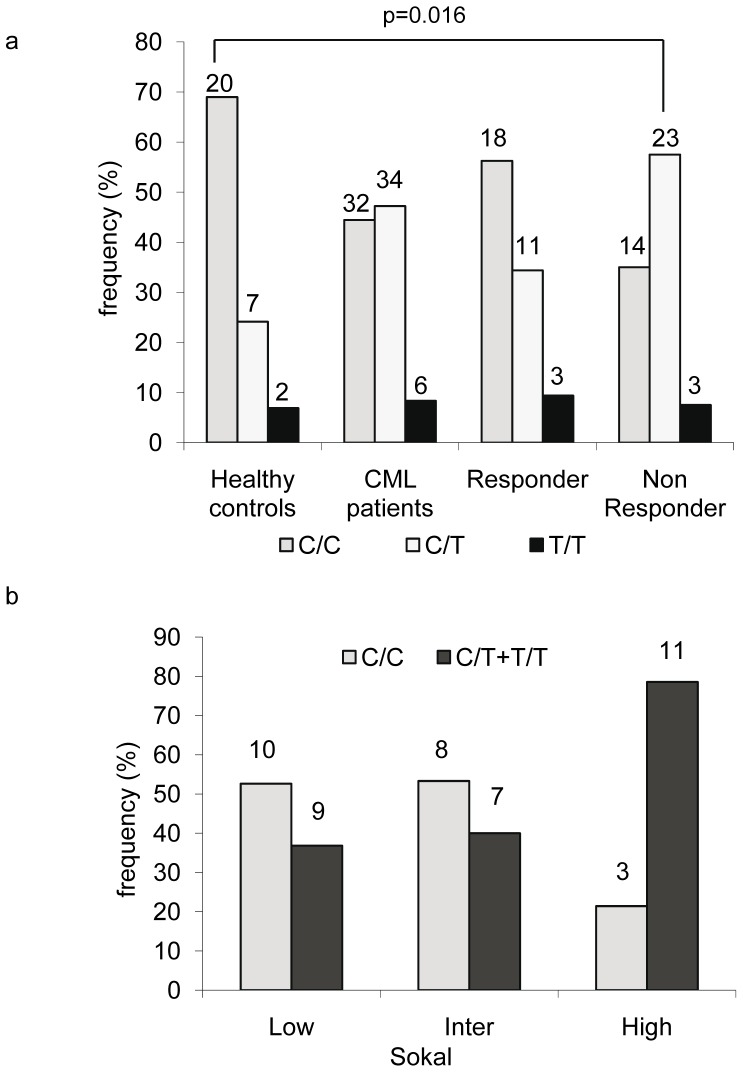
Figure 1. Relation between the c465C>T genotypes and the Sokal risk score or imatinib response.
a: BIMEL coding region was sequenced in the cDNA from 72 CML patients and 29 healthy donors. The c465C>T genotype frequency (in %) was plotted for the healthy controls and the whole patient cohort. In this cohort, 32 were responders (optimal response) while 40 “non responders” exhibited sub-optimal or failure to first line imatinib treatment. Each bar represents the frequency percentage of the corresponding genotype in each group. b: cDNAs from 48 patients were sequenced for the BIMEL coding region and the frequency of C/C or C/T+T/T genotypes was plotted for risk subcategories according to the Sokal score: <0.8 characterizes the low risk group, >1.2 the high risk group and 0.8<–<1.2 the intermediate group. The bars represent the frequency (in percentage) of the C/C (light grey) and C/T+T/T (dark grey) genotype. The number of cases was indicated above each bar?
Figure 2
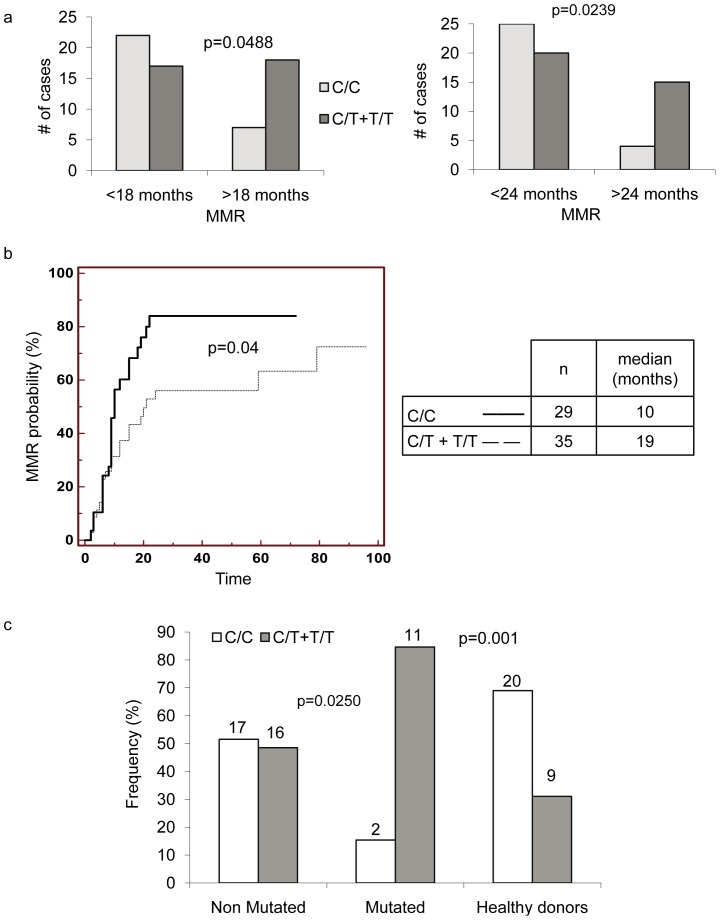
Figure 2. Relation between the C/C or T/T plus C/T BIM genotypes and the achievement of MMR.
a: cDNAs from 64 patients followed in the laboratory for their Bcr-Abl expression were sequenced for the BIMEL coding region. The number of patients achieving a MMR before or after 18 months (left panel) or 24 months (right panel) was plotted as a function of the c465C>T genotype: C/C (white bars) or C/T plus T/T (grey bars). p indicates significance with the chi-square test. b: Kaplan-Meier analysis of the achievement of a MMR. The figure represents the probability to achieve a MMR (in %) as a function of the treatment duration (in months) for patients with the C/C genotype (continuous line) or patients with the C/T or T/T genotype (dotted line). c: cDNAs from 37 resistant patients were sequenced for both the BCR-ABL tyrosine kinase domain (TKD) and BIMEL coding region. The frequency of patients with non mutated or mutated TKD was plotted as a function of the c465C>T genotype. The numbers above the bars indicate the sample size. The p value was calculated using the Chi-square test.
Figure 3
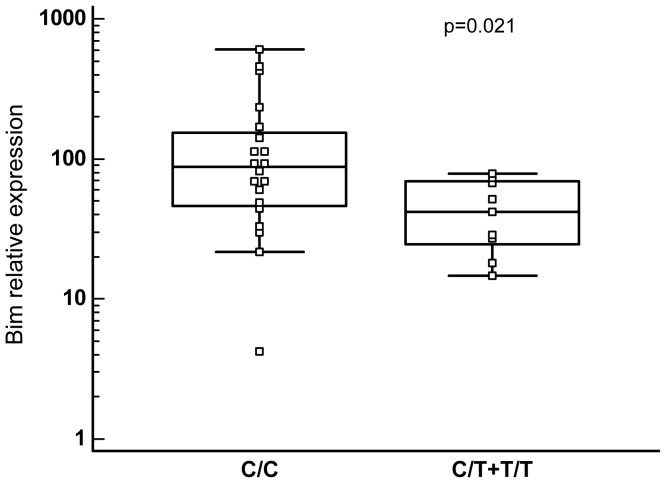
Figure 3. Relation between the C/C or C/T plus T/T BIM genotypes and the basal expression of Bim.
The cDNA from mononuclear cells of 29 healthy controls was analysed for BIM mRNA expression by quantitative RT-PCR and sequencing of the BIM coding region. The BIM expression (relative to β actin) was plotted as a function of the c465C>T genotype comparing the C/C to the C/T and T/T genotypes. The p value was calculated using the Mann-Whitney test.

References

    1. Baccarani M, Cortes J, Pane F, Niederwieser D, Saglio G, et al. (2009) Chronic myeloid leukemia: an update of concepts and management recommendations of European LeukemiaNet. J Clin Oncol 27: 6041–6051. - PMC - PubMed
    1. Lahaye T, Riehm B, Berger U, Paschka P, Muller MC, et al. (2005) Response and resistance in 300 patients with BCR-ABL-positive leukemias treated with imatinib in a single center: a 4.5-year follow-up. Cancer 103: 1659–1669. - PubMed
    1. Baran Y, Ural AU, Gunduz U (2007) Mechanisms of cellular resistance to imatinib in human chronic myeloid leukemia cells. Hematology: 1. - PubMed
    1. Deininger MW, Goldman JM, Lydon N, Melo JV (1997) The tyrosine kinase inhibitor CGP57148B selectively inhibits the growth of BCR-ABL-positive cells. Blood 90: 3691–3698. - PubMed
    1. Shinjyo T, Kuribara R, Inukai T, Hosoi H, Kinoshita T, et al. (2001) Downregulation of Bim, a proapoptotic relative of Bcl-2, is a pivotal step in cytokine-initiated survival signaling in murine hematopoietic progenitors. Mol Cell Biol 21: 854–864. - PMC - PubMed

Publication types

MeSH terms