


Chlorine dioxide is a size-selective antimicrobial agent
- PMID: 24223899
- PMCID: PMC3818415
- DOI: 10.1371/journal.pone.0079157
Chlorine dioxide is a size-selective antimicrobial agent
Abstract
Background / aims: ClO2, the so-called "ideal biocide", could also be applied as an antiseptic if it was understood why the solution killing microbes rapidly does not cause any harm to humans or to animals. Our aim was to find the source of that selectivity by studying its reaction-diffusion mechanism both theoretically and experimentally.
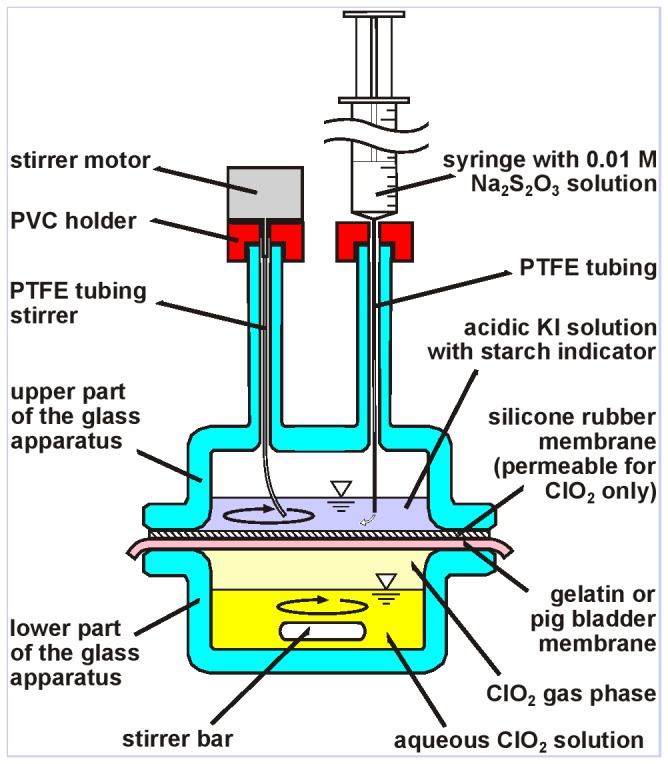
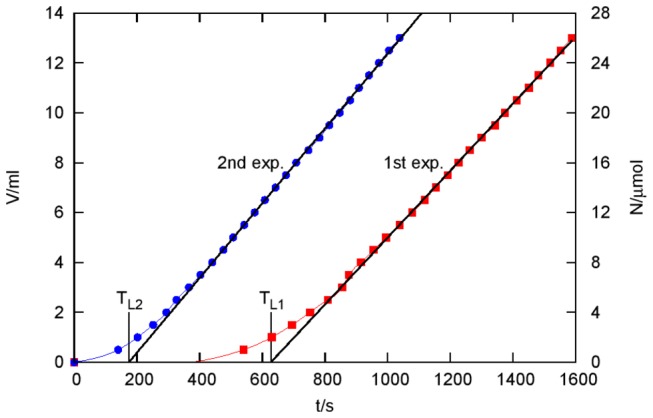
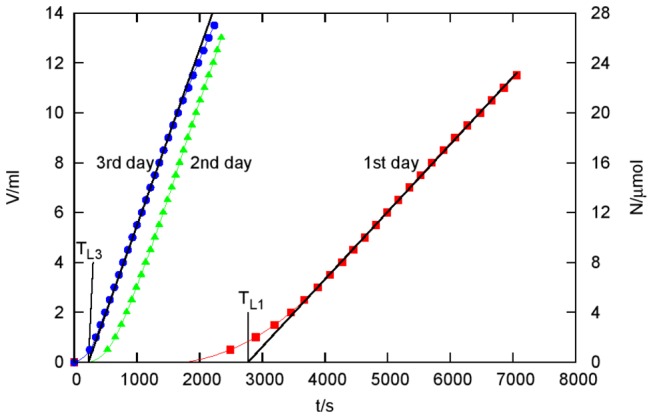
Methods: ClO2 permeation measurements through protein membranes were performed and the time delay of ClO2 transport due to reaction and diffusion was determined. To calculate ClO2 penetration depths and estimate bacterial killing times, approximate solutions of the reaction-diffusion equation were derived. In these calculations evaporation rates of ClO2 were also measured and taken into account.
Results: The rate law of the reaction-diffusion model predicts that the killing time is proportional to the square of the characteristic size (e.g. diameter) of a body, thus, small ones will be killed extremely fast. For example, the killing time for a bacterium is on the order of milliseconds in a 300 ppm ClO2 solution. Thus, a few minutes of contact time (limited by the volatility of ClO2) is quite enough to kill all bacteria, but short enough to keep ClO2 penetration into the living tissues of a greater organism safely below 0.1 mm, minimizing cytotoxic effects when applying it as an antiseptic. Additional properties of ClO2, advantageous for an antiseptic, are also discussed. Most importantly, that bacteria are not able to develop resistance against ClO2 as it reacts with biological thiols which play a vital role in all living organisms.
Conclusion: Selectivity of ClO2 between humans and bacteria is based not on their different biochemistry, but on their different size. We hope initiating clinical applications of this promising local antiseptic.
Conflict of interest statement
Figures
References
-
- Amyes SGB (2010) Antibacterial Chemotherapy. Theory, Problems and Practice. Oxford: Oxford University Press.
-
- Spellberg B (2009) Rising Plague. The Global Threat from Deadly Bacteria and Our Dwindling Arsenal to Fight Them. Amherst, NY: Prometheus Books.
Publication types
MeSH terms
Substances
LinkOut - more resources
Full Text Sources
Other Literature Sources
Medical
