. 2014 Apr;50(4):796-804.
doi: 10.1165/rcmb.2013-0418OC.

Native small airways secrete bicarbonate

Affiliations

Native small airways secrete bicarbonate

A K M Shamsuddin et al. Am J Respir Cell Mol Biol. 2014 Apr.

Abstract

Since the discovery of Cl(-) impermeability in cystic fibrosis (CF) and the cloning of the responsible channel, CF pathology has been widely attributed to a defect in epithelial Cl(-) transport. However, loss of bicarbonate (HCO3(-)) transport also plays a major, possibly more critical role in CF pathogenesis. Even though HCO3(-) transport is severely affected in the native pancreas, liver, and intestines in CF, we know very little about HCO3(-) secretion in small airways, the principle site of morbidity in CF. We used a novel, mini-Ussing chamber system to investigate the properties of HCO3(-) transport in native porcine small airways (∼ 1 mm φ). We assayed HCO3(-) transport across small airway epithelia as reflected by the transepithelial voltage, conductance, and equivalent short-circuit current with bilateral 25-mM HCO3(-) plus 125-mM NaGlu Ringer's solution in the presence of luminal amiloride (10 μM). Under these conditions, because no major transportable anions other than HCO3(-) were present, we took the equivalent short-circuit current to be a direct measure of active HCO3(-) secretion. Applying selective agonists and inhibitors, we show constitutive HCO3(-) secretion in small airways, which can be stimulated significantly by β-adrenergic- (cAMP) and purinergic (Ca(2+)) -mediated agonists, independently. These results indicate that two separate components for HCO3(-) secretion, likely via CFTR- and calcium-activated chloride channel-dependent processes, are physiologically regulated for likely roles in mucus clearance and antimicrobial innate defenses of small airways.


Figures

Figure 1.
Figure 1.
Anion selectivity of small airways. Small airways show significant conductance to Cl and bicarbonate (HCO3), as indicated by changes in transepithelial potential (Vt) and transepithelial conductance (Gt) after anion substitution with 150 mM gluconate in the presence of 3-isobutyl-1-methylxanthine (IBMX)/forskolin (Fsk) and amiloride in the luminal bath. Representative electrical trace (A) of Vt responses to substitutions of 150 mM gluconate (black) on the lumen of a small airway with equimolar HCO3 (gray) or Cl (white) while maintaining 150 mM NaCl on the serosal surface. Summary of results of anion replacements on Vt (B) and Gt (C). Representative trace (D) of constitutive electrical properties in bilateral 150 mM NaGlu with responses to substitution of 25 mM luminal Glu with either equimolar Cl or HCO3, which significantly depolarized the electrogenic Na+-dependent component of Vt. Note that Cl-induced depolarization was more than three times that due to HCO3, indicating that HCO3 conductance is significantly greater than the impermeant gluconate, but much less than Cl in shunting the Na+ absorptive potential. Summary of Vt (E) and Gt (F) responses to replacements of 25 mM Glu (black) with equimolar HCO3 (gray) or Cl (white). 25HCO3, 25 mM NaHCO3; 25NaCl, 25 mM NaCl. *P < 0.05, **P < 0.001; data presented are means ± SEM.
Figure 2.
Figure 2.
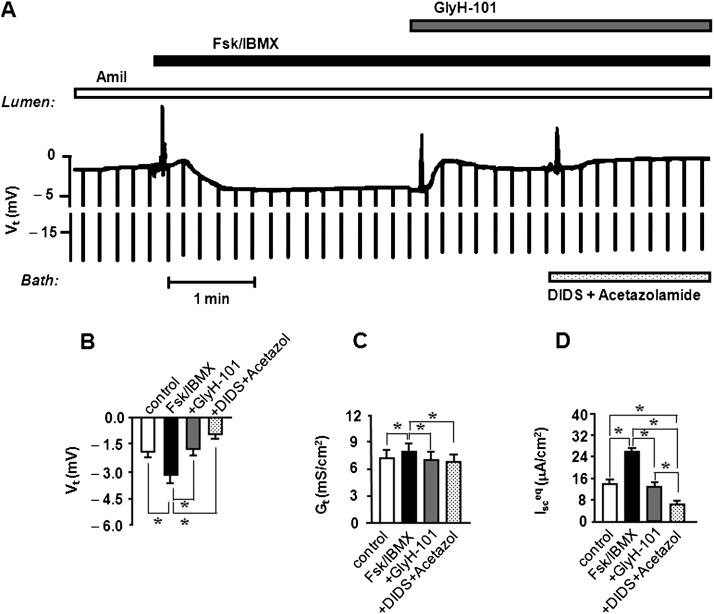
Effect of cAMP agonist Fsk/IBMX and inhibitors on HCO3 transport. (A) Representative trace of electrogenic HCO3 transport properties in native small airways with 25 mM HCO3 in both basolateral and luminal baths (Cl free). In the presence of luminal amiloride (Amil), mucosal addition of Fsk/IBMX significantly hyperpolarized Vt and stimulated equivalent short-circuit current (Isceq). Luminal addition of cystic fibrosis (CF) transmembrane conductance regulator (CFTR) inhibitor, GlyH-101 blocked the Isceq response. Furthermore, addition of serosal 4,4′diisothiocyanostilbene-2,2′-disulfonic acid (DIDS) plus acetazolamide reduced the Isceq to significantly less than the initial, unstimulated constitutive current (white). Summary of the effects of Fsk/IBMX (black), GlyH-101 (gray), and DIDS + acetazolamide (stippled) on Vt (B), Gt (C), and Isceq (D). *P < 0.05; data presented are means ± SEM.
Figure 3.
Figure 3.
Effects of inhibitor GlyH-101on isoproterenol (IPR) stimulation of HCO3 transport. (A) Representative trace of changes in electrogenic HCO3 transport properties with addition of IPR (10 μM), which significantly hyperpolarized Vt and stimulated Isceq (P < 0.05; n = 3). Luminal addition of inhibitor, GlyH-101, blocked stimulated HCO3 secretion. Summary constitutive properties (white) and of the effects of IPR (black) and GlyH-101 (gray) on Vt (B), Gt (C), and Isceq (D). *P < 0.05; data presented are means ± SEM.
Figure 4.
Figure 4.
Effect of the inhibitors 4,4′-dinitrostilbene-2,2′-disulphonic acid (DNDS) and GlyH-101 on Fsk/IBMX stimulation. (A) Representative trace of electrogenic HCO3 transport properties after luminal addition of Fsk/IBMX (black), which significantly hyperpolarized Vt, increased Gt, and stimulated Isceq in the continuous presence of luminal amiloride (white). Subsequent contraluminal addition of the inhibitor DNDS (gray) significantly blocked Vt, Gt, and Isceq response (P < 0.05; n = 3). Further luminal addition of GlyH-101 (stippled) reduced the remaining Isceq to significantly less than the initial constitutive current. Summary of the effects of Fsk/IBMX (black), DNDS (gray), and GlyH-101 (stippled) on Vt (B), Gt (C), and Isceq (D). *P < 0.05; data presented are means ± SEM.
Figure 5.
Figure 5.
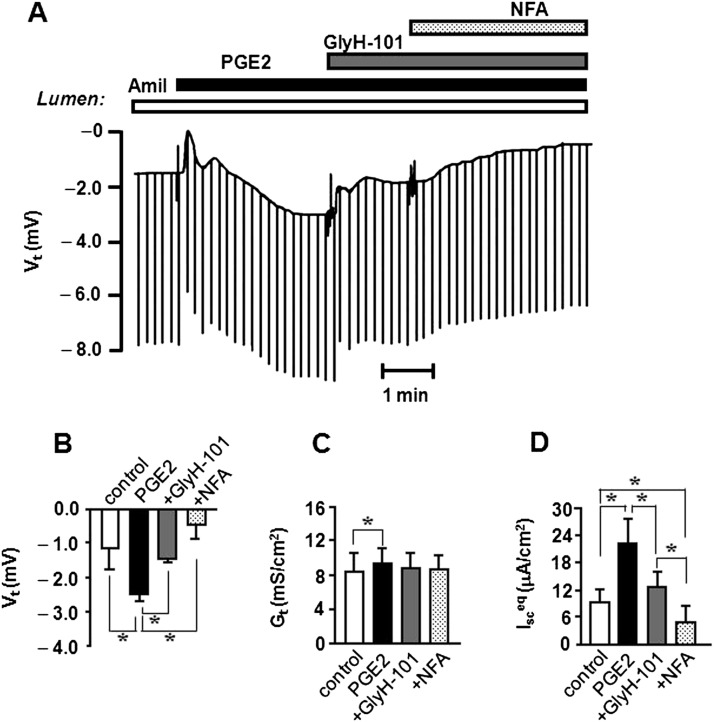
Effects of inhibitors, GlyH-101 and niflumic acid (NFA), on prostaglandin E (PGE) -2 stimulation. (A) Representative trace of electrogenic properties of HCO3 transport stimulated by luminal PGE2 (black; 1 μM). Vt hyperpolarized and Isceq increased significantly (P < 0.05; n = 4). Luminal addition of inhibitor, GlyH-101 (gray), significantly decreased the HCO3 secretion, and further addition of the Ca2+-activated chloride channel (CaCC) antagonist, NFA (stippled), further depressed the HCO3 secretion to levels significantly below the initial constitutive value. Summary of the effects of PGE2 (black), GlyH-101 (gray), and NFA (stippled) on Vt (B), Gt (C), and Isceq (D). *P < 0.05; data presented are means ± SEM.
Figure 6.
Figure 6.
Effects of inhibitor, NFA, on UTP stimulation. (A) Representative trace of changes in electrical properties reflecting HCO3 transport induced by luminal addition of UTP (black; 100 μM), which significantly hyperpolarized Vt, increased Gt, and stimulated Isceq (P < 0.05; n = 5). Luminal addition of the CACC inhibitor, NFA (gray), decreased the HCO3 secretion Isceq to values significantly less than initial constitutive secretion in the continuous presence of luminal amiloride (white). Summary of the effects of UTP (black) and NFA (gray) on Vt (B), Gt (C), and Isceq (D). *P < 0.05; data presented are means ± SEM.
Figure 7.
Figure 7.
Additive effects of Fsk/IBMX and UTP stimulation. (A) Representative trace of electrical properties reflecting HCO3 transport when stimulated by Fsk/IBMX, which significantly hyperpolarized Vt, and increased Gt and Isceq (P < 0.05; n = 4) in the presence of luminal amiloride. Subsequent addition of UTP to Fsk/IBMX hyperpolarized Vt further, and increased Gt and Isceq even further (P < 0.05; n = 4). Summary of the additive effects of Fsk/IBMX (black) and UTP (gray) on Vt (B), Gt (C), and Isceq (D) relative to control (white). *P < 0.05; data presented are means ± SEM.

References

    1. Anderson CM. Hypothesis revisited: cystic fibrosis: a disturbance of water and electrolyte movement in exocrine secretory tissue associated with altered prostaglandin (PGE2) metabolism? J Pediatr Gastroenterol Nutr. 1984;3:15–22. - PubMed
    1. Kopelman H, Corey M, Gaskin K, Durie P, Weizman Z, Forstner G. Impaired chloride secretion, as well as bicarbonate secretion, underlies the fluid secretory defect in the cystic fibrosis pancreas. Gastroenterology. 1988;95:349–355. - PubMed
    1. Johansen PG, Anderson CM, Hadorn B. Cystic fibrosis o the pancreas: a generalised disturbance of water and electrolyte movement in exocrine tissues. Lancet. 1968;1:455–460. - PubMed
    1. Choi JY, Muallem D, Kiselyov K, Lee MG, Thomas PJ, Muallem S. Aberrant CFTR-dependent HCO3− transport in mutations associated with cystic fibrosis. Nature. 2001;410:94–97. - PMC - PubMed
    1. Lee MG, Ohana E, Park HW, Yang D, Muallem S. Molecular mechanism of pancreatic and salivary gland fluid and HCO3 secretion. Physiol Rev. 2012;92:39–74. - PMC - PubMed

Publication types