Comparative Study
. 2013 Nov 13;44(1):110.
doi: 10.1186/1297-9716-44-110.

Replication characteristics of swine influenza viruses in precision-cut lung slices reflect the virulence properties of the viruses

Affiliations
Comparative Study

Replication characteristics of swine influenza viruses in precision-cut lung slices reflect the virulence properties of the viruses

Fandan Meng et al. Vet Res. .

Abstract

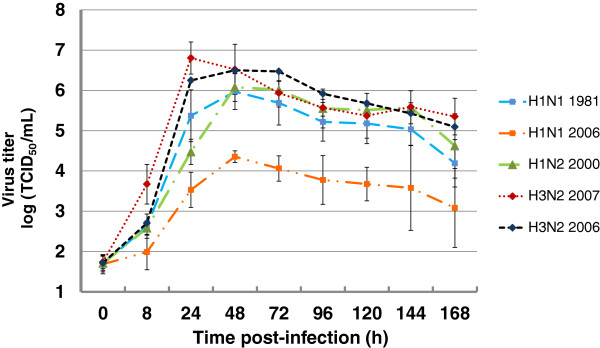
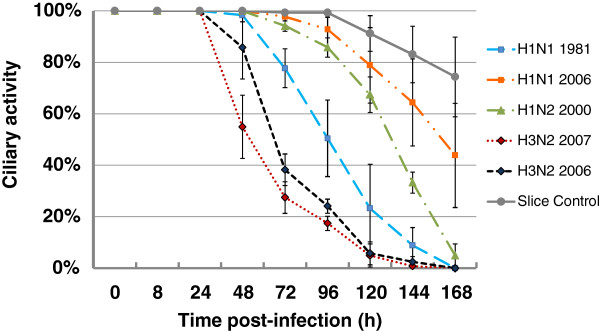
Precision-cut lung slices of pigs were infected with five swine influenza A viruses of different subtypes (A/sw/Potsdam/15/1981 H1N1, A/sw/Bad Griesbach/IDT5604/2006 H1N1, A/sw/Bakum/1832/2000 H1N2, A/sw/Damme/IDT5673/2006 H3N2, A/sw/Herford/IDT5932/2007 H3N2). The viruses were able to infect ciliated and mucus-producing cells. The infection of well-differentiated respiratory epithelial cells by swine influenza A viruses was analyzed with respect to the kinetics of virus release into the supernatant. The highest titres were determined for H3N2/2006 and H3N2/2007 viruses. H1N1/1981 and H1N2/2000 viruses replicated somewhat slower than the H3N2 viruses whereas a H1N1 strain from 2006 multiplied at significantly lower titres than the other strains. Regarding their ability to induce a ciliostatic effect, the two H3N2 strains were found to be most virulent. H1N1/1981 and H1N2/2000 were somewhat less virulent with respect to their effect on ciliary activity. The lowest ciliostatic effect was observed with H1N1/2006. In order to investigate whether this finding is associated with a corresponding virulence in the host, pigs were infected experimentally with H3N2/2006, H1N2/2000, H1N1/1981 and H1N1/2006 viruses. The H1N1/2006 virus was significantly less virulent than the other viruses in pigs which was in agreement with the results obtained by the in vitro-studies. These findings offer the possibility to develop an ex vivo-system that is able to assess virulence of swine influenza A viruses.


Figures
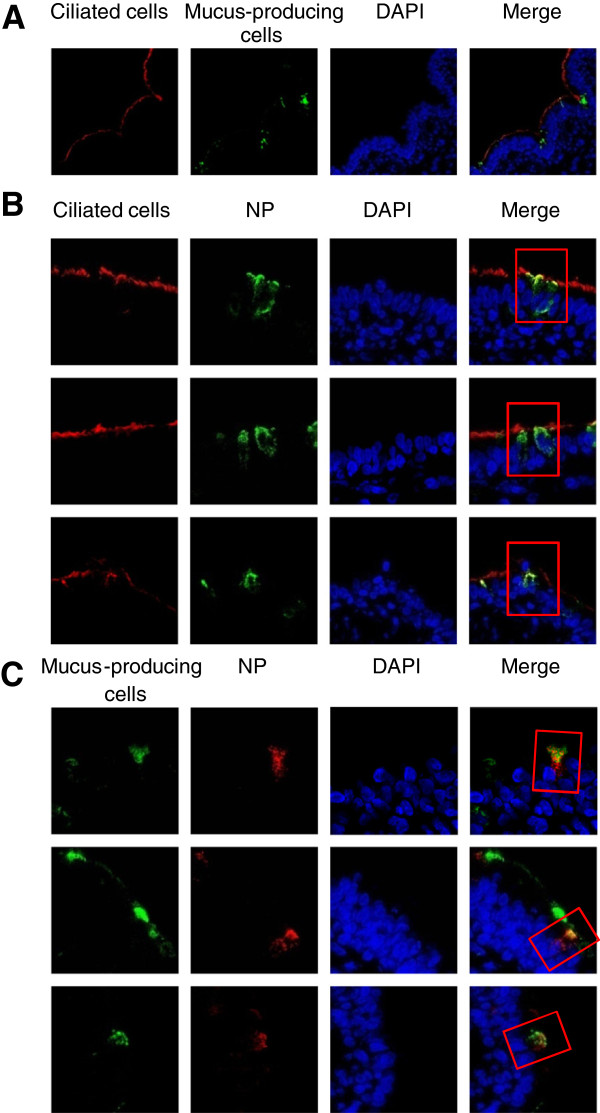
Figure 1
Figure 1
Immunostaining of swine PCLS infected by swine influenza A viruses. PCLS were infected by subtypes H1N1 (H1N1/1981), H1N2 (H1N2/2000) and H3N2 (H3N2/2007) swine influenza viruses. Cryosections were prepared at 24 hpi and used for detection of infected cells, ciliated cells, and mucus-producing cells. Infected cells were stained with anti-nucleoprotein (NP) antibody; ciliated cells were stained using anti-β-tubulin antibody (red) and mucus-producing cells were stained using anti-Muc5Ac antibody (green). A, control slices showing ciliated and mucus-producing cells; B, co-staining of ciliated and virus-infected cells; C, co-staining of mucus-producing cells and virus-infected cells. Nuclei were stained with 4′,6-diamidino-2-phenylindole (DAPI).
Figure 2
Figure 2
Infectivity kinetics in supernatants of PCLS infected by swine influenza A viruses. PCLS were mock-infected or infected by subtypes H1N1, H1N2, H3N2 swine influenza virus. Up to 7 dpi, infectious virus released into the supernatants of PCLS was titrated at daily intervals by endpoint dilution titration (TCID50/mL; 50% tissue culture infectious dose/mL).
Figure 3
Figure 3
Ciliary activity of swine PCLS infected by swine influenza A viruses. PCLS were mock-infected or infected by subtypes H1N1, H1N2, H3N2 swine influenza virus. Up to seven dpi, PCLS were analyzed for ciliary activity at daily intervals.
Figure 4
Figure 4
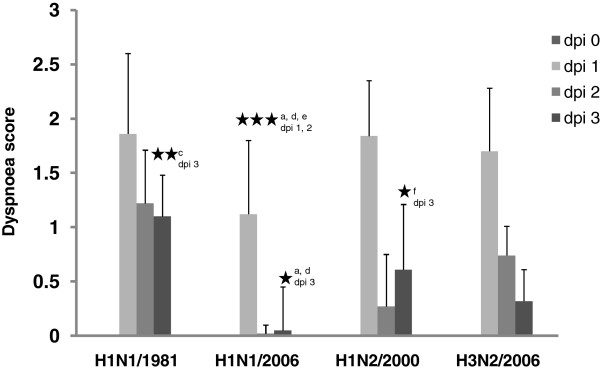
Dispnoea score. Dyspnoea (score) observed in pigs after experimental infection with influenza A viruses, dpi, days post infection; statistics: asterisk (1 p < 0.05, 2 p < 0.010, 3 p < 0.005, comparison of following groups: a H1N1/1981:H1N1/2006, b H1N1/1981:H1N2/2000, c H1N1/1981:H3N2/2006, d H1N1/2006:H1N2/2000, e H1N1/2006:H3N2/2006, f H1N2/2000:H3N2/2006).
Figure 5
Figure 5
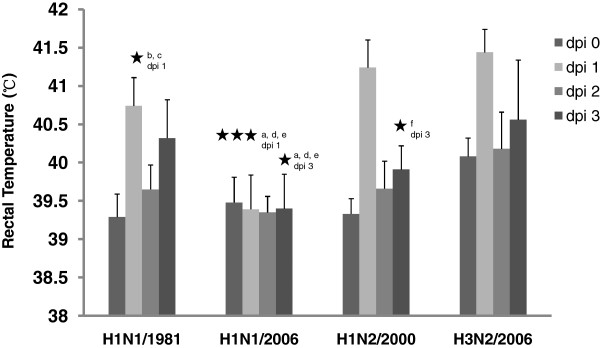
Rectal temperature. Rectal temperatures (°C) in pigs after experimental aerosol infection with swine influenza A viruses, dpi, days post infection; statistics: asterisk (1 p < 0.05, 2 p < 0.010, 3 p < 0.005, comparison of following groups: a H1N1/1981:H1N1/2006, b H1N1/1981:H1N2/2000, c H1N1/1981:H3N2/2006, d H1N1/2006:H1N2/2000, e H1N1/2006:H3N2/2006, f H1N2/2000:H3N2/2006).
Figure 6
Figure 6
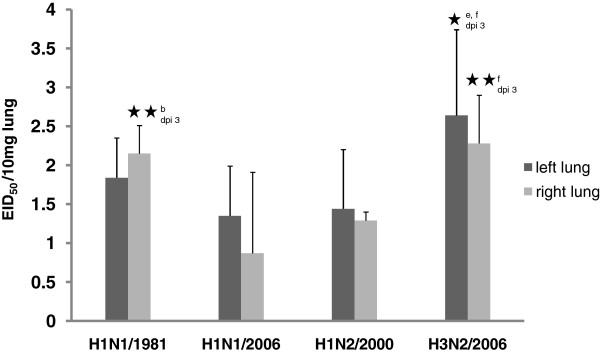
Viral lung load. Viral lung load (EID50/10 mg lung) in pigs 3 days after aerosol infection with swine influenza A viruses; statistics: asterisk (1 p < 0.05, 2 p < 0.010, 3 p < 0.005, comparison of following groups: a H1N1/1981:H1N1/2006, b H1N1/1981:H1N2/2000, c H1N1/1981:H3N2/2006, d H1N1/2006:H1N2/2000, e H1N1/2006:H3N2/2006, f H1N2/2000:H3N2/2006).

References

    1. Kyriakis CS, Rose N, Foni E, Maldonado J, Loeffen WLA, Madec F, Simon G, Van Reeth K. Influenza A virus infection dynamics in swine farms in Belgium, France, Italy and Spain, 2006–2008. Vet Microbiol. 2013;162:543–550. doi: 10.1016/j.vetmic.2012.11.014. - DOI - PubMed
    1. Van Reeth K, Brown IH, Dürrwald R, Foni E, Labarque G, Lenihan P, Maldonado J, Markowska-Daniel I, Pensaert M, Pospisil Z, Koch G. Seroprevalence of H1N1, H3N2 and H1N2 influenza viruses in pigs in seven European countries in 2002–2003. Influenza Other Respi Viruses. 2008;2:99–105. doi: 10.1111/j.1750-2659.2008.00043.x. - DOI - PMC - PubMed
    1. Kuntz-Simon G, Madec F. Genetic and antigenic evolution of swine influenza viruses in Europe and evaluation of their zoonotic potential. Zoonoses Public Health. 2009;56:310–325. doi: 10.1111/j.1863-2378.2009.01236.x. - DOI - PubMed
    1. Pensaert M, Ottis K, Vandeputte J, Kaplan MM, Bachmann PA. Evidence for the natural transmission of influenza A virus from wild ducks to swine and its potential importance for man. Bull World Health Organ. 1981;59:75–78. - PMC - PubMed
    1. Haesebrouck F, Biront P, Pensaert MB, Leunen J. Epizootics of respiratory tract disease in swine in Belgium due to H3N2 influenza virus and experimental reproduction of disease. Am J Vet Res. 1985;46:1926–1928. - PubMed

Publication types

MeSH terms

LinkOut - more resources