


Pulse pressure is associated with Alzheimer biomarkers in cognitively normal older adults
- PMID: 24225352
- PMCID: PMC3854831
- DOI: 10.1212/01.wnl.0000436935.47657.78
Pulse pressure is associated with Alzheimer biomarkers in cognitively normal older adults
Abstract
Objective: The current study examined the association between pulse pressure (PP) and CSF-based biomarkers for Alzheimer disease, including β-amyloid 1-42 (Aβ1-42) and phosphorylated tau (P-tau) protein, in cognitively normal older adults.
Methods: One hundred seventy-seven cognitively normal, stroke-free older adult participants (aged 55-100 years) underwent blood pressure assessment for determination of PP (systolic - diastolic blood pressure) and lumbar puncture for measurement of CSF Aβ1-42 and P-tau. Pearson correlations and multiple linear regression, controlling for age, sex, APOE genotype, and body mass index, evaluated the relationship between PP and Alzheimer disease biomarkers.
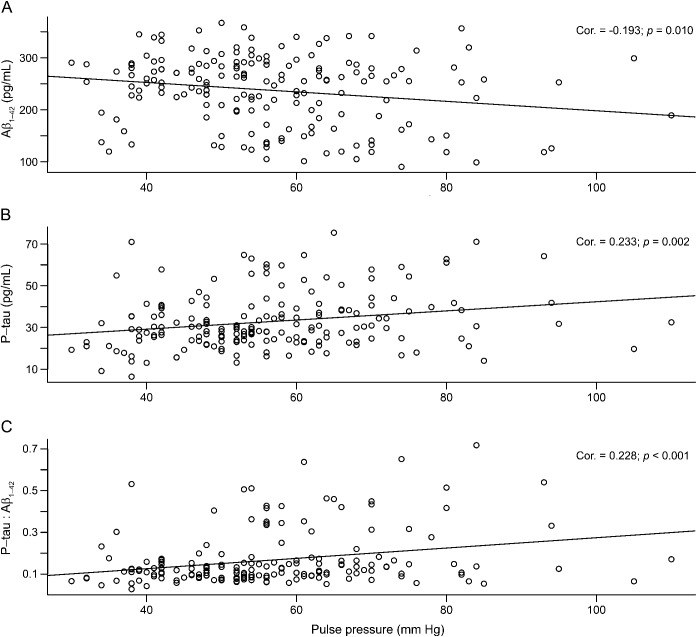
Results: PP elevation was associated with increased P-tau (r = 0.23, p = 0.002), reduced Aβ1-42 (r = -0.19, p = 0.01), and increased P-tau to Aβ1-42 ratio (r = 0.27, p < 0.001). After controlling for covariates, PP remained associated with P-tau (β = 0.18, p = 0.0196) and P-tau to Aβ1-42 ratio (β = 0.0016, p < 0.001) but was no longer associated with Aβ1-42 (β = -0.1, p = 0.35). Post hoc multivariate analyses indicated that increased PP was associated with all biomarkers in younger participants (aged 55-70 years) (Aβ1-42: p = 0.050; P-tau: p = 0.003; P-tau to Aβ ratio: p = 0.0007) but not older participants (aged 70-100 years).
Conclusions: PP elevation is associated with increased CSF P-tau and decreased Aβ1-42 in cognitively normal older adults, suggesting that pulsatile hemodynamics may be related to amyloidosis and tau-related neurodegeneration. The relationship between PP and CSF biomarkers is age-dependent and observed only in participants in the fifth and sixth decades of life.
Figures
References
-
- Qiu C, Winblad B, Fratiglioni L. The age-dependent relation of blood pressure to cognitive function and dementia. Lancet Neurol 2005;4:487–499 - PubMed
-
- Qiu C, Winblad B, Viitanen M, Fratiglioni L. Pulse pressure and risk of Alzheimer disease in persons aged 75 years and older: a community-based, longitudinal study. Stroke 2003;34:594–599 - PubMed
Publication types
MeSH terms
Substances
Grants and funding
LinkOut - more resources
Full Text Sources
Other Literature Sources
Medical
Miscellaneous
