. 2014 Jan;59(1):46-50.
doi: 10.1038/jhg.2013.119. Epub 2013 Nov 14.

Differences in carrier frequency between mothers of Duchenne and Becker muscular dystrophy patients

Affiliations
Free PMC article

Differences in carrier frequency between mothers of Duchenne and Becker muscular dystrophy patients

Tomoko Lee et al. J Hum Genet. 2014 Jan.
Free PMC article

Abstract

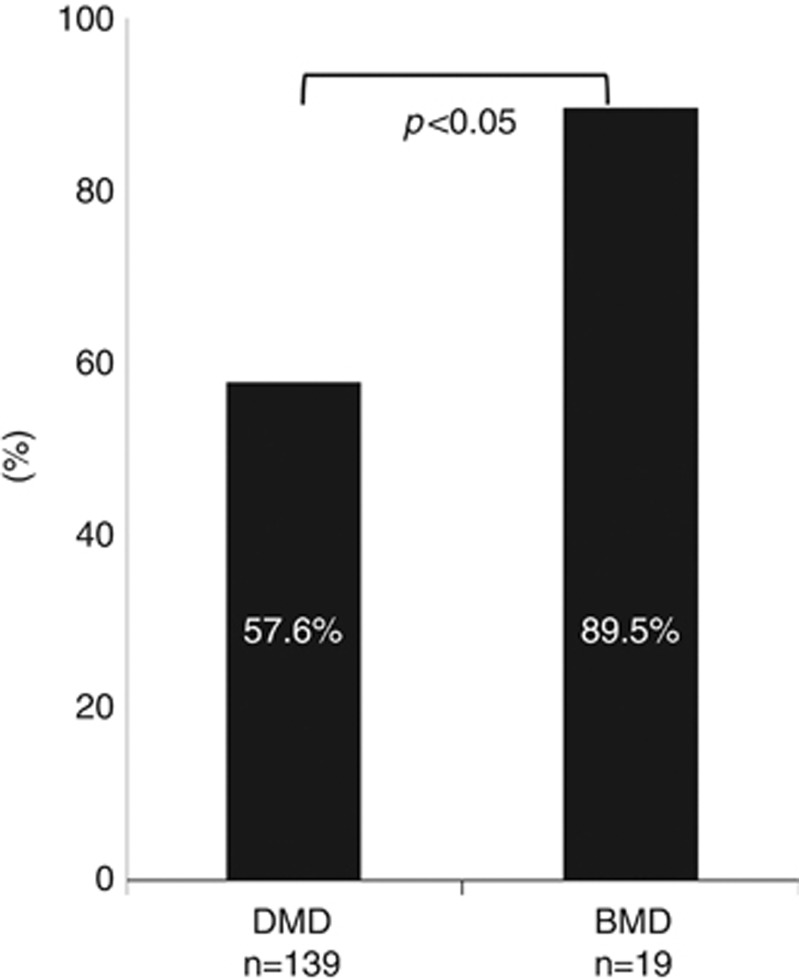
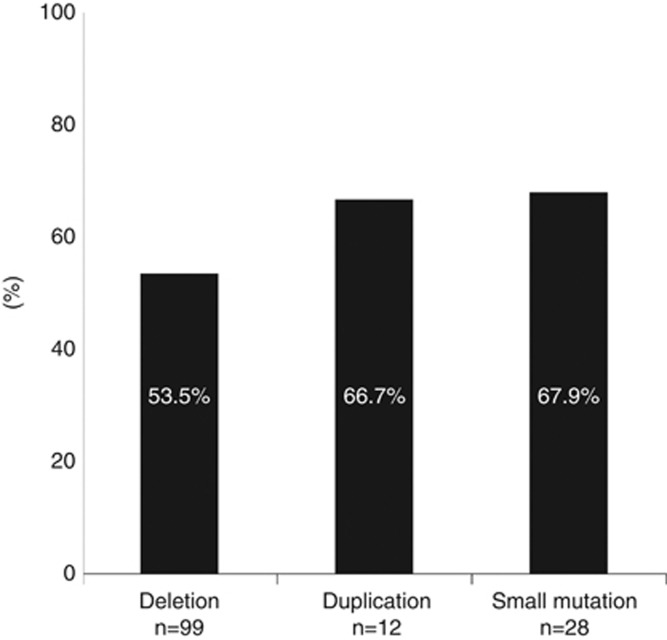
Duchenne and Becker muscular dystrophies (DMD/BMD) are X-linked inherited muscular disorders caused by mutations in the dystrophin gene. Two-thirds of DMD cases are thought to be caused by inheritance from carrier mothers and this study aimed to clarify and compare the carrier frequency of mothers of DMD and BMD patients according to the mutation type. We included 139 DMD and 19 BMD mothers. Of these, 113 patients (99 DMD and 14 BMD) and 13 patients (12 DMD and 1 BMD) had deletions and duplications of one or more exons, respectively. Small mutations, including nonsense mutations, small deletions/insertions and splice site mutations, were identified in 32 patients (28 DMD and four BMD). The overall carrier frequency for BMD mothers was significantly higher than for DMD (89.5% vs 57.6%, P<0.05), probably as BMD patients can leave descendants. The carrier frequency tended to be lower in mothers of DMD patients with deletion mutations than with duplications and small mutations (53.5%, 66.7% and 67.9%, respectively). It was suggested that de novo mutations are more prevalent for deletions than other mutations. This is the first report to analyze the carrier frequency according to mutation type.


Figures
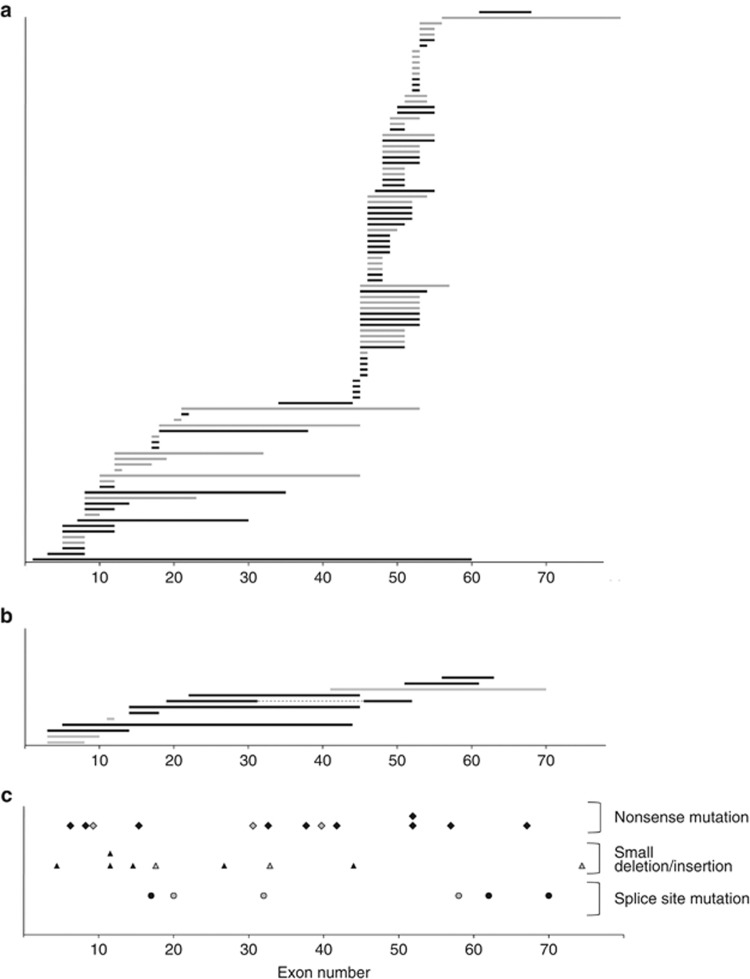
Figure 1
Figure 1
The location of mutations in Duchenne muscular dystrophy patients from carrier and non-carrier mothers. (a) Exon deletions identified in 99 patients. Horizontal bars represent deleted exon regions. Black and gray bars represent patients from carrier and non-carrier mothers, respectively. Exons 1–79 are numbered on the bottom line. Deletions are clustered in two hot spots. No tendency was identified based on the carrier status. (b) Exon duplications identified in 12 patients. Horizontal bars represent duplicated exon regions. Black and gray bars represent patients from carrier and non-carrier mothers, respectively. On the 5th line from the top, dotted lines indicate normal exons between separated duplications (duplication of exons 19–31 and 45–51). No tendency was identified based on the carrier status. (c) Twenty-eight patients were identified with small mutations, including thirteen with nonsense mutations, nine with small deletions/insertions and six with splice site mutations. Diamonds, triangles and circles represent nonsense mutations, small deletions/insertions and splice site mutations, respectively. Black and gray marks represent patients from carrier mothers and non-carrier mothers, respectively. No tendency was identified based on the carrier status.
Figure 2
Figure 2
The location of deletion mutations in Becker muscular dystrophy cases from carrier and non-carrier mothers. Exons 1–79 are numbered on the bottom line. Exon deletions were identified in 14 cases. Horizontal bars represent deleted exon regions. Black and gray bars represent cases from carrier mothers and non-carrier mothers, respectively.
Figure 3
Figure 3
The carrier frequency of mothers of Duchenne muscular dystrophy (DMD) and Becker muscular dystrophy (BMD) patients. Based on all types of mutations, the carrier frequency was significantly lower in mothers of DMD patients compared with BMD patients using the Fisher's exact test (57.6% vs 89.5% P<0.05).
Figure 4
Figure 4
The carrier frequency of mothers of Duchenne muscular dystrophy patients based on the type of mutation. The carrier frequency was 53.5% in the mothers of patients with deletion mutations, which was lower than that with duplication mutations (66.7%) and small mutations (67.9%), although the difference was not statistically significant using the χ2-test.

References

    1. Emery A. E. The muscular dystrophies. Lancet. 2002;23:687–695. - PubMed
    1. Ahn A. H., Kunkel L. M. The structural and functional diversity of dystrophin. Nat. Genet. 1993;3:283–291. - PubMed
    1. Takeshima Y., Yagi M., Okizuka Y., Awano H., Zhang Z., Yamauchi Y., et al. Mutation spectrum of the dystrophin gene in 442 Duchenne/Becker muscular dystrophy cases from one Japanese referral center. J. Hum. Genet. 2010;55:379–388. - PubMed
    1. Monaco A. P., Bertelson C. J., Liechti-Gallati S., Moser H., Kunhekel L. M. An explanation for the phenotypic differences between patients bearing partial deletions of the DMD locus. Genomics. 1988;2:90–95. - PubMed
    1. Haldane J. B. The rate of spontaneous mutation of a human gene. J. Genet. 1935;31:317–326. - PubMed

Publication types

LinkOut - more resources