. 2014 Jan;306(2):F194-204.
doi: 10.1152/ajprenal.00520.2013. Epub 2013 Nov 13.

SGLT2 inhibitor empagliflozin reduces renal growth and albuminuria in proportion to hyperglycemia and prevents glomerular hyperfiltration in diabetic Akita mice

Affiliations

SGLT2 inhibitor empagliflozin reduces renal growth and albuminuria in proportion to hyperglycemia and prevents glomerular hyperfiltration in diabetic Akita mice

Volker Vallon et al. Am J Physiol Renal Physiol. 2014 Jan.

Abstract

Our previous work has shown that gene knockout of the sodium-glucose cotransporter SGLT2 modestly lowered blood glucose in streptozotocin-diabetic mice (BG; from 470 to 300 mg/dl) and prevented glomerular hyperfiltration but did not attenuate albuminuria or renal growth and inflammation. Here we determined effects of the SGLT2 inhibitor empagliflozin (300 mg/kg of diet for 15 wk; corresponding to 60-80 mg·kg(-1)·day(-1)) in type 1 diabetic Akita mice that, opposite to streptozotocin-diabetes, upregulate renal SGLT2 expression. Akita diabetes, empagliflozin, and Akita + empagliflozin similarly increased renal membrane SGLT2 expression (by 38-56%) and reduced the expression of SGLT1 (by 33-37%) vs. vehicle-treated wild-type controls (WT). The diabetes-induced changes in SGLT2/SGLT1 protein expression are expected to enhance the BG-lowering potential of SGLT2 inhibition, and empagliflozin strongly lowered BG in Akita (means of 187-237 vs. 517-535 mg/dl in vehicle group; 100-140 mg/dl in WT). Empagliflozin modestly reduced GFR in WT (250 vs. 306 μl/min) and completely prevented the diabetes-induced increase in glomerular filtration rate (GFR) (255 vs. 397 μl/min). Empagliflozin attenuated increases in kidney weight and urinary albumin/creatinine ratio in Akita in proportion to hyperglycemia. Empagliflozin did not increase urinary glucose/creatinine ratios in Akita, indicating the reduction in filtered glucose balanced the inhibition of glucose reabsorption. Empagliflozin attenuated/prevented the increase in systolic blood pressure, glomerular size, and molecular markers of kidney growth, inflammation, and gluconeogenesis in Akita. We propose that SGLT2 inhibition can lower GFR independent of reducing BG (consistent with the tubular hypothesis of diabetic glomerular hyperfiltration), while attenuation of albuminuria, kidney growth, and inflammation in the early diabetic kidney may mostly be secondary to lower BG.

Keywords: diabetes; diabetic nephropathy; gluconeogenesis; inflammation; phosphoenolpyruvate carboxykinase; proximal tubule; renal growth.


Figures
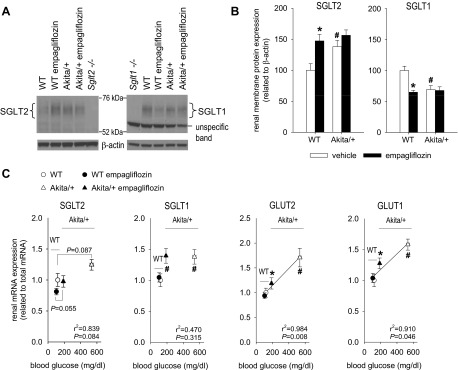
Fig. 1.
Fig. 1.
Empagliflozin treatment of nondiabetic mice and Akita-diabetes increased renal membrane protein expression of SGLT2 and reduced SGLT1 protein expression. Empagliflozin attenuated the diabetes-induced increase in renal mRNA expression of GLUT1 and GLUT2 but not SGLT1. Divergent effects on mRNA and membrane protein expression of SGLT2 and SGLT1 indicate complex translational and posttranslational regulation. Empagliflozin (300 mg/kg of diet) or repelleted diet (vehicle) were given to Akita/+ and wild-type (WT) mice. A and B: renal membrane SGLT2 and SGLT1 protein expression. Kidneys from knockout mice served as negative controls (Sglt2−/−, Sglt1−/−). C: renal mRNA expression of glucose transporters. For Sglt2 and Sglt1 mRNA analysis, kidneys from knockout mice confirmed specificity of primers (data not shown). *P < 0.05 vs. vehicle treatment in same genotype; #P < 0.05 vs. WT; ANOVA and unpaired Student's t-test and linear regression analysis. Linear regression lines were included when statistical significance was achieved; n = 10–13 per group.
Fig. 2.
Fig. 2.
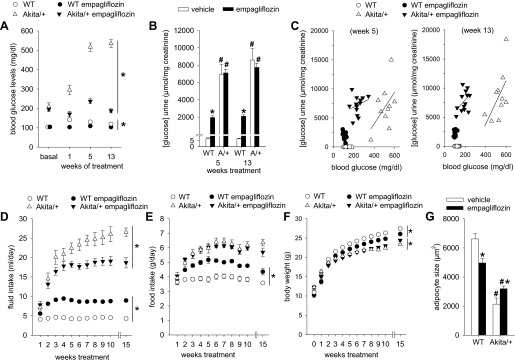
Empagliflozin strongly lowered hyperglycemia in diabetic Akita/+ mice. Empagliflozin (300 mg/kg of diet) or repelleted diet (vehicle) were given to Akita/+ and WT mice. A: empagliflozin lowered blood glucose levels in WT and much stronger in Akita/+ mice. B: empagliflozin increased urinary glucose/creatinine ratios in WT but not in Akita/+ mice. C: for a given level of hyperglycemia, urinary glucose/creatinine ratios were greater in empagliflozin-treated compared with vehicle-treated Akita/+ mice. D–G: in WT, empagliflozin lowered body weight and adipocyte size and increased food and fluid intake. In Akita/+ mice, empagliflozin did not affect food intake and modestly increased body weight and adipocyte size, respectively. *P < 0.05 vs. vehicle-treatment in same genotype; #P < 0.05 vs. WT. ANOVA and unpaired Student's t-test. A and D–F: statistical analysis refers to last time point shown; n = 10–13 per group for A–F; n = 3–5 for G.
Fig. 3.
Fig. 3.
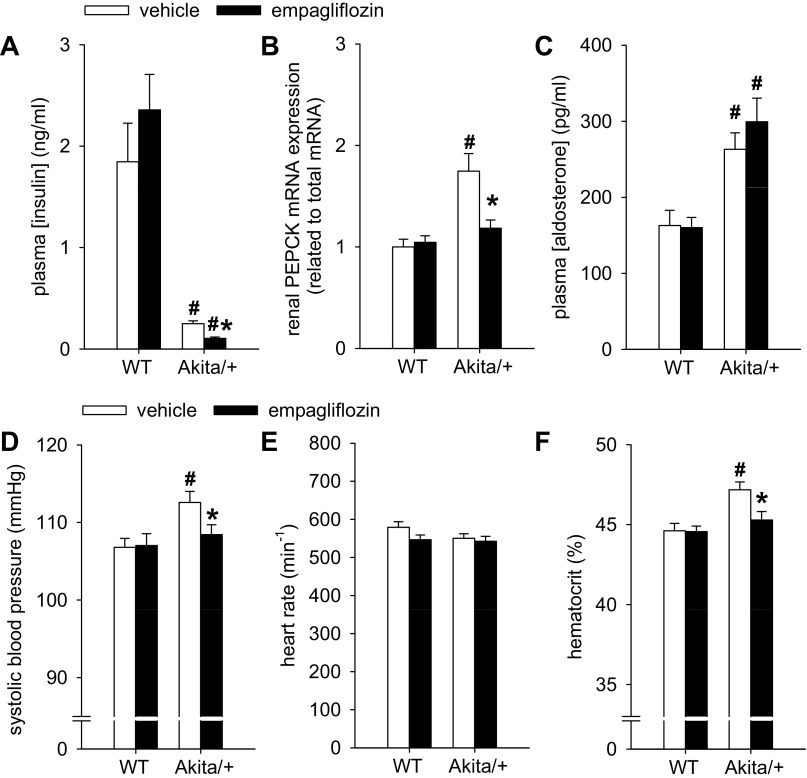
Empagliflozin further lowered plasma insulin in diabetic Akita/+ mice and prevented diabetes-induced increase in renal mRNA expression of phosphoenolpyruvate carboxykinase (PEPCK), systolic blood pressure, and hematocrit. Empagliflozin (300 mg/kg of diet) or repelleted diet (vehicle) were given to Akita/+ and WT mice. Depicted are results for plasma insulin in nonfasted mice (A), renal PEPCK mRNA (B), plasma aldosterone (C), systolic blood pressure (D), heart rate (E), and hematocrit (F). *P < 0.05 vs. vehicle treatment in same genotype; #P < 0.05 vs. WT. ANOVA and unpaired Student's t-test; n = 10–13 per group.
Fig. 4.
Fig. 4.
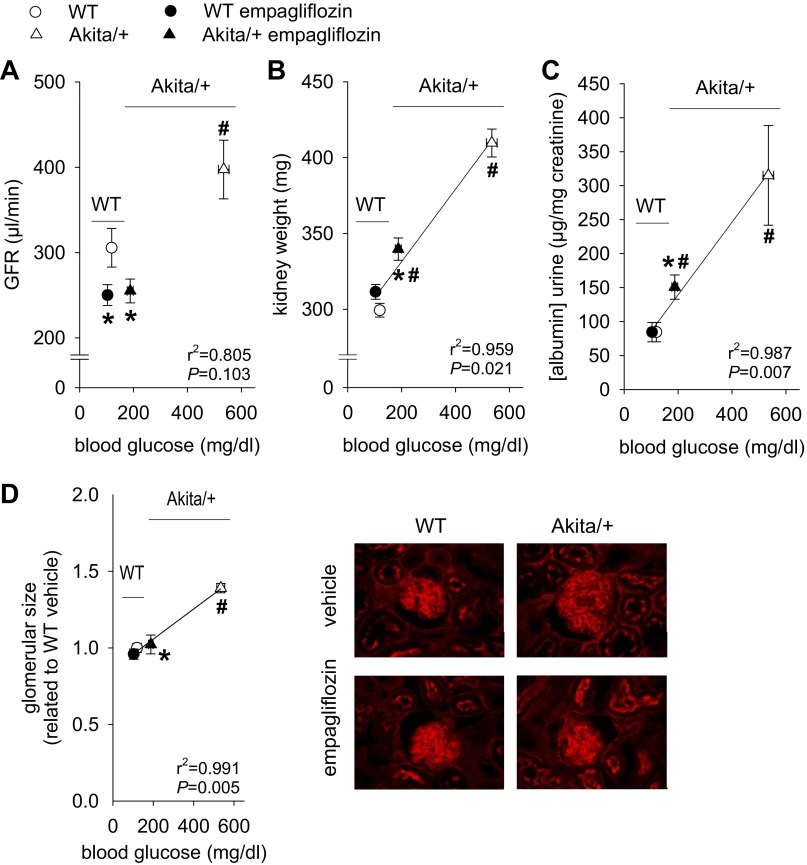
Empagliflozin prevented the diabetes-induced increase in glomerular filtration rate (GFR) and attenuated the increase in kidney weight, glomerular size, and albuminuria in proportion to hyperglycemia. Empagliflozin (300 mg/kg of diet) or repelleted diet (vehicle) were given to Akita/+ and WT mice. Depicted are results for GFR (A), kidney weight (B), urinary albumin/creatinine ratios (C), and glomerular size (D). *P < 0.05 vs. vehicle treatment in same genotype; #P < 0.05 vs. WT. ANOVA and unpaired Student's t-test and linear regression analysis. Linear regression lines were included when statistical significance was achieved. n = 10–13 per group for A–C, and n = 6–7 for D.
Fig. 5.
Fig. 5.
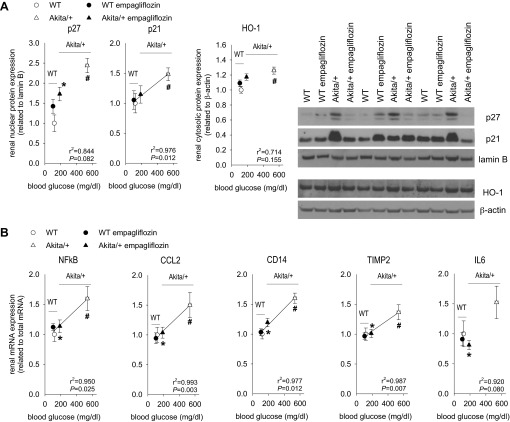
Empagliflozin attenuated diabetes-induced rise in renal expression of markers of kidney growth and inflammation. Empagliflozin (300 mg/kg of diet) or repelleted diet (vehicle) were given to Akita/+ and WT mice and kidneys harvested after 15 wk. Depicted are results for renal nuclear expression of p27 and p21 and renal cytosolic expression of HO-1 (A), and renal mRNA expression of NFkB, CCL2, CD14, TIMP2, and IL6 (B). *P < 0.05 vs. vehicle treatment in same genotype; #P < 0.05 vs. WT. ANOVA and unpaired Student's t-test and linear regression analysis. Linear regression lines were included when statistical significance was achieved. n = 10–13 per group.

References

    1. Balen D, Ljubojevic M, Breljak D, Brzica H, Zlender V, Koepsell H, Sabolic I. Revised immunolocalization of the Na+-d-glucose cotransporter SGLT1 in rat organs with an improved antibody. Am J Physiol Cell Physiol 295: C475–C489, 2008 - PubMed
    1. Baumgartl HJ, Sigl G, Banholzer P, Haslbeck M, Standl E. On the prognosis of IDDM patients with large kidneys. Nephrol Dial Transplant 13: 630–634, 1998 - PubMed
    1. Bognetti E, Zoja A, Meschi F, Paesano PL, Chiumello G. Relationship between kidney volume, microalbuminuria and duration of diabetes mellitus. Diabetologia 39: 1409, 1996 - PubMed
    1. Cherney DZ, Perkins BA, Soleymanlou N, Maione M, Lai V, Lee A, Fagan NM, Woerle HJ, Johansen OE, Broedl UC, von Eynatten M. Renal hemodynamic effect of sodium-glucose cotransporter 2 inhibition in patients with type 1 diabetes mellitus. Circulation. [E pub before print] - PubMed
    1. Christiansen JS, Gammelgaard J, Frandsen M, Parving HH. Increased kidney size, glomerular filtration rate and renal plasma flow in short-term insulin-dependent diabetics. Diabetologia 20: 451–456, 1981 - PubMed

Publication types

MeSH terms