Meta-Analysis
. 2014 Feb 18;129(7):737-46.
doi: 10.1161/CIRCULATIONAHA.113.004500. Epub 2013 Nov 13.

Association between insomnia symptoms and mortality: a prospective study of U.S. men

Affiliations
Meta-Analysis

Association between insomnia symptoms and mortality: a prospective study of U.S. men

Yanping Li et al. Circulation. .

Abstract

Background: Insomnia complaints are common in older adults and may be associated with mortality risk. However, evidence regarding this association is mixed. Thus, we prospectively examined whether men with insomnia symptoms had an increased risk of mortality during 6 years of follow-up.

Methods and results: A prospective cohort study of 23,447 US men participating in the Health Professionals Follow-Up Study and free of cancer, reported on insomnia symptoms in 2004, were followed through 2010. Deaths were identified from state vital statistic records, the National Death Index, family reports, and the postal system. We documented 2025 deaths during 6 years of follow-up (2004-2010). The multivariable-adjusted hazard ratios of total mortality were 1.25 (95% confidence interval [CI], 1.04-1.50) for difficulty initiating sleep, 1.09 (95% CI, 0.97-1.24) for difficulty maintaining sleep, 1.04 (95% CI, 0.88-1.22) for early-morning awakenings, and 1.24 (95% CI, 1.05-1.46) for nonrestorative sleep, comparing men with those symptoms most of the time with men without those symptoms, after adjusting for age, lifestyle factors, and presence of common chronic conditions. Men with difficulty initiating sleep and nonrestorative sleep most of the time had a 55% (hazard ratio, 1.55; 95% CI, 1.19-2.04; P-trend=0.01) and 32% (hazard ratio, 1.32; 95% CI, 1.02-1.72; P-trend=0.002) increased risk of cardiovascular disease mortality, respectively, relative to men without those symptoms.

Conclusion: Some insomnia symptoms, especially difficulty initiating asleep and nonrestorative sleep, are associated with a modestly higher risk of mortality.

Keywords: cardiovascular disease; meta-analysis; mortality; sleep disorders; sleep initiation and maintenance disorders.


Figures

Figure 1
Figure 1
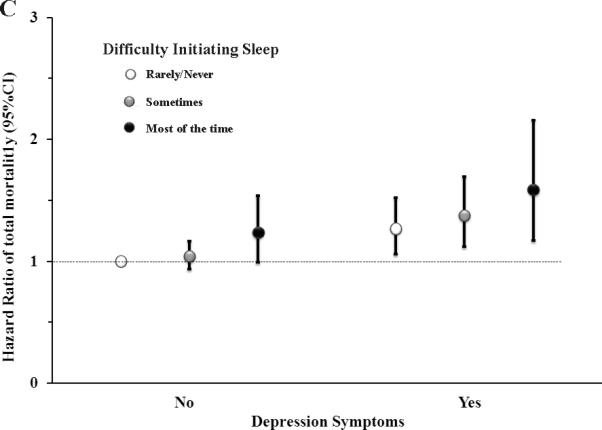
Hazard ratio of total mortality according to the joint classification of difficulty initiating sleep with non-restorative sleep (A), excessive daytime sleepiness (B) and Depression symptoms (C) *,†,‡. *Up to six years of follow-up (2004-2010) of the Health Professionals Follow-up Study;Multivariable adjusted hazard ratio estimated from Cox proportional hazards models adjusted for age, ethnicity (Caucasian, yes/no), smoking status (never smoker, former smoker, or current smoker), alcohol drinking (g/d: 0, 0.1-9.9, 10.0-19.9, 20.0-29.9, and ≥30), body mass index (kg/m2: <23, 23-24.9, 25-26.0, 27-29.9, ≥30), physical activity (quintiles), alternate healthy eating index (quintile), marriage status (married, divorced/separate/single, widowed); living status (alone or not), regular use of aspirin (yes/no), the Crown-Crisp phobic anxiety index (0-1,2,3 or>3), lower urinary tract symptoms (0-6, 7-14, ≥15), presence of elevated total cholesterol, high blood pressure, elevated triglyceride, diabetes, myocardial infarction and stroke (each yes vs. no), sleep duration (hours: ≤5, 6, 7, 8, ≥9), snoring frequency (every night, most night, few night per week, occasionally, once a week or less, missing); feel sad, blue or depressed two more weeks, use of antidepressant drugs, non-restorative sleep and excessive daytime sleepiness, except the joint variable. P for interaction was 0.98 for difficulty initiating sleep and non-restorative sleep (A), 0.96 for difficulty initiating sleep and excessive daytime sleepiness (B), and 0.72 for difficulty initiating sleep and depression symptom (C), tested by comparing the -2 log likelihood of the model including interaction term with the model that contained only the main effects.
Figure 1
Figure 1
Hazard ratio of total mortality according to the joint classification of difficulty initiating sleep with non-restorative sleep (A), excessive daytime sleepiness (B) and Depression symptoms (C) *,†,‡. *Up to six years of follow-up (2004-2010) of the Health Professionals Follow-up Study;Multivariable adjusted hazard ratio estimated from Cox proportional hazards models adjusted for age, ethnicity (Caucasian, yes/no), smoking status (never smoker, former smoker, or current smoker), alcohol drinking (g/d: 0, 0.1-9.9, 10.0-19.9, 20.0-29.9, and ≥30), body mass index (kg/m2: <23, 23-24.9, 25-26.0, 27-29.9, ≥30), physical activity (quintiles), alternate healthy eating index (quintile), marriage status (married, divorced/separate/single, widowed); living status (alone or not), regular use of aspirin (yes/no), the Crown-Crisp phobic anxiety index (0-1,2,3 or>3), lower urinary tract symptoms (0-6, 7-14, ≥15), presence of elevated total cholesterol, high blood pressure, elevated triglyceride, diabetes, myocardial infarction and stroke (each yes vs. no), sleep duration (hours: ≤5, 6, 7, 8, ≥9), snoring frequency (every night, most night, few night per week, occasionally, once a week or less, missing); feel sad, blue or depressed two more weeks, use of antidepressant drugs, non-restorative sleep and excessive daytime sleepiness, except the joint variable. P for interaction was 0.98 for difficulty initiating sleep and non-restorative sleep (A), 0.96 for difficulty initiating sleep and excessive daytime sleepiness (B), and 0.72 for difficulty initiating sleep and depression symptom (C), tested by comparing the -2 log likelihood of the model including interaction term with the model that contained only the main effects.
Figure 1
Figure 1
Hazard ratio of total mortality according to the joint classification of difficulty initiating sleep with non-restorative sleep (A), excessive daytime sleepiness (B) and Depression symptoms (C) *,†,‡. *Up to six years of follow-up (2004-2010) of the Health Professionals Follow-up Study;Multivariable adjusted hazard ratio estimated from Cox proportional hazards models adjusted for age, ethnicity (Caucasian, yes/no), smoking status (never smoker, former smoker, or current smoker), alcohol drinking (g/d: 0, 0.1-9.9, 10.0-19.9, 20.0-29.9, and ≥30), body mass index (kg/m2: <23, 23-24.9, 25-26.0, 27-29.9, ≥30), physical activity (quintiles), alternate healthy eating index (quintile), marriage status (married, divorced/separate/single, widowed); living status (alone or not), regular use of aspirin (yes/no), the Crown-Crisp phobic anxiety index (0-1,2,3 or>3), lower urinary tract symptoms (0-6, 7-14, ≥15), presence of elevated total cholesterol, high blood pressure, elevated triglyceride, diabetes, myocardial infarction and stroke (each yes vs. no), sleep duration (hours: ≤5, 6, 7, 8, ≥9), snoring frequency (every night, most night, few night per week, occasionally, once a week or less, missing); feel sad, blue or depressed two more weeks, use of antidepressant drugs, non-restorative sleep and excessive daytime sleepiness, except the joint variable. P for interaction was 0.98 for difficulty initiating sleep and non-restorative sleep (A), 0.96 for difficulty initiating sleep and excessive daytime sleepiness (B), and 0.72 for difficulty initiating sleep and depression symptom (C), tested by comparing the -2 log likelihood of the model including interaction term with the model that contained only the main effects.
Figure 2
Figure 2
Meta-analysis of the association between individual insomnia symptoms and total mortality *,†,‡. *Publication bias are estimated by the Begg's test, all P>0.4; The name of the study and full list of covariates each study adjusted for were listed in Supplemental Table 1; Pooled, Total = pooled relative risk for all studies listed in the Figure; Pooled sensitivity = pooled relative risk for studies excluded the two studies, e.g. Althuis, 1998 (21) and Newman, 2000 (23), with the Newcastle-Ottawa Quality Score <7 (Wells G, Shea B, O’Connell D, Peterson J, Welch V, Losos M, Tugwell P. The Newcastle-Ottawa Scale (NOS) for assessing the quality of nonrandomised studies in meta-analyses. Available at: http://www.ohri.ca/programs/clinical_epidemiology/oxford.htm. Accessed August 8, 2013.).
Figure 3
Figure 3
Meta-analysis of the association between individual insomnia symptoms and cardiovascular mortality (publication bias are estimated by the Begg's test, all P>0.4, there is no other published data of non-restorative sleep and cardiovascular mortality).

References

    1. National Institute of Health [October 19, 2012];Insomnia. http://www.nhlbi.nih.gov/health/public/sleep/insomnia.pdf.
    1. Edinger JD, Bonnet MH, Bootzin RR, Doghramji K, Dorsey CM, Espie CA, Jamieson AO, McCall WV, Morin CM, Stepanski EJ, American Academy of Sleep Medicine Work Group Derivation of research diagnostic criteria for insomnia: report of an American Academy of Sleep Medicine Work Group. Sleep. 2004;27:1567–1596. - PubMed
    1. Carskadon MA, Brown ED, Dement WC. Sleep fragmentation in the elderly: relationship to daytime sleep tendency. Neurobiol Aging. 1982;3:321–327. - PubMed
    1. Carskadon MA, van den Hoed J, Dement WC. Sleep and daytime sleepiness in the elderly. J Geriatr Psychiatry. 1980;13:135–151. - PubMed
    1. Prinz PN, Vitiello MV, Raskind MA, Thorpy MJ. Geriatrics: Sleep disorders and aging. N Engl J Med. 1990;323:520–526. - PubMed

Publication types