. 2014 Jan;88(2):1175-88.
doi: 10.1128/JVI.02526-13. Epub 2013 Nov 13.

Risk assessment of H2N2 influenza viruses from the avian reservoir

Affiliations

Risk assessment of H2N2 influenza viruses from the avian reservoir

Jeremy C Jones et al. J Virol. 2014 Jan.

Abstract

H2N2 influenza A viruses were the cause of the 1957-1958 pandemic. Historical evidence demonstrates they arose from avian virus ancestors, and while the H2N2 subtype has disappeared from humans, it persists in wild and domestic birds. Reemergence of H2N2 in humans is a significant threat due to the absence of humoral immunity in individuals under the age of 50. Thus, examination of these viruses, particularly those from the avian reservoir, must be addressed through surveillance, characterization, and antiviral testing. The data presented here are a risk assessment of 22 avian H2N2 viruses isolated from wild and domestic birds over 6 decades. Our data show that they have a low rate of genetic and antigenic evolution and remained similar to isolates circulating near the time of the pandemic. Most isolates replicated in mice and human bronchial epithelial cells, but replication in swine tissues was low or absent. Multiple isolates replicated in ferrets, and 3 viruses were transmitted to direct-contact cage mates. Markers of mammalian adaptation in hemagglutinin (HA) and PB2 proteins were absent from all isolates, and they retained a preference for avian-like α2,3-linked sialic acid receptors. Most isolates remained antigenically similar to pandemic A/Singapore/1/57 (H2N2) virus, suggesting they could be controlled by the pandemic vaccine candidate. All viruses were susceptible to neuraminidase inhibitors and adamantanes. Nonetheless, the sustained pathogenicity of avian H2N2 viruses in multiple mammalian models elevates their risk potential for human infections and stresses the need for continual surveillance as a component of prepandemic planning.


Figures
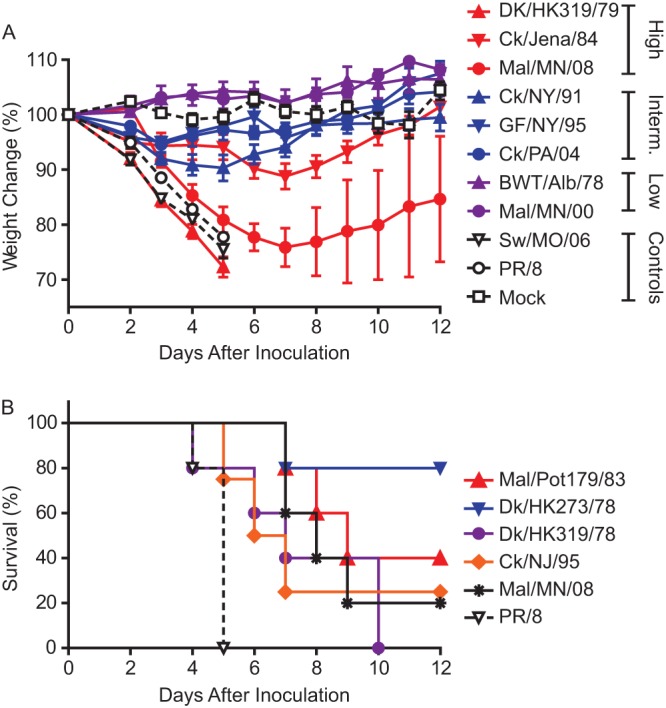
FIG 1
FIG 1
Replication of representative avian H2N2 viruses in DBA/2J mice. (A) Virus induced morbidity and virulence as classified by weight loss: high, >10% loss of starting weight; intermediate, 5 to 10% loss; low, <5% loss. (B) Viruses that induced mortality. Data in morbidity curves are presented as mean values ± standard deviations. Control groups are denoted as dashed lines.
FIG 2
FIG 2
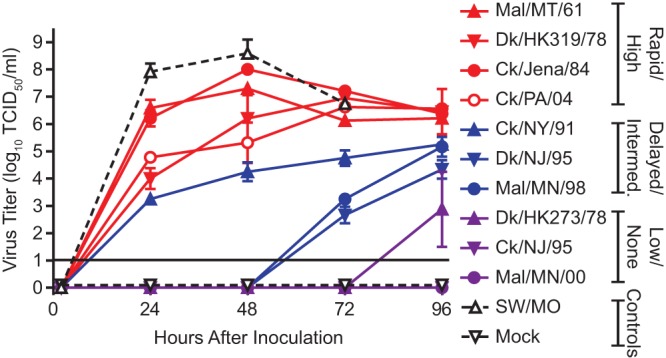
Replication kinetics of representative avian H2N2 viruses in normal human bronchial epithelial (NHBE) cells. The replication patterns indicated were scored based upon 24-h-time-point titers as follows: rapid/high, ≥4 log10 TCID50/ml; intermediate/delayed, ≤4 log10; low, ≤4 log10 throughout the time course; none, 0 log10 throughout the time course. Control groups are represented by open shapes and dashed lines. Data are presented as mean values from 6 inserts per virus group from two independent experiments, excluding negative inserts. The limit of detection is indicated by a solid horizontal line.
FIG 3
FIG 3
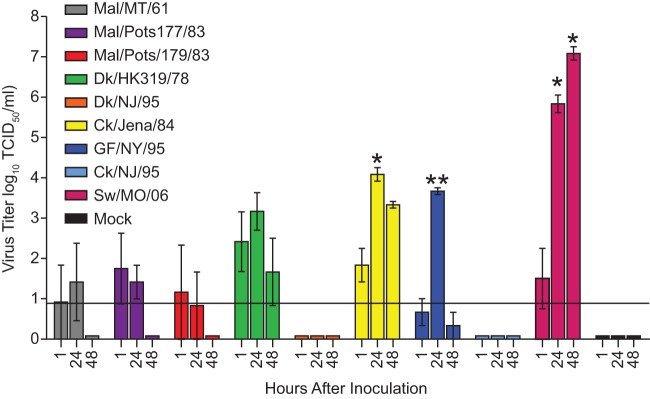
Replication kinetics of representative avian H2N2 viruses in ex vivo swine tracheal explants. Data are presented as the mean values of 3 explants per virus group ± standard deviation. The limit of detection is indicated by a solid horizontal line, and bars below without standard deviations are indicative of 0 values. Statistical significance of replication (as determined by comparison to the amount of virus 1 h after inoculation) was determined by performing t tests. *, P < 0.05; **, P < 0.005. Isolate Mal/Pot177/83 is subtype H2N1.
FIG 4
FIG 4
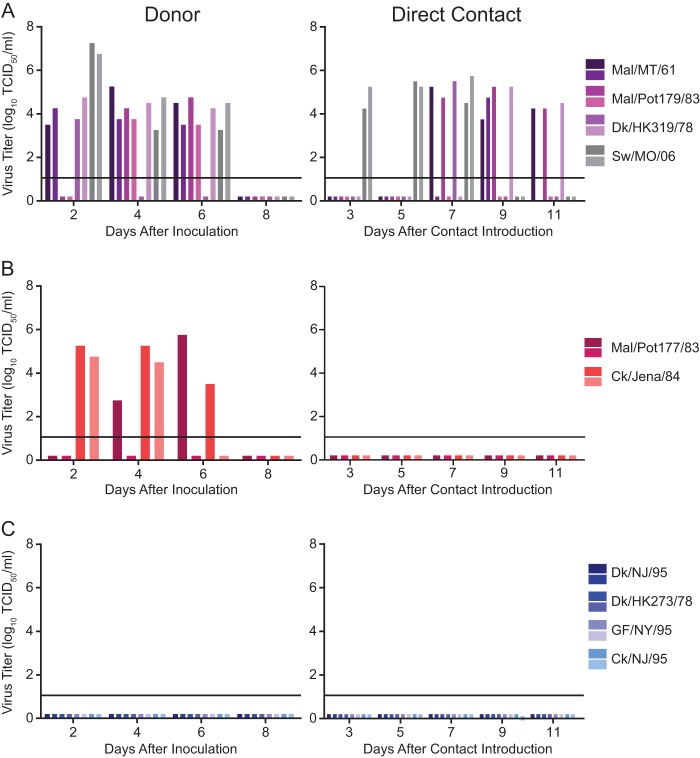
Replication and transmission of avian H2N2 viruses in ferrets. Each virus group contained 6 ferrets: 2 each of donors, direct contacts, and aerosol contacts. (A) Viruses exhibiting droplet/contact transmission; (B) viruses exhibiting replication in donors only; (C) viruses exhibiting no replication in ferrets. Data are presented as TCID50 values for each individual animal at a given time point. The limit of detection is indicated by a solid horizontal line, and bars below are indicative of 0 values. Isolate Mal/Pot177/83 is subtype H2N1.
FIG 5
FIG 5
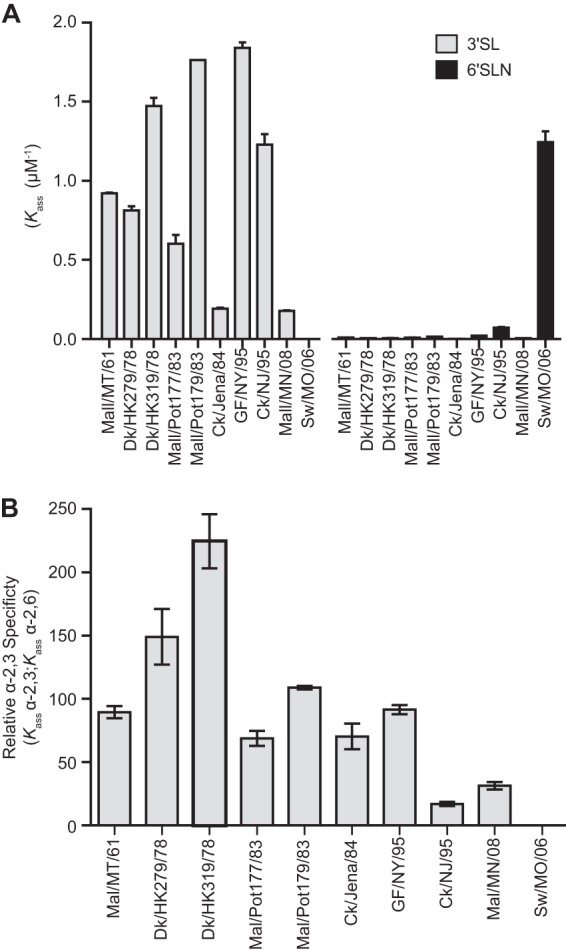
Receptor specificity of avian H2N2 viruses. (A) Apparent association (Kass) of viruses to α2,3 (3′SL)- or α2,6 (6′SLN)-linked biotinylated sialylglycopolymers. (B) Relative affinity to the α2,3-sialylglycopolymer. Data are presented as the mean values of repeat measures ± standard deviations. Isolate Mal/Pot177/83 is subtype H2N1.
FIG 6
FIG 6
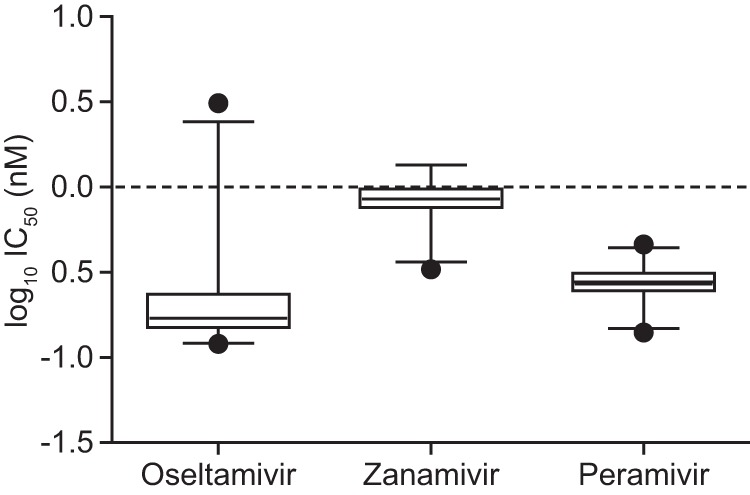
Box plots of the mean IC50s (nM) for oseltamivir carboxylate, zanamivir, and peramivir for avian H2N2 influenza viruses by the fluorometric assay. Boxes represent the 25th to 75th percentiles, and the horizontal lines within the boxes represent the median values. The length of the box represents the interquartile range (IQR). The end of the solid lines (whiskers) extending on either side of the box represent the 95% confidence limits. The isolates with IC50s between 1.5 and 3.0 IQR from the 25th and 75th percentiles were defined as mild outliers. The detected mild outlier for oseltamivir carboxylate A/Mal/Pot177/83 is shown as a closed circle.

References

    1. Scholtissek C, Rohde W, Von Hoyningen V, Rott R. 1978. On the origin of the human influenza virus subtypes H2N2 and H3N2. Virology 87:13–20. 10.1016/0042-6822(78)90153-8 - DOI - PubMed
    1. Webster RG. 1997. Predictions for future human influenza pandemics. J. Infect. Dis. 176(Suppl 1):S14–S19 - PubMed
    1. Simonsen L, Clarke MJ, Schonberger LB, Arden NH, Cox NJ, Fukuda K. 1998. Pandemic versus epidemic influenza mortality: a pattern of changing age distribution. J. Infect. Dis. 178:53–60. 10.1086/515616 - DOI - PubMed
    1. Kawaoka Y, Krauss S, Webster RG. 1989. Avian-to-human transmission of the PB1 gene of influenza A viruses in the 1957 and 1968 pandemics. J. Virol. 63:4603–4608 - PMC - PubMed
    1. Palese P, Wang TT. 2011. Why do influenza virus subtypes die out? A hypothesis. mBio 2(5):e00150–11. 10.1128/mBio.00150-11 - DOI - PMC - PubMed

Publication types

LinkOut - more resources