


Risk prediction models for mortality in community-acquired pneumonia: a systematic review
- PMID: 24228253
- PMCID: PMC3817804
- DOI: 10.1155/2013/504136
Risk prediction models for mortality in community-acquired pneumonia: a systematic review
Abstract
Background: Several models have been developed to predict the risk of mortality in community-acquired pneumonia (CAP). This study aims to systematically identify and evaluate the performance of published risk prediction models for CAP.
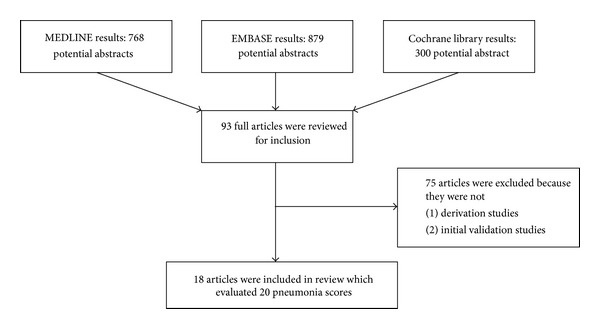
Methods: We searched MEDLINE, EMBASE, and Cochrane library in November 2011 for initial derivation and validation studies for models which predict pneumonia mortality. We aimed to present the comparative usefulness of their mortality prediction.
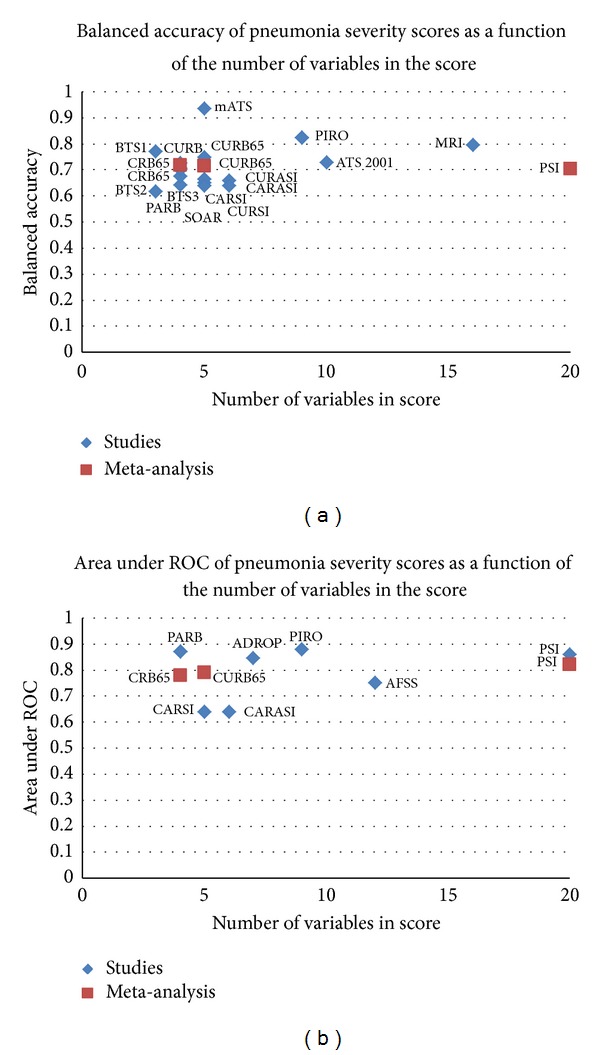
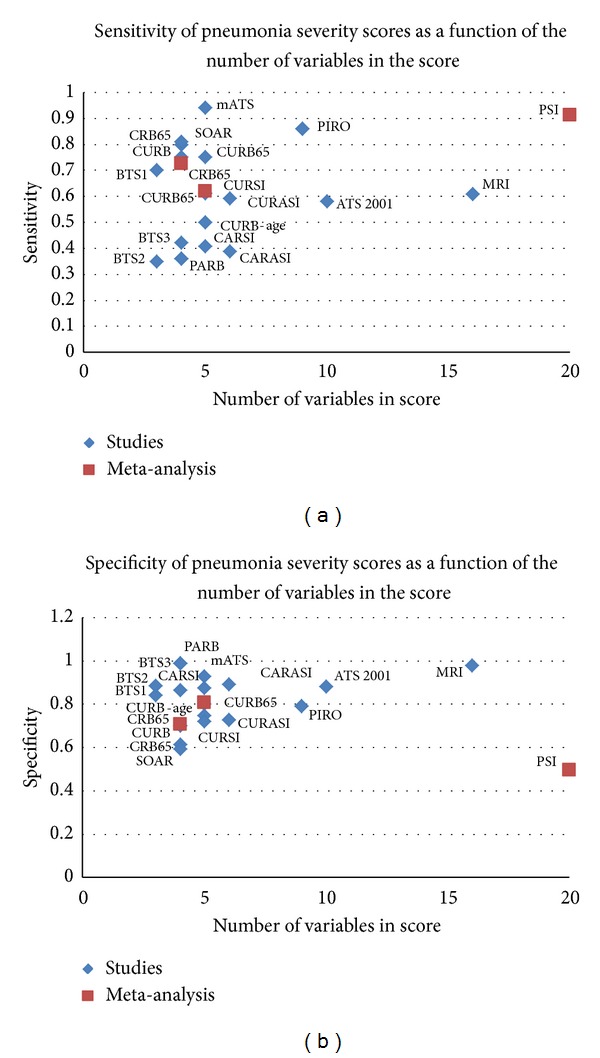
Results: We identified 20 different published risk prediction models for mortality in CAP. Four models relied on clinical variables that could be assessed in community settings, with the two validated models BTS1 and CRB-65 showing fairly similar balanced accuracy levels (0.77 and 0.72, resp.), while CRB-65 had AUROC of 0.78. Nine models required laboratory tests in addition to clinical variables, and the best performance levels amongst the validated models were those of CURB and CURB-65 (balanced accuracy 0.73 and 0.71, resp.), with CURB-65 having an AUROC of 0.79. The PSI (AUROC 0.82) was the only validated model with good discriminative ability among the four that relied on clinical, laboratorial, and radiological variables.
Conclusions: There is no convincing evidence that other risk prediction models improve upon the well-established CURB-65 and PSI models.
Figures
References
-
- Fine MJ, Stone RA, Singer DE, et al. Processes and outcomes of care for patients with community-acquired pneumonia: results from the Pneumonia Patient Outcomes Research Team (PORT) cohort study. Archives of Internal Medicine. 1999;159(9):970–980. - PubMed
-
- Capelastegui A, España PP, Quintana JM, et al. Validation of a predictive rule for the management of community-acquired pneumonia. European Respiratory Journal. 2006;27(1):151–157. - PubMed
Publication types
MeSH terms
LinkOut - more resources
Full Text Sources
Other Literature Sources
Medical
Miscellaneous
