Work in multiple jobs and the risk of injury in the US working population
- PMID: 24228681
- PMCID: PMC3910039
- DOI: 10.2105/AJPH.2013.301431
Work in multiple jobs and the risk of injury in the US working population
Abstract
Objectives: We compared the risk of injury for multiple job holders (MJHs) with that for single job holders (SJHs).
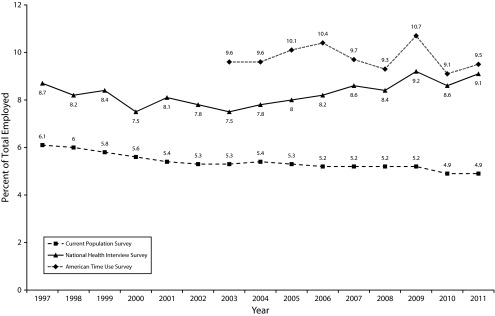
Methods: We used information from the National Health Interview Survey for the years 1997 through 2011 to estimate the rate of multiple job holding in the United States and compared characteristics and rates of self-reported injury (work and nonwork) for SJHs versus MJHs.
Results: Approximately 8.4% of those employed reported working more than 1 job in the week before the interview. The rate of work and nonwork injury episodes per 100 employed workers was higher for MJHs than for SJHs (4.2; 95% confidence interval [CI] = 3.5, 4.8; vs 3.3; 95% CI = 3.1, 3.5 work injuries and 9.9; 95% CI = 8.9, 10.9; vs 7.4; 95% CI = 7.1, 7.6 nonwork injuries per 100 workers, respectively). When calculated per 100 full-time equivalents (P < .05), the rate ratio remained higher for MJHs.
Conclusions: Our findings suggest that working in multiple jobs is associated with an increased risk of an injury, both at work and not at work, and should be considered in injury surveillance.
Figures
References
-
- National Occupational Research Agenda. Cincinnati, OH: National Institute for Occupational Safety and Health; 2002. Organization of Work Team Members. The changing organization of work and the safety and health of working people: knowledge gaps and research directions. DHHS (NIOSH) publication no. 2002-116.
-
- Kuhn S, Wooding J. The changing structure of work in the United States. Implications for health and welfare. Part 2. New Solut. 1994;4(4):21–27. - PubMed
-
- Bureau of Labor Statistics. Data retrieval: labor force statistics from the Current Population Survey. Household data: Table 7. Employment status of the civilian population 25 years and over by educational attainment, sex, race, and Hispanic or Latino ethnicity. 2012. Available at: http://www.bls.gov/cps/cpsaat07.htm. Accessed December 20, 2012.
-
- Canadian Imperial Bank of Commerce, Centre for Human Capital and Productivity. The transferability of skills. Policy brief no. 4. London, Ontario: Western University, Department of Economics, Social Science Centre; 2012. Available at: http://economics.uwo.ca/cibc/cibc_docs/policybrief4.pdf. Accessed September 5, 2013.
-
- Bureau of Labor Statistics. Number of jobs, labor market experience, and earnings growth: results from a National Longitudinal Survey news release: USDL-12-1489. Washington, DC: US Department of Labor; 2012. Available at: http://www.bls.gov/news.release/nlsoy.htm. Accessed December 20, 2012.
MeSH terms
LinkOut - more resources
Full Text Sources
Other Literature Sources
Medical