. 2013 Nov 15:14:794.
doi: 10.1186/1471-2164-14-794.

The Drosophila early ovarian transcriptome provides insight to the molecular causes of recombination rate variation across genomes

Affiliations

The Drosophila early ovarian transcriptome provides insight to the molecular causes of recombination rate variation across genomes

Andrew B Adrian et al. BMC Genomics. .

Abstract

Background: Evidence in yeast indicates that gene expression is correlated with recombination activity and double-strand break (DSB) formation in some hotspots. Studies of nucleosome occupancy in yeast and mice also suggest that open chromatin influences the formation of DSBs. In Drosophila melanogaster, high-resolution recombination maps show an excess of DSBs within annotated transcripts relative to intergenic sequences. The impact of active transcription on recombination landscapes, however, remains unexplored in a multicellular organism. We then investigated the transcription profile during early meiosis in D. melanogaster females to obtain a glimpse at the relevant transcriptional dynamics during DSB formation, and test the specific hypothesis that DSBs preferentially target transcriptionally active genomic regions.

Results: Our study of transcript profiles of early- and late-meiosis using mRNA-seq revealed, 1) significant differences in gene expression, 2) new genes and exons, 3) parent-of-origin effects on transcription in early-meiosis stages, and 4) a nonrandom genomic distribution of transcribed genes. Importantly, genomic regions that are more actively transcribed during early meiosis show higher rates of recombination, and we ruled out DSB preference for genic regions that are not transcribed.

Conclusions: Our results provide evidence in a multicellular organism that transcription during the initial phases of meiosis increases the likelihood of DSB and give insight into the molecular determinants of recombination rate variation across the D. melanogaster genome. We propose that a model where variation in gene expression plays a role altering the recombination landscape across the genome could provide a molecular, heritable and plastic mechanism to observed patterns of recombination variation, from the high level of intra-specific variation to the known influence of environmental factors and stress conditions.


Figures
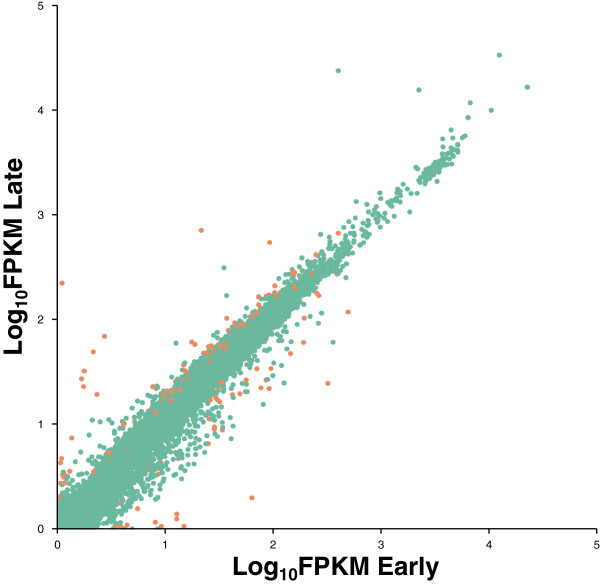
Figure 1
Figure 1
Comparison of Log10 FPKM values for Drosophila Early- and Late- ovarian transcriptome. Orange points indicate significantly differentially expressed genes based on FDR-corrected significance level of 5% (q < 0.05). Spearman’s R = 0.952 (P < 1x10-12).
Figure 2
Figure 2
Transcriptional differences between autosomes and the X chromosome. (A) Mean FPKM values for autosomes and the X chromosome. Error bars represent +/− 1 standard error. (B) Percentage of total transcribed genes across each chromosome. Error bars represent 90% confidence intervals. Green: Early-ovarian transcriptome, Orange: Late-ovarian transcriptome.
Figure 3
Figure 3
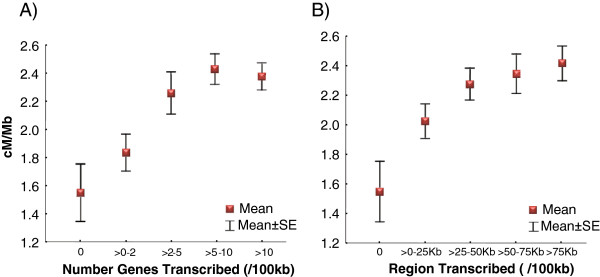
Relationship between transcription and recombination rates. (A) Mean recombination rate in cM/Mb (centimorgans per megabase) for genomic regions grouped according to the number of genes transcribed (FPKM > 0.1) within each 100-kb region. Spearman’s R = 0.168 (P = 1.5x10⁻⁹) based on non-overlaping 100-kb regions. (B) Mean recombination rate in cM/Mb for regions grouped according to the total region transcribed within each 100-kb region. R = 0.123 (P = 1.1x10⁻⁵). Error bars represent +/− 1 standard error.
Figure 4
Figure 4
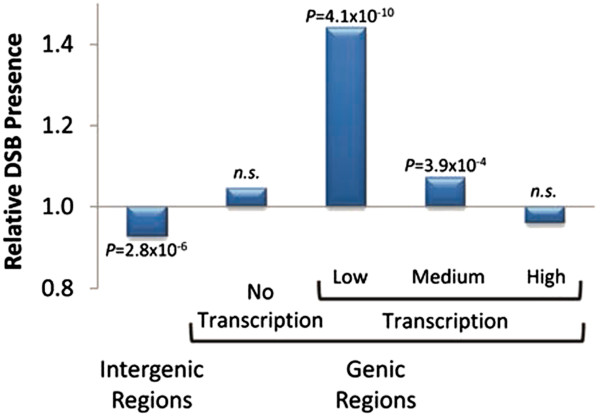
Relative presence of DSBs across the genome. Analyses based on the 5,610 DSB events delimited by 500 bp or less described in [20]. The relative presence is measured as the ratio of the number of DSBs observed within each category to the number expected based on a random distribution of DSBs across the genome. Conservatively, we classified genes as showing no active transcription when FPKM < 0.001 and groups of genes with low-, medium- and high-transcription represent levels of target potential associated with transcription (FPKM x transcript length); 33, 46 and 21% of active genes belong to the low-, medium- and high- transcription groups, respectively. Probabilities (shown above each bar) associated with the relative presence of DSBs were obtained based on 10,000 independent replicates of the 5,610 DSBs randomly distributed across the genome.

References

    1. Wang Z, Gerstein M, Snyder M. RNA-Seq: a revolutionary tool for transcriptomics. Nat Rev Genet. 2009;10:57–63. doi: 10.1038/nrg2484. - DOI - PMC - PubMed
    1. Tang F, Barbacioru C, Wang Y, Nordman E, Lee C, Xu N, Wang X, Bodeau J, Tuch BB, Siddiqui A. et al.mRNA-Seq whole-transcriptome analysis of a single cell. Nat Methods. 2009;6:377–382. doi: 10.1038/nmeth.1315. - DOI - PubMed
    1. Lake CM, Hawley RS. The molecular control of meiotic chromosomal behavior: events in early meiotic prophase in Drosophila oocytes. Annu Rev Physiol. 2012;74:425–451. doi: 10.1146/annurev-physiol-020911-153342. - DOI - PubMed
    1. Roth S, Lynch JA. Symmetry breaking during Drosophila oogenesis. Cold Spring Harb Perspect Biol. 2009;1:a001891. doi: 10.1101/cshperspect.a001891. - DOI - PMC - PubMed
    1. Kirilly D, Xie T. The Drosophila ovary: an active stem cell community. Cell Res. 2007;17:15–25. doi: 10.1038/sj.cr.7310123. - DOI - PubMed

Publication types

LinkOut - more resources