


Long-term drug treatment for obesity: a systematic and clinical review
- PMID: 24231879
- PMCID: PMC3928674
- DOI: 10.1001/jama.2013.281361
Long-term drug treatment for obesity: a systematic and clinical review
Abstract
Importance: Thirty-six percent of US adults are obese, and many cannot lose sufficient weight to improve health with lifestyle interventions alone.
Objective: To conduct a systematic review of medications currently approved in the United States for obesity treatment in adults. We also discuss off-label use of medications studied for obesity and provide considerations for obesity medication use in clinical practice.
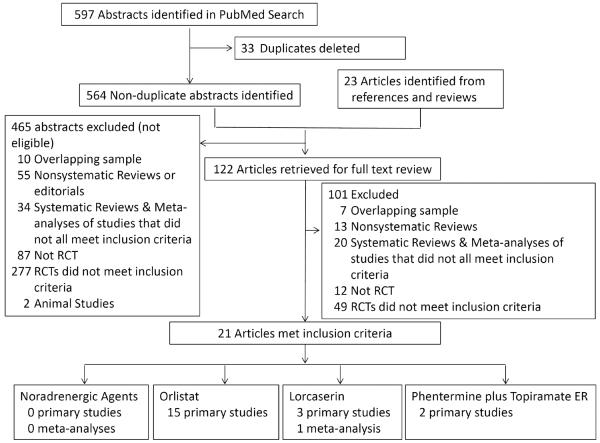
Evidence review: A PubMed search from inception through September 2013 was performed to find meta-analyses, systematic reviews, and randomized, placebo-controlled trials for currently approved obesity medications lasting at least 1 year that had a primary or secondary outcome of body weight change, included at least 50 participants per group, reported at least 50% retention, and reported results on an intention-to-treat basis. Studies of medications approved for other purposes but tested for obesity treatment were also reviewed.
Findings: Obesity medications approved for long-term use, when prescribed with lifestyle interventions, produce additional weight loss relative to placebo ranging from approximately 3% of initial weight for orlistat and lorcaserin to 9% for top-dose (15/92 mg) phentermine plus topiramate-extended release at 1 year. The proportion of patients achieving clinically meaningful (at least 5%) weight loss ranges from 37% to 47% for lorcaserin, 35% to 73% for orlistat, and 67% to 70% for top-dose phentermine plus topiramate-extended release. All 3 medications produce greater improvements in many cardiometabolic risk factors than placebo, but no obesity medication has been shown to reduce cardiovascular morbidity or mortality. Most prescriptions are for noradrenergic medications, despite their approval only for short-term use and limited data for their long-term safety and efficacy.
Conclusions and relevance: Medications approved for long-term obesity treatment, when used as an adjunct to lifestyle intervention, lead to greater mean weight loss and an increased likelihood of achieving clinically meaningful 1-year weight loss relative to placebo. By discontinuing medication in patients who do not respond with weight loss of at least 5%, clinicians can decrease their patients' exposure to the risks and costs of drug treatment when there is little prospect of long-term benefit.
Figures
Comment in
-
Drugs for the treatment of obesity.JAMA. 2014 May 7;311(17):1807. doi: 10.1001/jama.2014.2104. JAMA. 2014. PMID: 24794378 No abstract available.
-
Drugs for the treatment of obesity--reply.JAMA. 2014 May 7;311(17):1807. doi: 10.1001/jama.2014.2110. JAMA. 2014. PMID: 24794379 No abstract available.
-
Obesity medications reduce total body weight by 3-9% compared with placebo, when combined with lifestyle changes.Evid Based Nurs. 2015 Jan;18(1):29-30. doi: 10.1136/eb-2014-101785. Epub 2014 May 19. Evid Based Nurs. 2015. PMID: 24842056 No abstract available.
References
-
- Ogden CL, Carroll MD, Kit BK, Flegal KM. Prevalence of obesity in the United States, 2009–2010. NCHS Data Brief. 2012;(82):1–8. - PubMed
-
- Ryan DH, Bray GA. Pharmacologic treatment options for obesity: what is old is new again. Curr Hypertens Rep. 2013;15(3):182–189. - PubMed
-
- Moyer VA. Screening for and management of obesity in adults: U.S. Preventive Services Task Force recommendation statement. Annals of internal medicine. 2012;157(5):373–378. - PubMed
Publication types
MeSH terms
Substances
Grants and funding
LinkOut - more resources
Full Text Sources
Other Literature Sources
Medical
Molecular Biology Databases
