. 2013 Nov 14;4(11):e923.
doi: 10.1038/cddis.2013.450.

FUT family mediates the multidrug resistance of human hepatocellular carcinoma via the PI3K/Akt signaling pathway

Affiliations

FUT family mediates the multidrug resistance of human hepatocellular carcinoma via the PI3K/Akt signaling pathway

L Cheng et al. Cell Death Dis. .

Abstract

The fucosyltransferase (FUT) family is the key enzymes in cell-surface antigen synthesis during various biological processes such as tumor multidrug resistance (MDR). The aim of this work was to analyze the alteration of FUTs involved in MDR in human hepatocellular carcinoma (HCC) cell lines. Using mass spectrometry (MS) analysis, the composition profiling of fucosylated N-glycans differed between drug-resistant BEL7402/5-FU (BEL/FU) cells and the sensitive line BEL7402. Further analysis of the expressional profiles of the FUT family in three pairs of parental and chemoresistant human HCC cell lines showed that FUT4, FUT6 and FUT8 were predominant expressed in MDR cell lines. The altered levels of FUT4, FUT6 and FUT8 were responsible for changed drug-resistant phenotypes of BEL7402 and BEL/FU cells both in vitro and in vivo. In addition, regulating FUT4, FUT6 or FUT8 expression markedly modulated the activity of the phosphoinositide 3 kinase (PI3K)/Akt signaling pathway and MDR-related protein 1 (MRP1) expression. Inhibition of the PI3K/Akt pathway by its specific inhibitor wortmannin, or by Akt small interfering RNA (siRNA), resulted in decreased MDR of BEL/FU cells, partly through the downregulation of MRP1. Taken together, our results suggest that FUT4-, FUT6- or FUT8-mediated MDR in human HCC is associated with the activation of the PI3K/Akt pathway and the expression of MRP1, but not of P-gp, indicating a possible novel mechanism by which the FUT family regulates MDR in human HCC.


Figures

Figure 1
Figure 1
Differential N-glycan composition of BEL7402 and BEL/FU cell lines. (a) MALDI-TOF MS spectra of permethylated N-glycans released from BEL7402 and BEL/FU cells, respectively. (b) Histograms of relative intensities of the differential glycan signals were observed. Data were analyzed as described in Materials and Methods and are the average±S.D. of triplicate determinations. The signals indicated with Arabic numerals are summarized in Table 1
Figure 2
Figure 2
Differential expression of the FUT gene family in three pairs of parental and chemoresistant human hepatocellular carcinoma cell lines. (ac) The mRNA levels of FUT gene family analyzed using real-time RT-PCR. The relative amount of gene mRNA level was normalized to the GAPDH level. Three MDR cells expressed higher levels of FUT4, FUT6 and FUT8 mRNA than their parental cell types (more than threefold; *P<0.05). Data are the means±S.D. of triplicate determinants
Figure 3
Figure 3
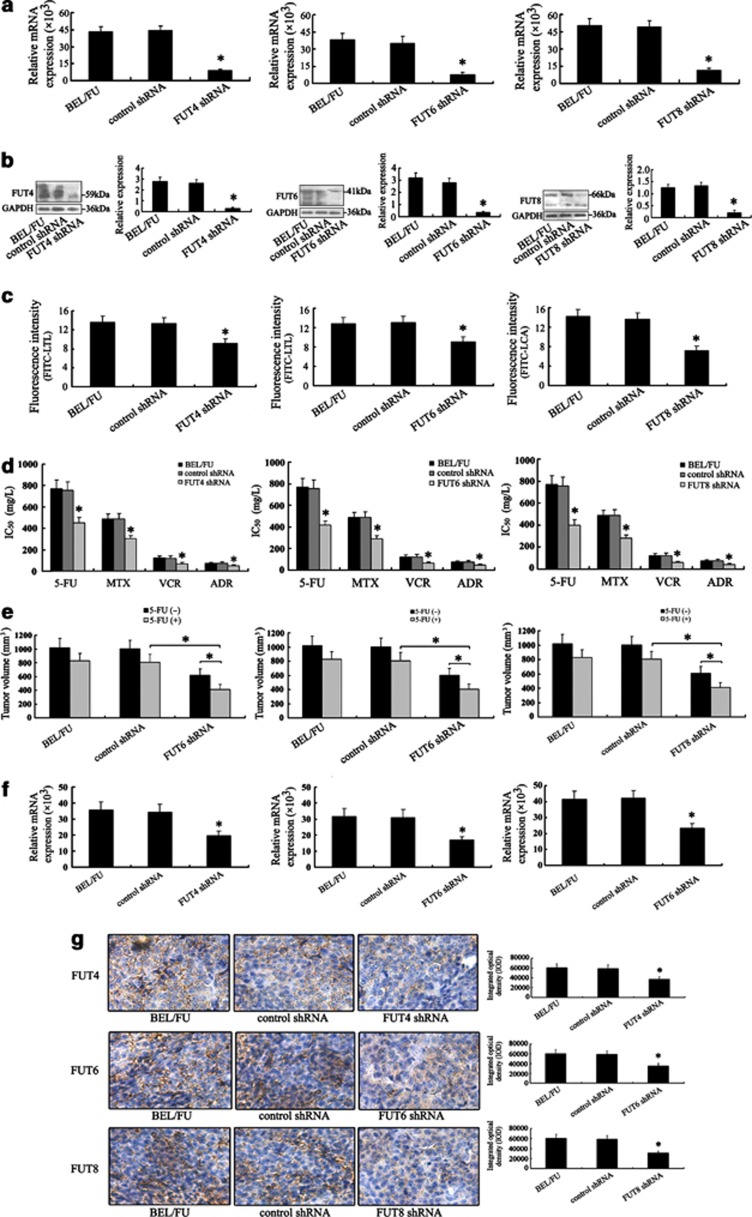
Silence of FUT4, FUT6 or FUT8 gene enhances the chemosensitivity of BEL/FU cells both in vitro and in vivo. (a) Silencing of FUT4, FUT6 or FUT8 in BEL/FU cells was analyzed with the RNAi approach. FUT4, FUT6 or FUT8 transcript was decreased apparently in BEL/FU cells by shRNA treatment. (b) After shRNA transfection, distinct reduction in FUT4, FUT6 or FUT8 was observed at protein levels using western blot analysis. (c) FITC-LTL- or FITC-LCA-binding profile of FUT4, FUT6 or FUT8 shRNA cells using flow cytometry. Histograms of fluorescence intensities of cells with specific carbohydrate expression as determined. (d) Cell chemosensitivity was assessed using cytotoxicity assays. The reported values were the IC50 (Mean±S.D.) of three independent experiments. IC50 represents the drug concentration producing 50% decrease in cell growth. *P<0.05 versus BEL/FU-control shRNA cells. (e) A decrease in the mean tumor volume in mice group with BEL/FU-FUT4, FUT6 or FUT8 shRNA tumors was observed, as compared with that in the BEL/FU group and the BEL/FU-control shRNA group. Within the BEL/FU-FUT4, FUT6 or FUT8 shRNA group, an increase in tumor growth was found in group without 5-FU, compared with that with 5-FU (*P<0.05). Downregulation of FUT4, FUT6 or FUT8 was also shown using real-time RT-PCR (f) and IHC staining (g) in xenograft tumors derived from BEL/FU-FUT4 shRNA, BEL/FU-FUT6 shRNA or BEL/FU-FUT8 shRNA cells (400 × ). The data are means±S.D. of three independent assays (*P<0.05)
Figure 4
Figure 4
Overexpression of FUT4, FUT6 or FUT8 gene enhances the chemoresistance of BEL7402 cells both in vitro and in vivo. After full-length sequence transfection, FUT4, FUT6 or FUT8 mRNA (a) and protein (b) were increased notably in BEL7402 cells using real-time PCR and western blot. (c) FITC-LTL- or FITC-LCA-binding profile of BEL7402/FUT4, BEL7402/FUT6 or BEL7402/FUT8 cells using flow cytometry. Histograms of fluorescence intensities of cells with specific carbohydrate expression as determined. (d) Cell chemosensitivity was assessed using cytotoxicity assays. The reported values were the IC50 (Mean±S.D.) of three independent experiments. IC50 represents the drug concentration producing 50% decrease in cell growth. *P<0.05 versus BEL7402/mock cells. (e) An increase in the mean tumor in the mice group with BEL7402/FUT4, BEL7402/FUT6 or BEL7402/FUT8 tumor was observed, as compared with that in the BEL7402 group and the BEL7402/mock group. Within the BEL7402/FUT4, FUT6 or FUT8 group, an increase in tumor growth was found in the group without 5-FU, compared with that with 5-FU (*P<0.05). Upregulation of FUT4, FUT6 or FUT8 was also shown using real-time RT-PCR (f) and IHC staining (g) in xenograft tumors derived from BEL7402/FUT4, FUT6 or FUT8 cells (400 × ). The data are means±S.D. of three independent assays (*P<0.05)
Figure 5
Figure 5
Effect of FUT4-, FUT6- or FUT8-activated the PI3K/Akt signaling pathway on the expression of multidrug resistance-associated proteins. (a) Expression of PI3K/Akt/NF-κB signaling molecules were repressed at protein levels with FUT4, FUT6 or FUT8 shRNA transfection in BEL/FU cells. (b) The increased protein levels of PI3K/Akt/NF-κB signaling molecules were determined using western blot in BEL7402/FUT4, FUT6 or FUT8 cells. (c) Decreased relative expression of MRP1 to Na+/K+-ATPase was examined using flow cytometry analysis in FUT4-, FUT6- or FUT8-shRNA-treated BEL/FU cells. (d) Flow cytometry analysis revealed a higher relative expression of MRP1 to Na+/K+-ATPase in BEL7402 cells with FUT4, FUT6 or FUT8 transfection. The data are means±S.D. of three independent assays (*P<0.05)
Figure 6
Figure 6
PI3K/Akt inhibition modulates the chemosensitivity of BEL/FU cells both in vitro and in vivo. (a) The BEL/FU cells were pretreated wortmannin or Akt siRNA. Expression of PI3K/Akt/NF-κB signaling molecules were then examined using western blot analysis. (b) Wortmannin or Akt siRNA treatment also alleviated chemoresistance of BEL/FU cells, revealed by in vitro and in vivo (c). (d) Downregulation of PI3K/Akt/NF-κB signaling molecules was also shown by IHC staining in xenograft tumors derived from wortmannin or Akt siRNA treatment cells (400 × ). (e) Flow cytometry analysis showed that the suppression of PI3K/Akt signaling resulted in reduced-level MRP1 (relative expression to Na+/K+-ATPase). The data are means±S.D. of three independent assays. *P<0.05 versus DMSO treatment cells; #P<0.05 vs control siRNA treatment cells

References

    1. Tong SW, Yang YX, Hu HD, An X, Ye F, Hu P, et al. Proteomic investigation of 5-fluorouracil resistance in a human hepatocellular carcinoma cell line. J Cell Biochem. 2012;113:1671–1680. - PubMed
    1. Szakács G, Paterson J. Targeting multidrug resistance in cancer. Nat Rev Drug Discover. 2006;5:219–234. - PubMed
    1. Teodori E, Dei S, Martelli C, Scapecchi S, Gualtieri F. The functions and structure of ABC transporters: implications for the design of new inhib-itors of Pgp and MRP1 to control multidrug resistance (MDR) Curr Drug Targets. 2006;7:893–909. - PubMed
    1. Baguley BC. Multidrug resistance in cancer. Methods Mol Biol. 2010;596:1–14. - PubMed
    1. Uchibori K, Kasamatsu A, Sunaga M, Yokota S, Sakurada T, Kobayashi E, et al. Establishment and characterization of two 5-fluorouracil-resistant hepatocellular carcinoma cell lines. Int J Oncol. 2012;40:1005–1010. - PMC - PubMed

Publication types

MeSH terms

Substances