Review
. 2014 Apr;87(1036):20130488.
doi: 10.1259/bjr.20130488.

Advances in post-mortem CT-angiography

Affiliations
Review

Advances in post-mortem CT-angiography

S Grabherr et al. Br J Radiol. 2014 Apr.

Abstract

Performing a post-mortem multidetector CT (MDCT) scan has already become routine in some institutes of forensic medicine. To better visualize the vascular system, different techniques of post-mortem CT-angiography have been explored, which can essentially be divided into partial- and whole-body angiography techniques. Probably the most frequently applied technique today is the so-called multiphase post-mortem CT-angiography (MPMCTA) a standardized method for investigating the vessels of the head, thorax and abdomen. Different studies exist, describing its use for medicolegal investigations, and its advantages as well as its artefacts and pitfalls. With the aim to investigate the performance of PMCTA and to develop and validate techniques, an international working group was created in 2012 called the "Technical Working Group Post-mortem Angiography Methods" (TWGPAM). Beyond its primary perspective, the goals of this group include creating recommendations for the indication of the investigation and for the interpretation of the images and to distribute knowledge about PMCTA. This article provides an overview about the different approaches that have been developed and tested in recent years and an update about ongoing research in this field. It will explain the technique of MPMCTA in detail and give an outline of its indications, application, advantages and limitations.


Figures
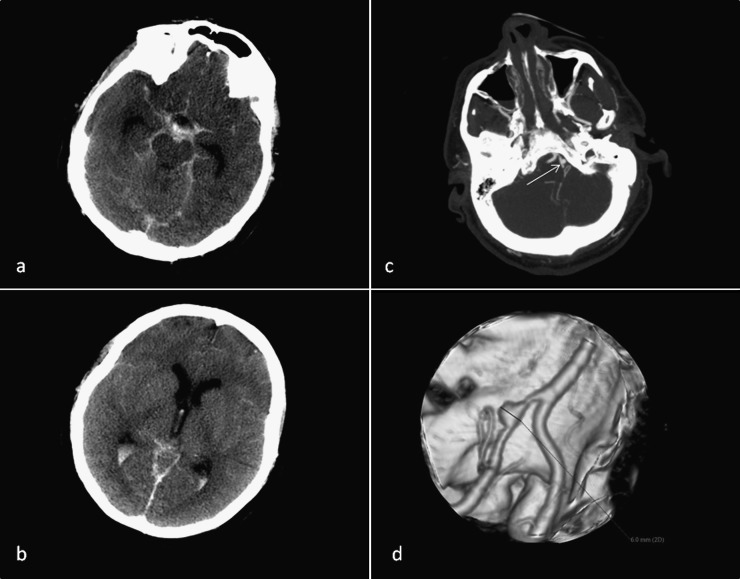
Figure 1
Figure 1
Images obtained from a case of a 48-year-old male, found dead sitting on his sofa. Native post-mortem CT (PMCT) (a, b) shows subarachnoid haemorrhage in basal compartment (a) and in the ventricular system (b). Arterial phase of multiphase PMCT-angiography (c, d) reveals the source of bleeding originating from an aneurysm in the left vertebral artery (arrow in c). The three-dimensional-volume rendering reconstruction (d) better visualizes the aneurysm and measurement shows a diameter of 6 mm.
Figure 2
Figure 2
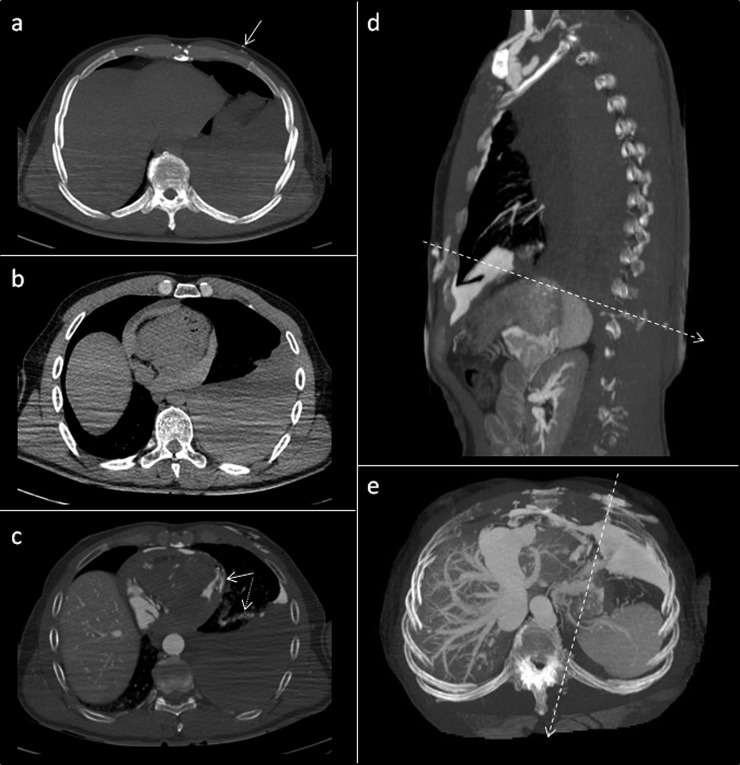
A case of a 55-year-old male found dead in his laundry with a pistol next to him. Police investigations could conclude a suicide. Native post-mortem CT (PMCT) (a, b) revealed a small cutaneous lesion with metallic particles in the skin corresponding to gunshot residues and indicating the entrance wound (arrow in a), a left haemothorax and a haemopericardium (b). PMCT-angiography (PMCTA) (c–e) could demonstrate an extravasation of contrast agent into the pericardium originating from a lesion of the myocardium in the left ventricle (arrow in c). Additionally, contrast agent indicated a trajectory through the pulmonary parenchyma (dotted arrow in c). The trajectory of the gun shot is reconstructed using the dynamic phase of multiphase PMCTA where the contrast agent indicates trajectories in soft tissue (d, e). In this case, the project described a descending trajectory directing from anterior to posterior and slightly from the left to the right considering an upright anatomical position.
Figure 3
Figure 3
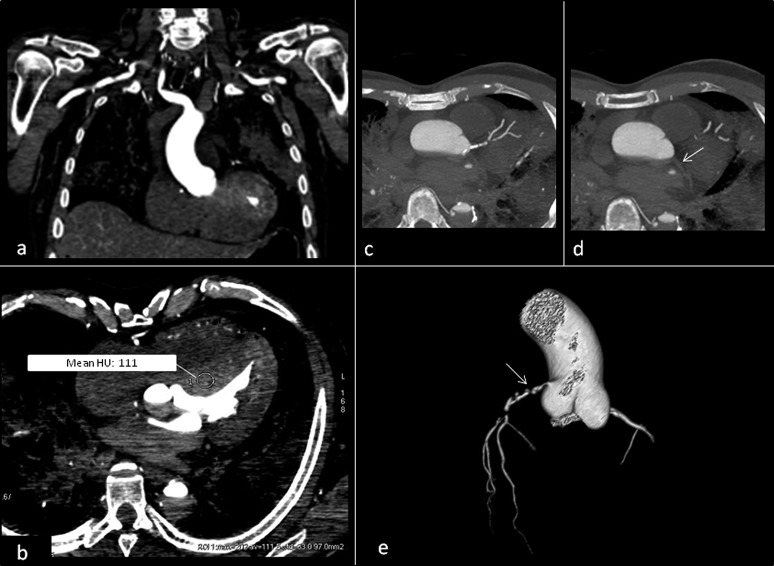
Multiphase post-mortem CT-angiography (MPMCTA) images of the arterial phase of a 63-year-old male found dead in his bed. Autopsy and histology revealed a subacute posteroseptal infarction of myocardium and a thrombosis of the circumflex artery. During the arterial phase of MPMCTA, a pathological enhancement of the myocardium can be observed (a, b), with a mean attenuation of 111 HU in the septum (b), indicating the region of the infarction. Maximum intensity projection (c, d) and 3D-volume rendering (e) reconstructions of the coronary arteries demonstrate multiple stenosis of the interventricular artery and the common trunk of the left coronary artery and a non-opacification of the circumflex artery (arrow in d and e). 3D, three-dimensional.

References

    1. Krantz P, Holtås S. Postmortem computed tomography in a diving fatality. J Comput Assist Tomogr 1983; 7: 132–4. - PubMed
    1. Dirnhofer R, Jackowski C, Vock P, Potter K, Thali MJ. VIRTOPSY: minimally invasive, imaging-guided virtual autopsy. Radiographics 2006; 26: 1305–33. doi: 10.1148/rg.265065001 - DOI - PubMed
    1. Thali M, Dirnhofer R, Vock P. The virtopsy approach: 3D optical and radiological scanning and reconstruction in forensic medicine. New York, NY: CRC; 2009. - PubMed
    1. Weustink AC, Hunink MG, van Dijke CF, Renken NS, Krestin GP, Oosterhuis JW. Minimally invasive autopsy: an alternative to conventional autopsy? Radiology 2009; 250: 897–904. doi: 10.1148/radiol.2503080421 - DOI - PubMed
    1. Jeffery AJ. The role of computed tomography in adult postmortem examinations: an overview. Diagn Histopathol 2010; 16: 546–51.

Publication types