


Statins and the risk of herpes zoster: a population-based cohort study
- PMID: 24235264
- PMCID: PMC3954107
- DOI: 10.1093/cid/cit745
Statins and the risk of herpes zoster: a population-based cohort study
Erratum in
- Clin Infect Dis. 2014 Apr;58(8):1203
Abstract
Background: Statins are widely used lipid-lowering drugs with immunomodulatory properties that may favor reactivation of latent varicella-zoster virus infection. However, whether statins increase the risk of herpes zoster is unknown.
Methods: We conducted a population-based retrospective cohort study of Ontario residents aged ≥ 66 years between 1 April 1997 and 31 March 2010 to examine the association between statin use and incidence of herpes zoster. We used propensity score matching to ensure similarity between users and nonusers of statins, and Cox proportional hazard models to assess differences in outcomes between study groups. To test the specificity of our findings, we examined the association between statin exposure and knee arthroplasty.
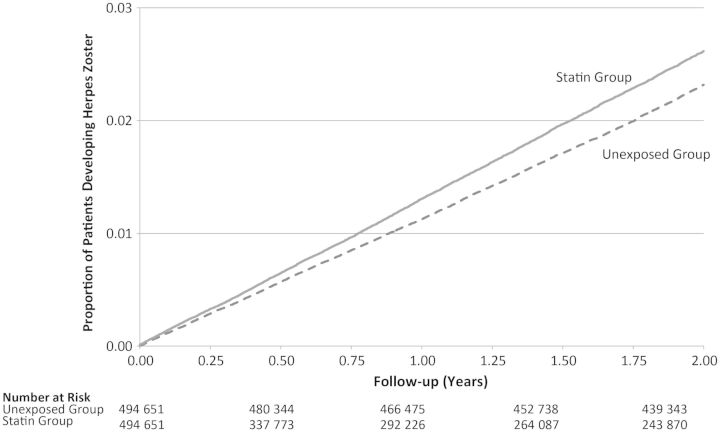
Results: During the 13-year study period, we matched 494 651 individuals treated with a statin to an equal number of untreated individuals. In the main analysis, the rate of herpes zoster was higher among users of statins relative to nonusers of these drugs (13.25 vs 11.71 per 1000 person-years, respectively; hazard ratio [HR], 1.13; 95% confidence interval [CI], 1.10-1.17). The attributable fraction of exposed individuals was 11.6%. In a prespecified analysis, we found a similar risk of herpes zoster among statin users in the subgroup of patients with diabetes (HR, 1.18; 95% CI, 1.09-1.27). As expected, we found no association between statin use and knee arthroplasty (HR, 1.04; 95% CI, .99-1.09).
Conclusions: Among older patients, treatment with statins is associated with a small but significantly increased risk of herpes zoster.
Keywords: drug safety; elderly; herpes zoster; population-based; statins.
Figures
Comment in
-
Statins, immunomodulation, and infections: a complex and unresolved relationship.Clin Infect Dis. 2014 Feb;58(3):357-8. doi: 10.1093/cid/cit751. Epub 2013 Nov 18. Clin Infect Dis. 2014. PMID: 24253243 No abstract available.
-
Shingles and statin treatment: confounding by cholesterol or APOE4 status?Clin Infect Dis. 2014 Apr;58(7):1042-3. doi: 10.1093/cid/ciu030. Epub 2014 Jan 14. Clin Infect Dis. 2014. PMID: 24429433 No abstract available.
-
Reply to Strandberg and Tienari.Clin Infect Dis. 2014 Apr;58(7):1043-4. doi: 10.1093/cid/ciu036. Epub 2014 Jan 14. Clin Infect Dis. 2014. PMID: 24429439 No abstract available.
References
-
- Thomas SL, Hall AJ. What does epidemiology tell us about risk factors for herpes zoster? Lancet Infect Dis. 2004;4:26–33. - PubMed
-
- Stein AN, Britt H, Harrison C, Conway EL, Cunningham A, MacIntyre CR. Herpes zoster burden of illness and health care resource utilization in the Australian population aged 50 years and older. Vaccine. 2009;27:520–9. - PubMed
-
- Dworkin RH, White R, O'Connor AB, Baser O, Hawkins K. Healthcare costs of acute and chronic pain associated with a diagnosis of herpes zoster. J Am Geriatr Soc. 2007;55:1168–75. - PubMed
-
- Yawn BP, Saddier P, Wolan PC, St. Sauver JL, Kurland MJ, Sy LS. A population-based study of the incidence and complication rates of herpes zoster before zoster vaccine introduction. Mayo Clin Proc. 2007;82:1341–9. - PubMed
Publication types
MeSH terms
Substances
LinkOut - more resources
Full Text Sources
Other Literature Sources
Medical
Research Materials
Miscellaneous
