


Antiretroviral therapy reduces HIV transmission in discordant couples in rural Yunnan, China
- PMID: 24236010
- PMCID: PMC3827220
- DOI: 10.1371/journal.pone.0077981
Antiretroviral therapy reduces HIV transmission in discordant couples in rural Yunnan, China
Abstract
Background: Although HIV treatment as prevention (TasP) via early antiretroviral therapy (ART) has proven to reduce transmissions among HIV-serodiscordant couples, its full implementation in developing countries remains a challenge. In this study, we determine whether China's current HIV treatment program prevents new HIV infections among discordant couples in rural China.
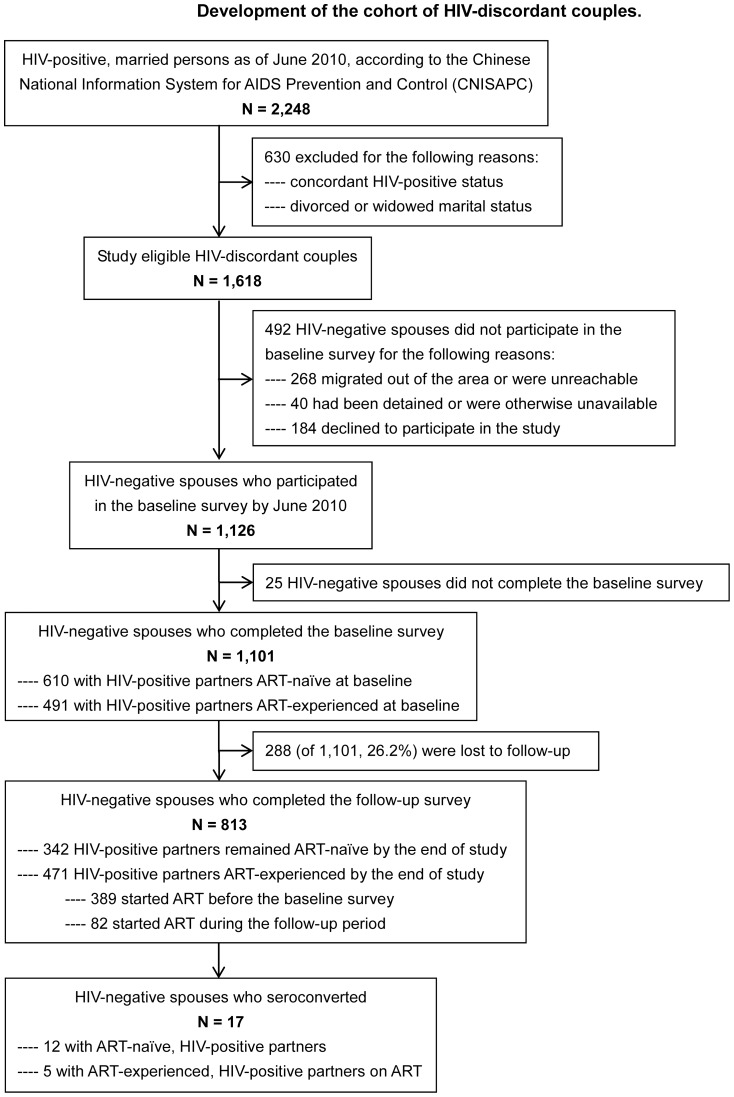
Methods: A prospective, longitudinal cohort study was conducted from June 2009 to March 2011, in rural Yunnan. A total of 1,618 HIV-discordant couples were eligible, 1,101 were enrolled, and 813 were followed for an average of 1.4 person-years (PY). Routine ART was prescribed to HIV-positive spouses according to eligibility (CD4<350 cells/µl). Seroconversion was used to determine HIV incidence.
Results: A total of 17 seroconversions were documented within 1,127 PY of follow-up, for an overall incidence of 1.5 per 100 PY. Epidemiological and genetic evidence confirmed that all 17 seroconverters were infected via marital secondary sexual transmission. Having an ART-experienced HIV-positive partner was associated with a lower rate of seroconvertion compared with having an ART-naïve HIV-positive partner (0.8 per 100 PY vs. 2.4 per 100 PY, HR = 0.34, 95%CI = 0.12-0.97, p = 0.0436). While we found that ART successfully suppressed plasma viral load to <400 copies/ml in the majority of cases (85.0% vs. 19.5%, p<0.0001 at baseline), we did document five seroconversions among ART-experienced subgroup.
Conclusions: ART is associated with a 66% reduction in HIV incidence among discordant couples in our sample, demonstrating the effectiveness of China's HIV treatment program at preventing new infections, and providing support for earlier ART initiation and TasP implementation in this region.
Conflict of interest statement
Figures
References
-
- Ministry of Health of the People's Republic of China, Joint United Nations Program on HIV/AIDS, World Health Organization (2011) 2011 Estimates for the HIV/AIDS epidemic in China. Beijing, China.
-
- Kumarasamy N, Venkatesh KK, Srikrishnan AK, Prasad L, Balakrishnan P, et al. (2010) Risk factors for HIV transmission among heterosexual discordant couples in South India. HIV Med 11: 178–186. - PubMed
-
- Arora P, Nagelkerke N, Sgaier SK, Kumar R, Dhingra N, et al. (2011) HIV, HSV-2 and syphilis among married couples in India: patterns of discordance and concordance. Sex Transm Infect 87: 516–520. - PubMed
Publication types
MeSH terms
Substances
LinkOut - more resources
Full Text Sources
Other Literature Sources
Medical
Research Materials
Miscellaneous
