


Trends in high-risk sexual behaviors among general population groups in China: a systematic review
- PMID: 24236121
- PMCID: PMC3827370
- DOI: 10.1371/journal.pone.0079320
Trends in high-risk sexual behaviors among general population groups in China: a systematic review
Abstract
Background: The objective of this review was to investigate whether Chinese population groups that do not belong to classical high risk groups show an increasing trend of engaging in high-risk sexual behaviors.
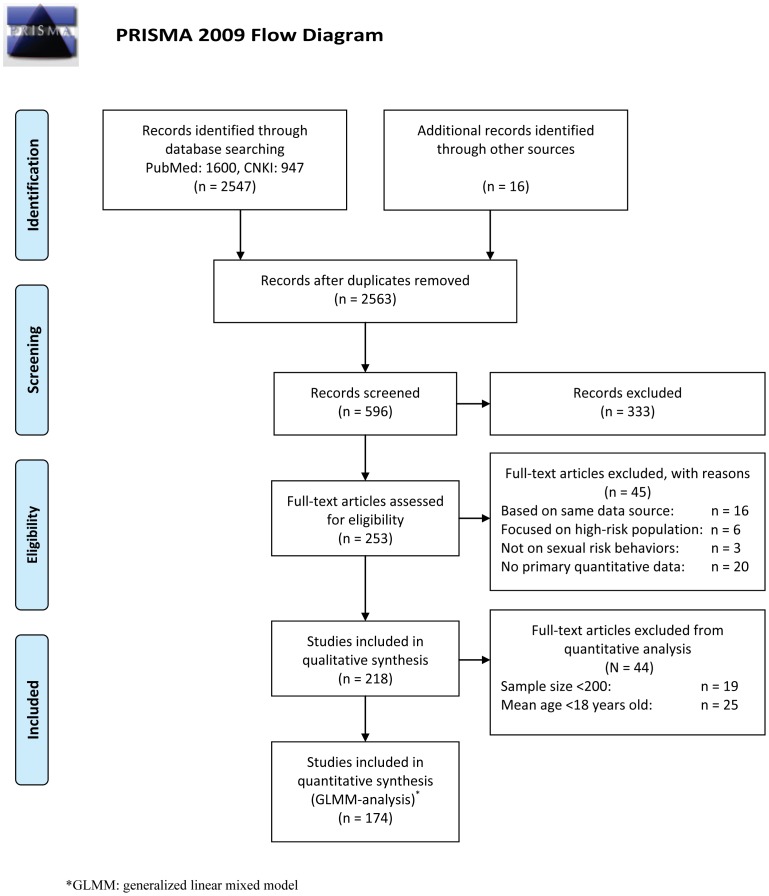
Methods: We systematically searched the English and Chinese literature on sexual risk behaviors published between January 1980 and March 2012 in PubMed and the China National Knowledge Infrastructure (CNKI). We included observational studies that focused on population groups other than commercial sex workers (CSWs) and their clients, and men who have sex with men (MSM) and quantitatively reported one of the following indicators of recent high-risk sexual behavior: premarital sex, commercial sex, multiple sex partners, condom use or sexually transmitted infections (STIs). We used generalized linear mixed model to examine the time trend in engaging in high-risk sexual behaviors.
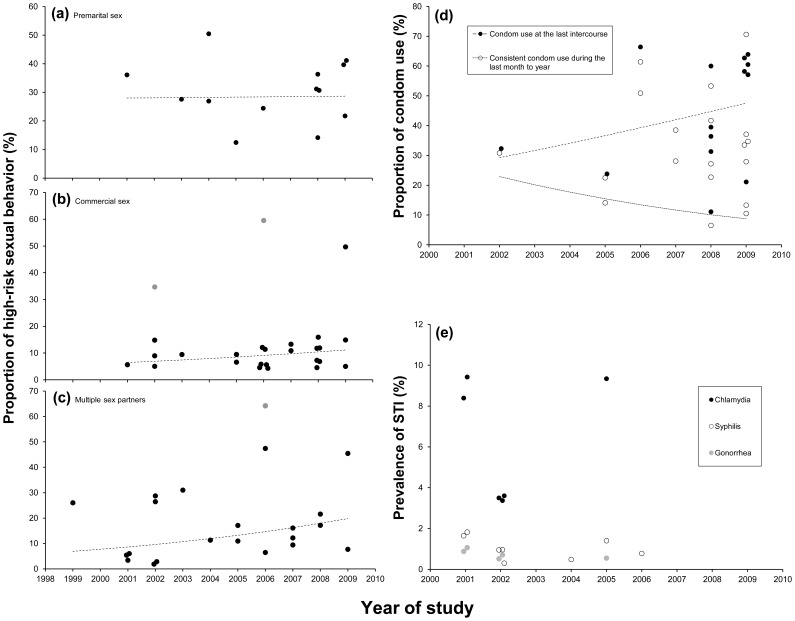
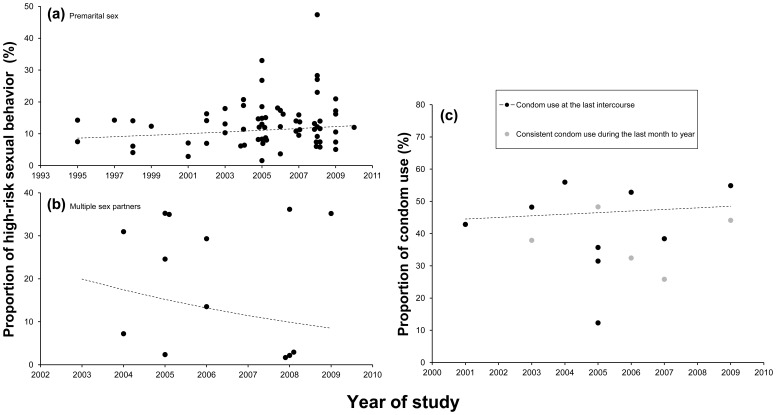
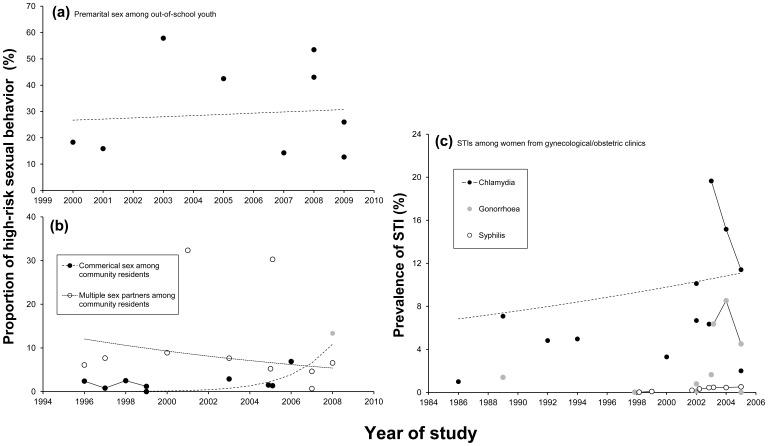
Results: We included 174 observational studies involving 932,931 participants: 55 studies reported on floating populations, 73 on college students and 46 on other groups (i.e. out-of-school youth, rural residents, and subjects from gynecological or obstetric clinics and premarital check-up centers). From the generalized linear mixed model, no significant trends in engaging in high-risk sexual behaviors were identified in the three population groups.
Discussion: Sexual risk behaviors among certain general population groups have not increased substantially. These groups are therefore unlikely to incite a STI/HIV epidemic among the general Chinese population. Because the studied population groups are not necessarily representative of the general population, the outcomes found may not reflect those of the general population.
Conflict of interest statement
Figures
References
-
- Cohen MS, Ping G, Fox K, Henderson GE (2000) Sexually transmitted diseases in the People's Republic of China in Y2K: back to the future. Sex Transm Dis 27: 143–145. - PubMed
-
- NHFPC (2013) China Health Statistics Yearbook 2012. National Health and Family Planning Commission of the People's Republic of China.
-
- Wang Q, Yang P, Gong X, He L (2009) Syphilis prevalence and high risk behaviors among female sex workers in different settings. Chinese Journal of AIDS and STD 15: 398–401.
-
- Hong Y, Li X (2008) Behavioral studies of female sex workers in China: a literature review and recommendation for future research. AIDS Behav 12: 623–636. - PubMed
Publication types
MeSH terms
LinkOut - more resources
Full Text Sources
Other Literature Sources
