


Ordinal-level phylogenomics of the arthropod class Diplopoda (millipedes) based on an analysis of 221 nuclear protein-coding loci generated using next-generation sequence analyses
- PMID: 24236165
- PMCID: PMC3827447
- DOI: 10.1371/journal.pone.0079935
Ordinal-level phylogenomics of the arthropod class Diplopoda (millipedes) based on an analysis of 221 nuclear protein-coding loci generated using next-generation sequence analyses
Abstract
Background: The ancient and diverse, yet understudied arthropod class Diplopoda, the millipedes, has a muddled taxonomic history. Despite having a cosmopolitan distribution and a number of unique and interesting characteristics, the group has received relatively little attention; interest in millipede systematics is low compared to taxa of comparable diversity. The existing classification of the group comprises 16 orders. Past attempts to reconstruct millipede phylogenies have suffered from a paucity of characters and included too few taxa to confidently resolve relationships and make formal nomenclatural changes. Herein, we reconstruct an ordinal-level phylogeny for the class Diplopoda using the largest character set ever assembled for the group.
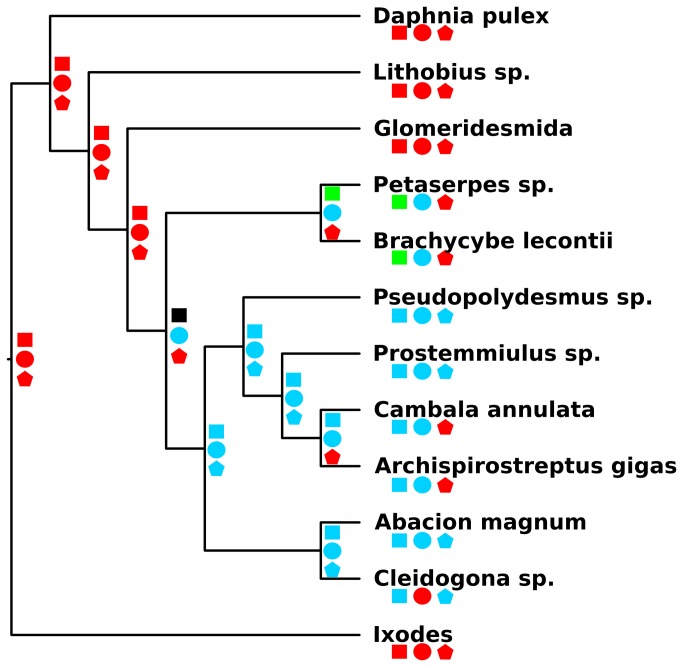
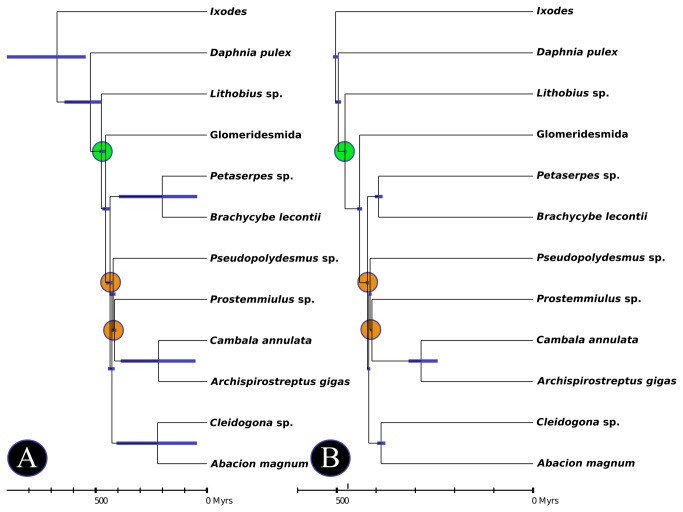
Methods: Transcriptomic sequences were obtained from exemplar taxa representing much of the diversity of millipede orders using second-generation (i.e., next-generation or high-throughput) sequencing. These data were subject to rigorous orthology selection and phylogenetic dataset optimization and then used to reconstruct phylogenies employing Bayesian inference and maximum likelihood optimality criteria. Ancestral reconstructions of sperm transfer appendage development (gonopods), presence of lateral defense secretion pores (ozopores), and presence of spinnerets were considered. The timings of major millipede lineage divergence points were estimated.
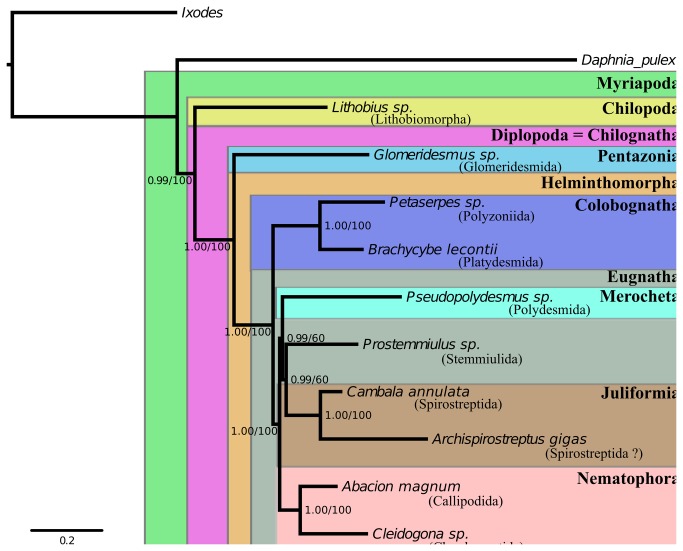
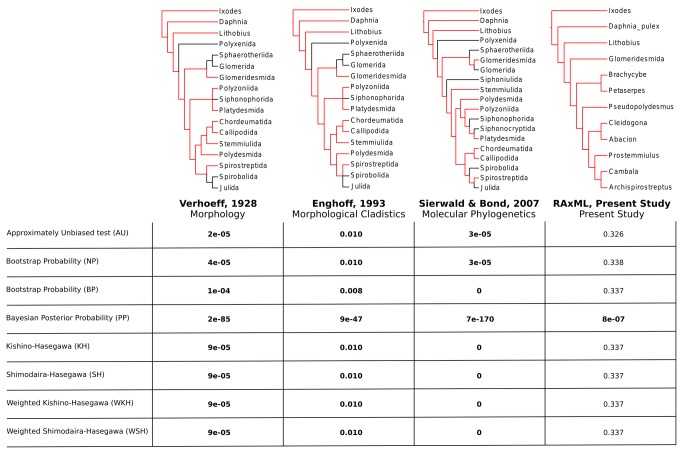
Results: The resulting phylogeny differed from the existing classifications in a number of fundamental ways. Our phylogeny includes a grouping that has never been described (Juliformia+Merocheta+Stemmiulida), and the ancestral reconstructions suggest caution with respect to using spinnerets as a unifying characteristic for the Nematophora. Our results are shown to have significantly stronger support than previous hypotheses given our data. Our efforts represent the first step toward obtaining a well-supported and robust phylogeny of the Diplopoda that can be used to answer many questions concerning the evolution of this ancient and diverse animal group.
Conflict of interest statement
Figures
References
-
- Snyder BA, Boots B, Hendrix PF (2009) Competition between invasive earthworms (Amynthas corticis, Megascolecidae) and native North American millipedes (Pseudopolydesmus erasus, Polydesmidae): Effects on carbon cycling and soil structure. Soil Biol Biochem 41: 1442–1449. doi:10.1016/j.soilbio.2009.03.023. - DOI
-
- Shear W, Jones T, Miras H (2007) A possible phylogenetic signal in milliped chemical defenses: The polydesmidan milliped Leonardesmus injucundus Shelley & Shear secretes p-cresol and lacks a cyanogenic defense (Diplopoda, Polydesmida, Nearctodesmidae). Biochem Syst Ecol 35: 838–842. doi:10.1016/j.bse.2007.01.005. - DOI
-
- Shear WA, McPherson IS, Jones TH, Loria SF, Zigler KS (2010) Chemical defense of a troglobiont millipede, Tetracion jonesi Hoffman (Diplopoda, Callipodida, Abacionidae). International J of Myriapology 3: 153–158. doi:10.1163/187525410X12578602960588. - DOI
Publication types
MeSH terms
Substances
LinkOut - more resources
Full Text Sources
Other Literature Sources
Miscellaneous
