. 2013:2013:827517.
doi: 10.1155/2013/827517. Epub 2013 Oct 23.

Immunization with a neural-derived peptide protects the spinal cord from apoptosis after traumatic injury

Affiliations

Immunization with a neural-derived peptide protects the spinal cord from apoptosis after traumatic injury

Roxana Rodríguez-Barrera et al. Biomed Res Int. 2013.

Abstract

Apoptosis is one of the most destructive mechanisms that develop after spinal cord (SC) injury. Immunization with neural-derived peptides (INDPs) such as A91 has shown to reduce the deleterious proinflammatory response and the amount of harmful compounds produced after SC injury. With the notion that the aforementioned elements are apoptotic inducers, we hypothesized that INDPs would reduce apoptosis after SC injury. In order to test this assumption, adult rats were subjected to SC contusion and immunized either with A91 or phosphate buffered saline (PBS; control group). Seven days after injury, animals were euthanized to evaluate the number of apoptotic cells at the injury site. Apoptosis was evaluated using DAPI and TUNEL techniques; caspase-3 activity was also evaluated. To further elucidate the mechanisms through which A91 exerts this antiapoptotic effects we quantified tumor necrosis factor-alpha (TNF-α). To also demonstrate that the decrease in apoptotic cells correlated with a functional improvement, locomotor recovery was evaluated. Immunization with A91 significantly reduced the number of apoptotic cells and decreased caspase-3 activity and TNF-α concentration. Immunization with A91 also improved the functional recovery of injured rats. The present study shows the beneficial effect of INDPs on preventing apoptosis and provides more evidence on the neuroprotective mechanisms exerted by this strategy.


Figures
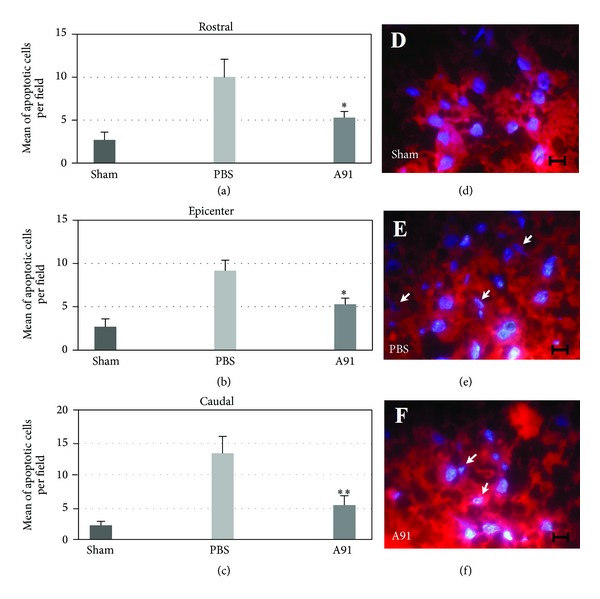
Figure 1
Figure 1
Number of apoptotic cells at the site of injury. Seven days after SC injury. (a) Rostral region 2 mm from injury epicenter. (b) Injury epicenter at T9 spinal cord level. (c) Caudal region 2 mm from injury epicenter. A91 immunization induced a significant reduction in apoptotic cells. *Different from PBS-immunized rats (P < 0.001; Student's t-test); **Different from PBS-immunized rats (P < 0.0001; Student's t-test). Bars represent the mean ± SD of 6 rats. DAPI stain micrograph depicting apoptosis as chromatin condensation and fragmentation of the injury epicenter at 7 days after SC injury. (d) Sham-operated animals had an average of 2.7 ± 1 apoptotic cells at the injury site. (e) Animals subjected to SC contusion and posterior immunization with PBS demonstrated an average of 9.17 ± 1.2 apoptotic cells at the epicenter. (f) The experimental group consisting of A91 immunization had 5.3 ± 0.7 apoptotic cells per field. Arrows depict examples of cells undergoing apoptosis identified by chromatin fragmentation, condensation, and appearance of apoptotic bodies seen as small DAPI-stained clusters within the nucleus or extruded from the cell within cytoplasm blebs. Scale bar = 10 μm.
Figure 2
Figure 2
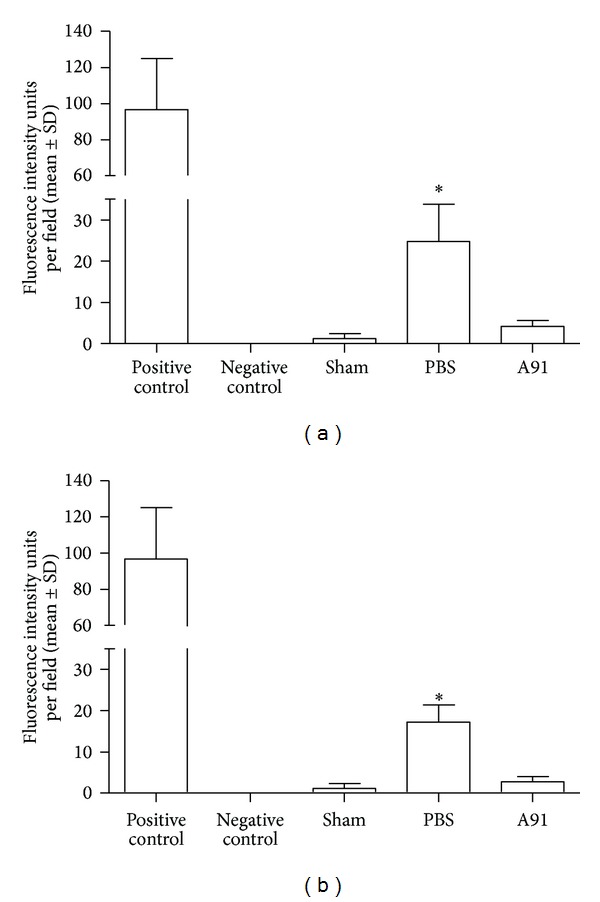
Reduction of apoptosis by A91 immunization as revealed by TUNEL assay in the injury site. Seven days after SC injury. (a) Rostral region 2 mm from injury epicenter. *Different from A91-immunized rats (P = 0.04; Mann-Whitney U test). (b) Caudal region 2 mm from injury epicenter. *Different from A91-immunized rats (P = 0.004; Mann-Whitney U test). A91 immunization induced a significant reduction in apoptosis. Bars represent the mean ± SD of 4 rats.
Figure 3
Figure 3
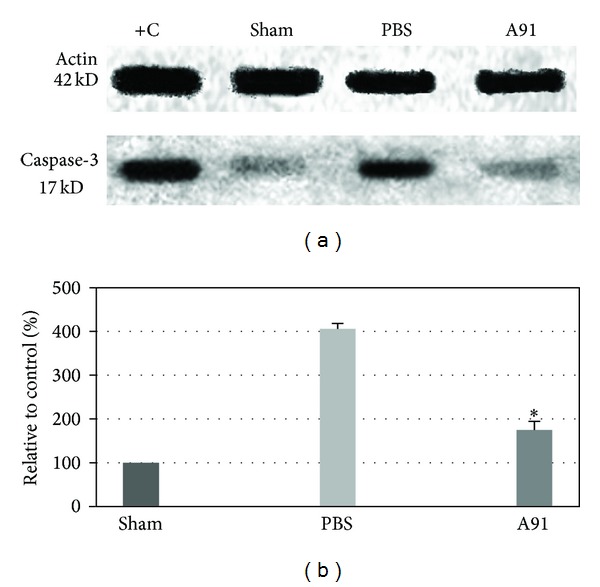
Activity of caspase-3 seven days after SC injury and PBS or A91 immunization. (a) Representative Western blots of caspase-3 expression. (b) Expression levels of caspase-3 after densitometric analysis. A91 immunization reduced the activity of caspase-3. *Different from PBS-immunized rats (P < 0.05; Student's t-test). Bars represent the mean ± SD of 6 rats. This is one of three independent Western blot assays performed in the 6 rats of each group, where we observed the same effect. Jurkat cells were used as a positive control (C+).
Figure 4
Figure 4
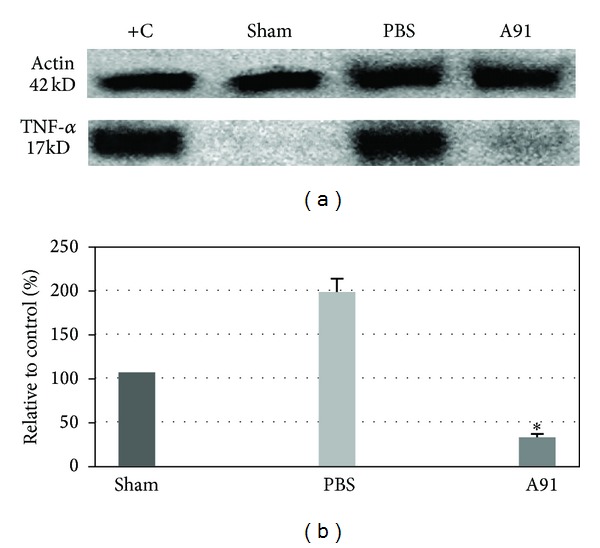
Expression of TNF-α seven days after SC injury and PBS or A91 immunization. (a) Representative Western blots of TNF-α expression. (b) Expression levels of TNF-α after densitometric analysis. A91 immunization reduced the expression of TNF-α. *Different from PBS-immunized rats (P < 0.001; Student's t-test). Bars represent the mean ± SD of 6 rats. This experiment is one of three in which we observed the same effect. L929 cells were used as a positive control (C+).
Figure 5
Figure 5
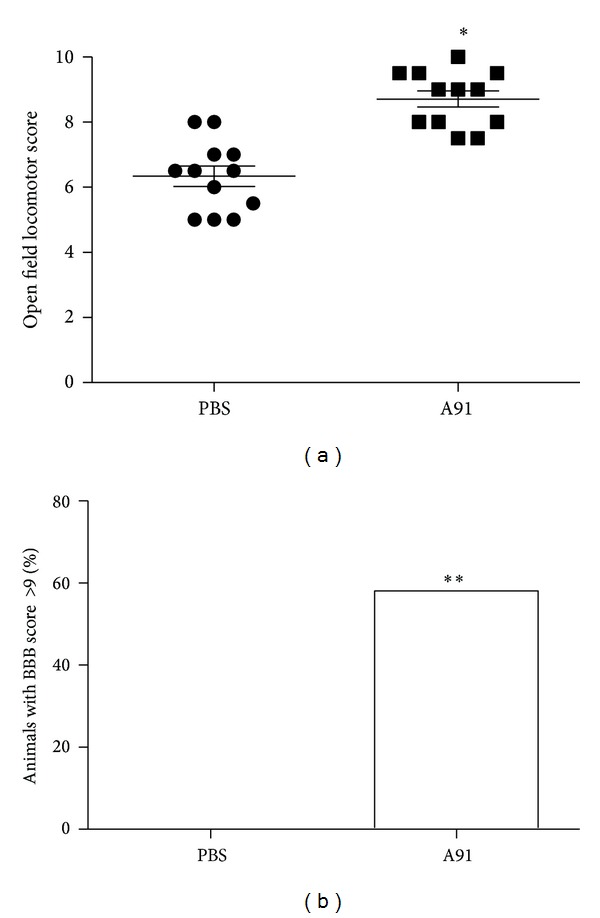
Motor recovery of rats subjected to a spinal cord contusion and immunized with A91 or PBS. Thirty days after SC injury, BBB scores showed a better improvement in rats receiving A91 immunization (a). *Different from PBS (P < 0.001; Student's t-test). Bars represent the mean ± SD of 12 rats. A significant percentage of animals attained BBB scores of 9 and 10 in A91-immunized rats (b). **Different from PBS group (P ≤ 0.05; Fisher exact probability test).

References

    1. Freire MA. Pathophysiology of neurodegeneration following traumatic brain injury. West Indian Medical Journal. 2012;61(7):751–755. - PubMed
    1. Rowland JW, Hawryluk GWJ, Kwon B, Fehlings MG. Current status of acute spinal cord injury pathophysiology and emerging therapies: promise on the horizon. Neurosurgical Focus. 2008;25(5, article E2) - PubMed
    1. Lou J, Lenke LG, Ludwig FJ, O’Brien MF. Apoptosis as a mechanism of neuronal cell death following acute experimental spinal cord injury. Spinal Cord. 1998;36(10):683–690. - PubMed
    1. Liu XZ, Xu XM, Hu R, et al. Neuronal and glial apoptosis after traumatic spinal cord injury. The Journal of Neuroscience. 1997;17(14):5395–5406. - PMC - PubMed
    1. Xu K, Chen Q-X, Li F-C, Chen W-S, Lin M, Wu Q-H. Spinal cord decompression reduces rat neural cell apoptosis secondary to spinal cord injury. Journal of Zhejiang University B. 2009;10(3):180–187. - PMC - PubMed

Publication types