


Early trajectory of psychiatric symptoms after traumatic brain injury: relationship to patient and injury characteristics
- PMID: 24237113
- PMCID: PMC3961785
- DOI: 10.1089/neu.2013.3041
Early trajectory of psychiatric symptoms after traumatic brain injury: relationship to patient and injury characteristics
Abstract
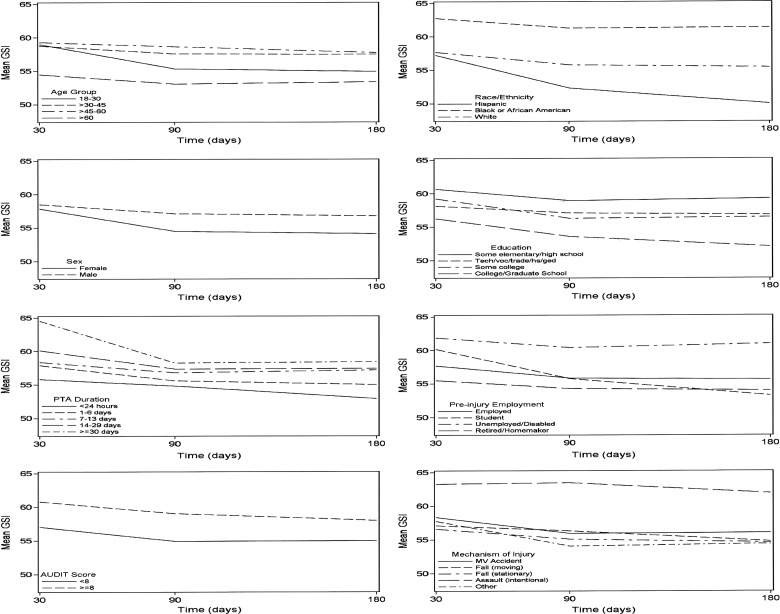
Psychiatric disturbance is common and disabling after traumatic brain injury (TBI). Few studies have investigated the trajectory of psychiatric symptoms in the first 6 months postinjury, when monitoring and early treatment might prevent persistent difficulties. The aim of this study was to examine the trajectory of psychiatric symptoms 1-6 months post-TBI, the patient/injury characteristics associated with changes, and characteristics predictive of persisting symptoms. A secondary analysis was performed on data from a clinical trial with three data collection points. Across eight centers, 872 participants with complicated mild to severe TBI were administered the Brief Symptom Inventory (BSI) at 30, 90, and 180 days postinjury. Mixed-effects models were used to assess longitudinal changes in the BSI Global Severity Index (GSI). Multi-variate logistic regression was used to assess predictors of clinically significant GSI elevations persisting to 6 months post-TBI. In general, GSI scores improved over time. Women improved faster than men; race/ethnicity was also significantly associated with rate of change, with Hispanics showing the most and African Americans the least improvement. Clinically significant psychiatric symptoms (caseness) occurred in 42% of the sample at 6 months, and more than one type of symptom was common. Significant predictors of caseness included African American race, age from 30 to 60 years, longer post-traumatic amnesia (PTA) duration, pre-TBI unemployment, and pre-TBI risky alcohol use. Findings indicate that psychiatric symptoms are common in the first 6 months post-TBI and frequently extend beyond the depression and anxiety symptoms that may be most commonly screened. Patients with longer PTA and preinjury alcohol misuse may need more intensive monitoring for symptom persistence.
Figures
References
-
- Whelan-Goodinson R., Ponsford J.L., Schonberger M., and Johnston L. (2010). Predictors of psychiatric disorders following traumatic brain injury. J. Head Trauma Rehabil. 25, 320–329 - PubMed
-
- Hart T., Brenner L., Clark A.N., Bogner J.A., Novack T.A., Chervoneva I., Nakase-Richardson R., and Arango-Lasprilla J.C. (2011). Major and minor depression after traumatic brain injury. Arch. Phys. Med. Rehabil. 92, 1211–1219 - PubMed
-
- Ashman T.A., Spielman L.A., Hibbard M.R., Silver J.M., Chandna T., and Gordon W.A. (2004). Psychiatric challenges in the first 6 years after traumatic brain injury: cross-sequential analyses of axis I disorders. Arch. Phys. Med. Rehabil. 85, 4 Suppl. 2, S36–S42 - PubMed
-
- Dikmen S., Machamer J., Fann J.R., and Temkin N.R. (2010). Rates of symptom reporting following traumatic brain injury. J. Int. Neuropsychol. Soc. 16, 401–411 - PubMed
Publication types
MeSH terms
Substances
Grants and funding
LinkOut - more resources
Full Text Sources
Other Literature Sources
