


Toward better drug repositioning: prioritizing and integrating existing methods into efficient pipelines
- PMID: 24239728
- PMCID: PMC4021005
- DOI: 10.1016/j.drudis.2013.11.005
Toward better drug repositioning: prioritizing and integrating existing methods into efficient pipelines
Abstract
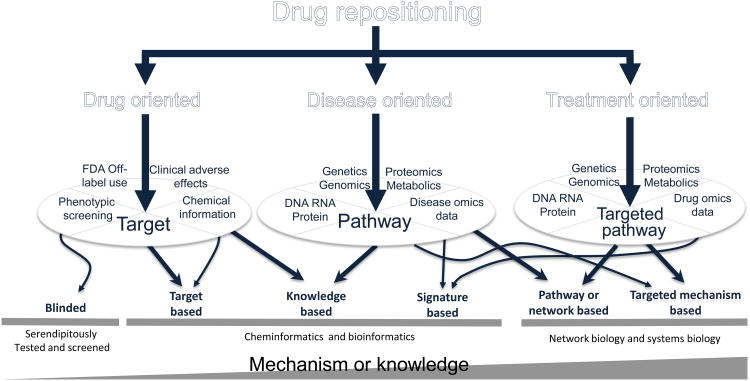
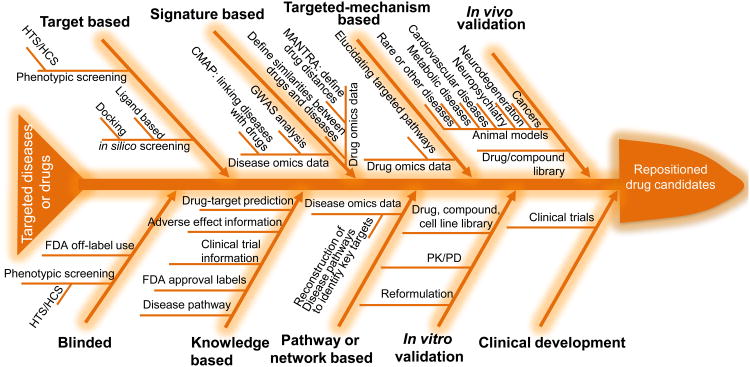
Recycling old drugs, rescuing shelved drugs and extending patents' lives make drug repositioning an attractive form of drug discovery. Drug repositioning accounts for approximately 30% of the newly US Food and Drug Administration (FDA)-approved drugs and vaccines in recent years. The prevalence of drug-repositioning studies has resulted in a variety of innovative computational methods for the identification of new opportunities for the use of old drugs. Questions often arise from customizing or optimizing these methods into efficient drug-repositioning pipelines for alternative applications. It requires a comprehensive understanding of the available methods gained by evaluating both biological and pharmaceutical knowledge and the elucidated mechanism-of-action of drugs. Here, we provide guidance for prioritizing and integrating drug-repositioning methods for specific drug-repositioning pipelines.
Copyright © 2013 Elsevier Ltd. All rights reserved.
Figures
References
-
- Ashburn TT, Thor KB. Drug repositioning: identifying and developing new uses for existing drugs. Nat Rev Drug Discov. 2004;3:673–683. - PubMed
-
- Novac N. Challenges and opportunities of drug repositioning. Trends Pharmacol Sci. 2013;34:267–272. - PubMed
-
- Pfister DG. Off-label use of oncology drugs: the need for more data and then some. J Clin Oncol. 2012;30:584–586. - PubMed
-
- Burstein HJ. Off-label use of oncology drugs: too much, too little, or just right? J Natl Compr Canc Netw. 2013;11:505–506. - PubMed
-
- Swinney DC, Anthony J. How were new medicines discovered? Nat Rev Drug Discov. 2011;10:507–519. - PubMed
Publication types
MeSH terms
Grants and funding
LinkOut - more resources
Full Text Sources
Other Literature Sources
