


doi: 10.1007/s11262-013-1008-x.
Epub 2013 Nov 16.
Alpha and lineage C betaCoV infections in Italian bats
Affiliations
- PMID: 24242847
- PMCID: PMC7089089
- DOI: 10.1007/s11262-013-1008-x
Item in Clipboard
Alpha and lineage C betaCoV infections in Italian bats
Virus Genes.
2014 Apr.
Abstract
AlphaCoV and lineage C betaCoV, genetically similar to those identified in Spanish related bat species, have been detected in Italian Myotis blithii and Eptesicus serotinus, respectively, out of 75 anal swabs collected from Vespertilionidae between 2009 and 2012. Sequence analysis of the 816-bp obtained RdRp sequence fragment indicates a 96.9 % amino acid identity of the Italian lineage C betaCoV with the recent Middle East Respiratory Syndrome Coronavirus (MERS-CoV, Genbank accession number KF192507). This is the first documented occurrence of a lineage C betaCoV in the Italian bat population, notably in E. serotinus.
Figures
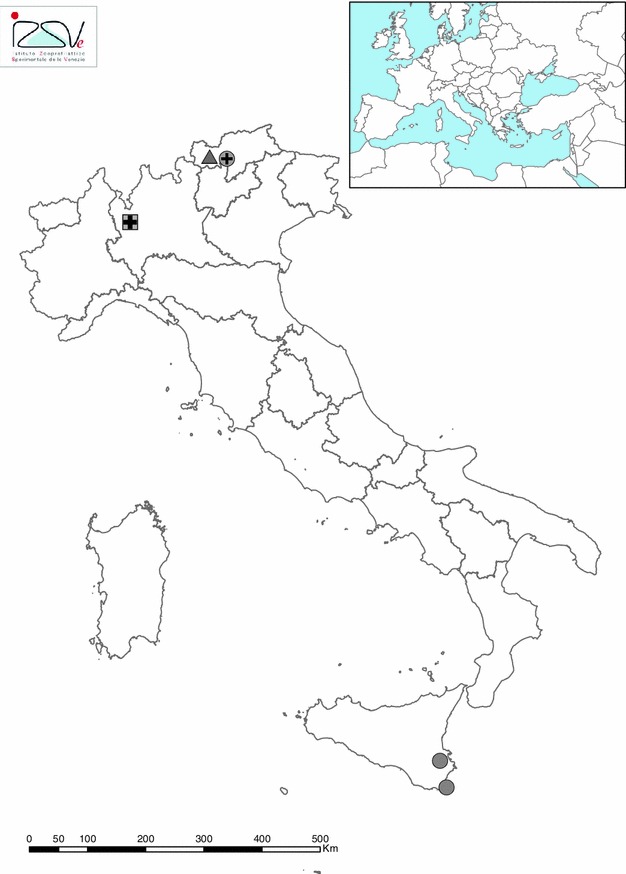
Geographical location of Vespertilionidae bat colonies surveyed in Italy for the occurrence of a CoV infection. 75 anal swabs were collected in 2009, 2011, and 2012. Colony sites are identified according to the bat species sampled (circle = mixed M. myotis and Myotis blythii; triangle = M. myotis; square = E. serotinus). Gray
daggers indicate colonies positive for the presence of CoV infection
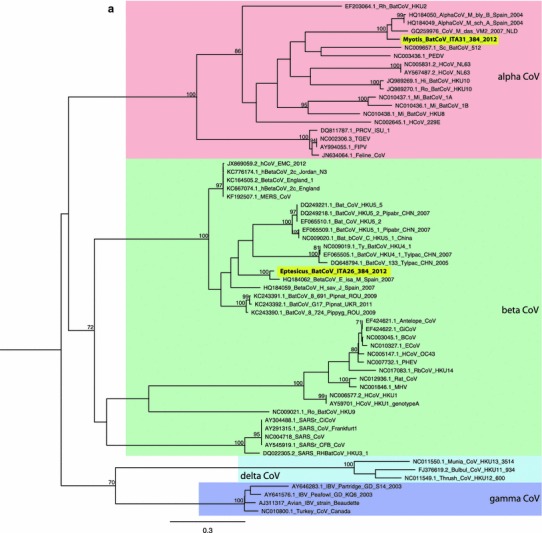
The Italian CoV sequences grouped with corresponding CoVs identified in Spanish bats. The lineage c betaCoV ITA26/384/2012, identified in E. serotinus, clustered with a sequence detected in Eptesicus isabellinus in Spain (GenBank accession number: HQ184062). The alphaCoV, ITA31/384/2012, identified in M. blithii, grouped with sequences identified in M. blithii and Miniopterus schreibersii in Spain and with one sequence collected from Myotis dasycneme in the Netherlands (GenBank accession number: HQ184050, HQ184049 and GQ259976, respectively). a Maximum likelihood (ML) tree estimated (using PhyML version 3.0) for the partial sequences codifying for the viral RNA dependent RNA polymerase. A bootstrap resampling process (100 replications) using the neighbor-joining (NJ) method was used to assess the robustness of individual nodes of the phylogeny. Bootstrap values are indicated as numbers at the nodes. b Comparison of the amino acid sequence of ITA26/384/2012 with the highest related sequences publicly available. c Comparison of the amino acid sequence of ITA31/384/2012 with the highest related sequences publicly available
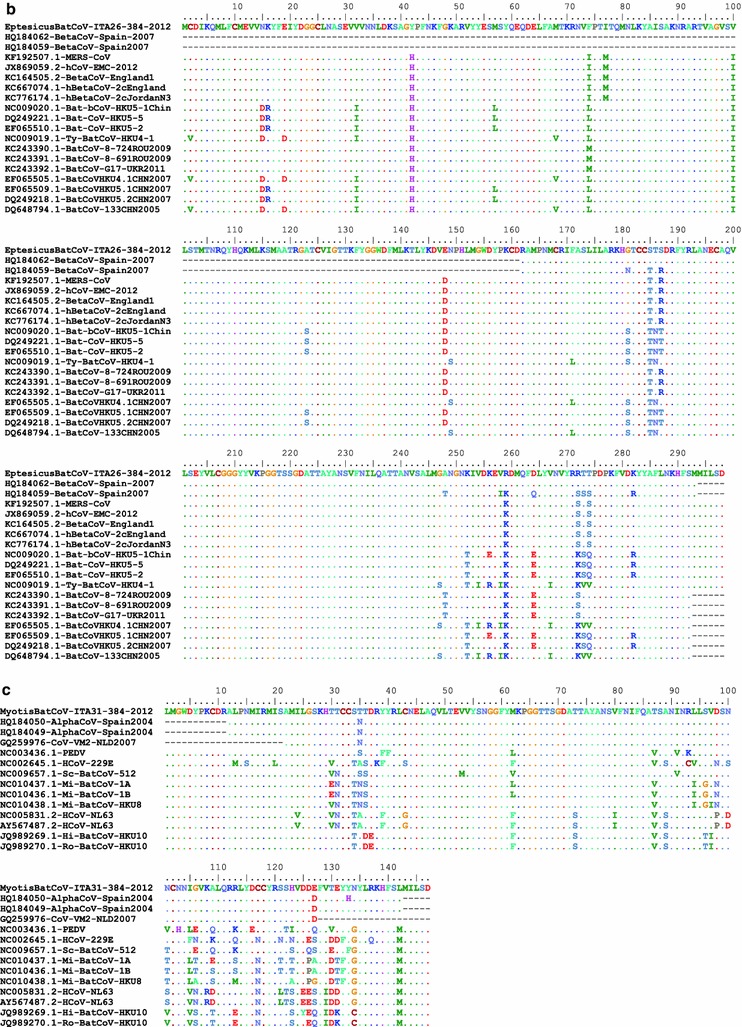
The Italian CoV sequences grouped with corresponding CoVs identified in Spanish bats. The lineage c betaCoV ITA26/384/2012, identified in E. serotinus, clustered with a sequence detected in Eptesicus isabellinus in Spain (GenBank accession number: HQ184062). The alphaCoV, ITA31/384/2012, identified in M. blithii, grouped with sequences identified in M. blithii and Miniopterus schreibersii in Spain and with one sequence collected from Myotis dasycneme in the Netherlands (GenBank accession number: HQ184050, HQ184049 and GQ259976, respectively). a Maximum likelihood (ML) tree estimated (using PhyML version 3.0) for the partial sequences codifying for the viral RNA dependent RNA polymerase. A bootstrap resampling process (100 replications) using the neighbor-joining (NJ) method was used to assess the robustness of individual nodes of the phylogeny. Bootstrap values are indicated as numbers at the nodes. b Comparison of the amino acid sequence of ITA26/384/2012 with the highest related sequences publicly available. c Comparison of the amino acid sequence of ITA31/384/2012 with the highest related sequences publicly available
References
-
- World Health Organization: Summary table of SARS cases by country (2003), http://www.who.int/csr/sars/country/country2003_08_15.pdf. Accessed 1 Nov 2002–7 Aug 2003
-
- Li W, Shi Z, Yu M, Ren W, Smith C, Epstein JH, Wang H, Crameri G, Hu Z, Zhang H, Zhang J, McEachern J, Field H, Daszak P, Eaton BT, Zhang S, Wang LF. Science. 2005;310:5748. - PubMed
MeSH terms
LinkOut - more resources
Full Text Sources
Other Literature Sources
Research Materials
