Review
. 2013 Dec;27(12):1984-95.
doi: 10.1210/me.2013-1278. Epub 2013 Nov 15.

Minireview: intraislet regulation of insulin secretion in humans

Affiliations
Review

Minireview: intraislet regulation of insulin secretion in humans

Guy A Rutter et al. Mol Endocrinol. 2013 Dec.

Abstract

The higher organization of β-cells into spheroid structures termed islets of Langerhans is critical for the proper regulation of insulin secretion. Thus, rodent β-cells form a functional syncytium that integrates and propagates information encoded by secretagogues, producing a "gain-of-function" in hormone release through the generation of coordinated cell-cell activity. By contrast, human islets possess divergent topology, and this may have repercussions for the cell-cell communication pathways that mediate the population dynamics underlying the intraislet regulation of insulin secretion. This is pertinent for type 2 diabetes mellitus pathogenesis, and its study in rodent models, because environmental and genetic factors may converge on these processes in a species-specific manner to precipitate the defective insulin secretion associated with glucose intolerance. The aim of the present minireview is therefore to discuss the structural and functional underpinnings that influence insulin secretion from human islets, and the possibility that dyscoordination between individual β-cells may play an important role in some forms of type 2 diabetes mellitus.


Figures
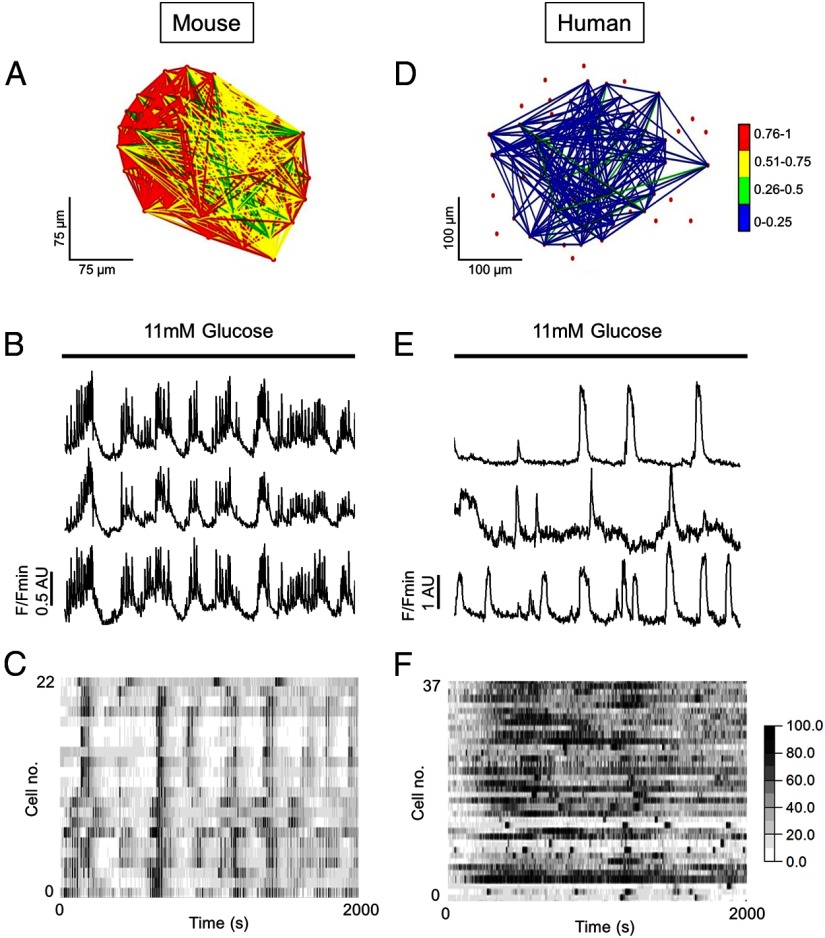
Figure 1.
Figure 1.
Glucose-stimulated β-cell dynamics in mouse vs human islets. Islets were loaded with the Ca2+-indicator fluo-2 for 30 minutes before being subjected to functional multicellular calcium imaging (fMCI) at the indicated glucose concentrations using a Nipkow spinning disk confocal (Zeiss M200 Axiovert coupled to a Yokogawa CSU10; λex = 491 nm; λex = 525 nm). Following image acquisition, glucose-responsive cells, here assumed to represent β-cells, were manually triaged before extraction of intensity over time traces. Correlations were determined by iterative pair-wise comparison of cell activity profiles using the Pearson R statistic, and a weighted functional connectivity (FC) map constructed on the basis of number, strength, and location (x-y) of correlated cell pairs within islets (see Refs. 21, 22, 57). Significance was calculated against the expected t-distribution of independent R-values assuming an equal sample size (P < .05). A, FC map showing the location and strength (color-coded; 0 [blue] = lowest, 1 [red] = highest) of correlated links between β-cells in an intact mouse islet during glucose stimulation. B, The network topology in panel A constitutes a functional syncytium that supports coordinated Ca2+-oscillations in response to elevated glucose. Representative traces from 3 individual 11 mM glucose-responsive cells are shown, here assumed to represent β-cells. C, A heat map showing signal intensity as a function of color depicts episodes of synchronous activity throughout the imaged population. D, As for panel A but β-cells within an intact human islet form a weakly correlated and poorly connected network. E, The human β-cell population responds to elevated glucose in a more stochastic manner (right panel) than their rodent counterpart. F, As for panel C. These data are previously unpublished. AU, arbitrary units.
Figure 2.
Figure 2.
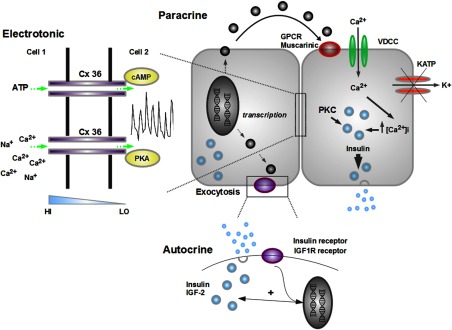
Schematic depicting cell-cell signaling modalities present within human islets. Chemical messengers act on the cell of origin (autocrine) or close neighbors (paracrine), and increase both insulin transcription and secretion. GJs composed of Cx36 provide electrotonic coupling between adjacent cells and also facilitate passage of small molecular weight molecules such as adenine nucleotides along their diffusion gradients (shown in blue). GJ transcription, phosphorylation status, and function can all be modulated by a range of intracellular signals including protein kinase A (PKA) and cAMP (figure adapted from Ref. 57). HI, high; KATP, ATP-sensitive K+ channel; LO, low; PKC, protein kinase C; VDCC, voltage-dependent calcium channel.
Figure 3.
Figure 3.
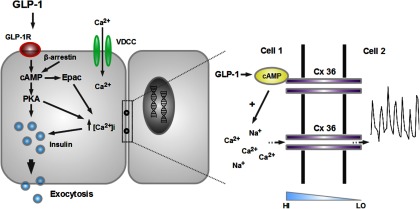
Incretins evoke coordinated activity in a subnetwork of human β-cells to influence insulin release. At permissive glucose concentrations, GLP-1 binding to the GLP-1R leads to stimulation of adenylate cyclase activity and generation of cAMP, as well as engagement of a β-arrestin scaffold. By interacting with downstream partners such as exchange protein activated by cAMP (Epac) and protein kinase A (PKA), GLP-1 potentiates insulin release via effects on Ca2+-influx and Ca2+-sensitivity of exocytosis. Coordinated intercellular transmission of GLP-1-derived signals is achieved by GJ coupling, and GLP-1 may modulate this in a state-dependent manner via its cAMP-raising effects (blue ramp; diffusion gradient) (figure adapted from Ref. 57). GLP-1R, GLP-1 receptor; HI, high; LO, low.

References

    1. International Diabetes Federation. IDF Diabetes Atlas, 5th ed Brussels, Belgium: International Diabetes Federation; 2011.
    1. Rutter GA. Nutrient-secretion coupling in the pancreatic islet β-cell: recent advances. Mol Aspects Med. 2001;22:247–284. - PubMed
    1. Meglasson MD, Matschinsky FM. Pancreatic islet glucose metabolism and regulation of insulin secretion. Diabetes Metab Rev. 1986;2:163–214. - PubMed
    1. Tarasov AI, Semplici F, Ravier MA, Bellomo EA, Pullen TJ, Gilon P, Sekler I, Rizzuto R, Rutter GA. The mitochondrial Ca2+ uniporter MCU is essential for glucose-induced ATP increases in pancreatic β-cells. PloS One. 2012;7:e39722. - PMC - PubMed
    1. Pullen TJ, Rutter GA. When less is more: the forbidden fruits of gene repression in the adult β-cell. Diabetes Obes Metab. 2013;15:503–512. - PubMed

Publication types

MeSH terms