


Dynamic scapular movement analysis: is it feasible and reliable in stroke patients during arm elevation?
- PMID: 24244414
- PMCID: PMC3823991
- DOI: 10.1371/journal.pone.0079046
Dynamic scapular movement analysis: is it feasible and reliable in stroke patients during arm elevation?
Abstract
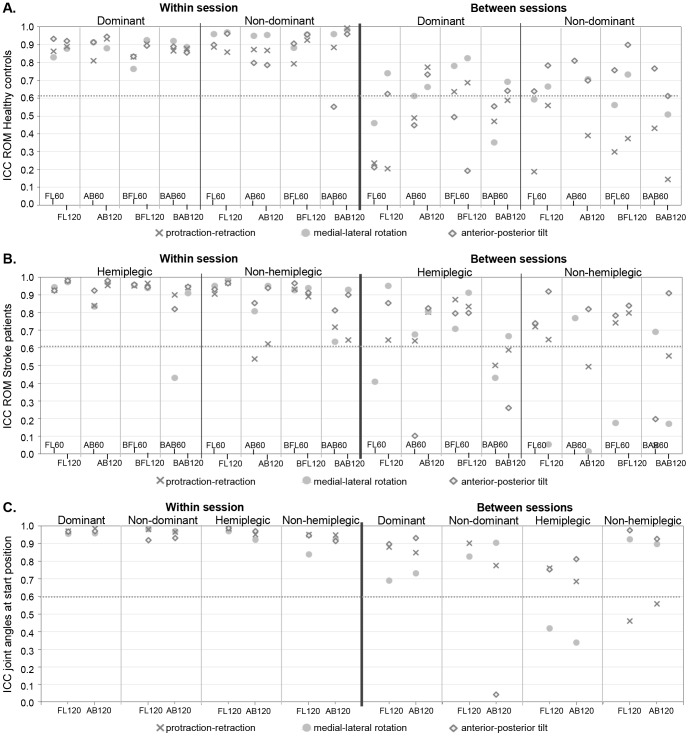
Knowledge of three-dimensional scapular movements is essential to understand post-stroke shoulder pain. The goal of the present work is to determine the feasibility and the within and between session reliability of a movement protocol for three-dimensional scapular movement analysis in stroke patients with mild to moderate impairment, using an optoelectronic measurement system. Scapular kinematics of 10 stroke patients and 10 healthy controls was recorded on two occasions during active anteflexion and abduction from 0° to 60° and from 0° to 120°. All tasks were executed unilaterally and bilaterally. The protocol's feasibility was first assessed, followed by within and between session reliability of scapular total range of motion (ROM), joint angles at start position and of angular waveforms. Additionally, measurement errors were calculated for all parameters. Results indicated that the protocol was generally feasible for this group of patients and assessors. Within session reliability was very good for all tasks. Between sessions, scapular angles at start position were measured reliably for most tasks, while scapular ROM was more reliable during the 120° tasks. In general, scapular angles showed higher reliability during anteflexion compared to abduction, especially for protraction. Scapular lateral rotations resulted in smallest measurement errors. This study indicates that scapular kinematics can be measured reliably and with precision within one measurement session. In case of multiple test sessions, further methodological optimization is required for this protocol to be suitable for clinical decision-making and evaluation of treatment efficacy.
Conflict of interest statement
Figures

References
-
- Lindgren I, Jönsson AC, Norrving B, Lindgren A (2007) Shoulder pain after stroke: a prospective population-based study. Stroke 38: 343–348. - PubMed
-
- Dromerick AW, Edwards DF, Kumar A (2008) Hemiplegic shoulder pain syndrome: frequency and characteristics during inpatient stroke rehabilitation. Arch Phys Med Rehabil 89: 1589–1593. - PubMed
-
- Roy CW, Sands MR, Hill LD (1994) Shoulder pain in the acutely admitted hemiplegics. Clin Rehabil 18: 334–340.
-
- Kwakkel G, Kollen BJ, van der Grond J, Prevo AJH (2003) Probability of regaining dexterity in the flaccid upper limb: impact of severity of paresis and time since onset in acute stroke. Stroke 34: 2181–2186. - PubMed
-
- Chae J, Mascarenhas D, Yu DT, Kirsteins A, Elovic EP, et al. (2007) Poststroke shoulder pain: its relationship to motor impairment, activity limitation, and quality of life. Arch Phys Med Rehabil 88: 298–301. - PubMed
Publication types
MeSH terms
LinkOut - more resources
Full Text Sources
Other Literature Sources
Medical
