Review
. 2013 Oct;50(4):333-47.
doi: 10.1053/j.seminhematol.2013.09.002.

Genomic characterization of the inherited bone marrow failure syndromes

Affiliations
Review

Genomic characterization of the inherited bone marrow failure syndromes

Payal P Khincha et al. Semin Hematol. 2013 Oct.

Abstract

The inherited bone marrow failure syndromes (IBMFS) are a set of clinically related yet heterogeneous disorders in which at least one hematopoietic cell lineage is significantly reduced. Many of the IBMFS have notably increased cancer risks, as well as other physical findings. Highly penetrant germline mutations in key pathways, such as DNA repair, telomere biology, or ribosomal biogenesis, are causative of Fanconi anemia (FA), dyskeratosis congenita (DC), and Diamond-Blackfan anemia (DBA), respectively. Next-generation sequencing (NGS) generally refers to high-throughput, large-scale sequencing technologies and is being used more frequently to understand disease etiology. In the IBMFS, NGS has facilitated the discovery of germline mutations that cause thrombocytopenia absent radii syndrome (TAR), a subset of DC and DBA, and other uncharacterized, but related, disorders. Panels of large numbers of genes are being used to molecularly characterize patients with IBMFS, such as FA and DBA. NGS is also accelerating the discovery of the genetic etiology of previously unclassified IBMFS. In this review, we will highlight recent studies that have employed NGS to ascertain the genetic etiology of IBMFS, namely, FA, DC, DBA, and TAR, and discuss the translational utility of these findings.


Figures

Figure 1
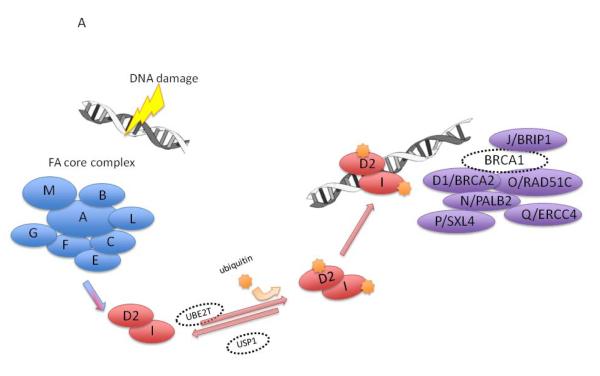
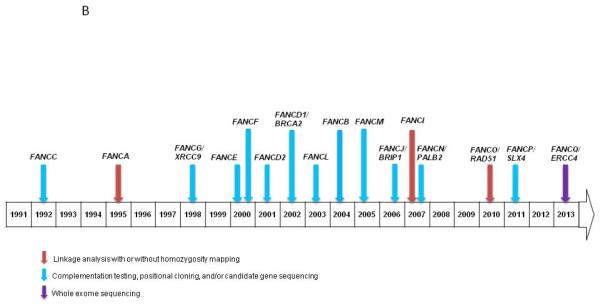
Figure 1. Fanconi anemia (FA) genetics and biologic pathway
A)FA/BRCA DNA damage response pathway. Following DNA damage, the proteins represented by A, B, C, E, F, G, L, and M form the core complex which is required for ubiquitination of the I and D2 proteins, which are in turn, required for the downstream complex of D2-ubi, I-ubi, and D1/BRCA1, N/PALB2, and J/BACH1/BRIP1 to form foci for DNA repair. Only BRCA1 is not yet known to be a FA gene. Adapted from Shimamura and Alter Blood Reviews 2010;24(3):101-22 B) Approximate timeline and methods of gene discovery in FA
Figure 1
Figure 1. Fanconi anemia (FA) genetics and biologic pathway
A)FA/BRCA DNA damage response pathway. Following DNA damage, the proteins represented by A, B, C, E, F, G, L, and M form the core complex which is required for ubiquitination of the I and D2 proteins, which are in turn, required for the downstream complex of D2-ubi, I-ubi, and D1/BRCA1, N/PALB2, and J/BACH1/BRIP1 to form foci for DNA repair. Only BRCA1 is not yet known to be a FA gene. Adapted from Shimamura and Alter Blood Reviews 2010;24(3):101-22 B) Approximate timeline and methods of gene discovery in FA
Figure 2
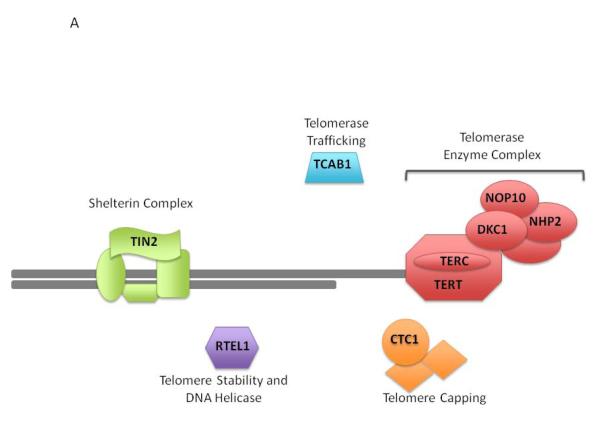
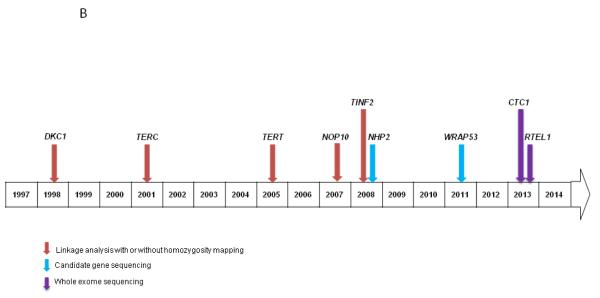
Figure 2. Dyskeratosis Congenita genetics and biologic pathway
A) Schematic of the telomere and functions of the proteins affected in dyskeratosis congenita and the related telomere biology disorders. Protein names are shown. Abbreviations: TCAB1, telomere Cajal body associated protein 1 (gene name: WRAP53); TIN2, TRF1-interacting nuclear factor 2 (TINF2); NOP10, NOP10 ribonucleoprotein (NOP10); NHP2, NHP2 ribonucleoprotein (NHP2); DKC1, dyskerin (DKC1); TERC, telomerase RNA component (TERC); TERT, telomerase (TERT); RTEL1, regulator of telomere elongation helicase 1 (RTEL1); CTC1, CTS telomere maintenance complex component 1 (CTC1) B) Approximate timeline and methods of gene discovery in DC
Figure 2
Figure 2. Dyskeratosis Congenita genetics and biologic pathway
A) Schematic of the telomere and functions of the proteins affected in dyskeratosis congenita and the related telomere biology disorders. Protein names are shown. Abbreviations: TCAB1, telomere Cajal body associated protein 1 (gene name: WRAP53); TIN2, TRF1-interacting nuclear factor 2 (TINF2); NOP10, NOP10 ribonucleoprotein (NOP10); NHP2, NHP2 ribonucleoprotein (NHP2); DKC1, dyskerin (DKC1); TERC, telomerase RNA component (TERC); TERT, telomerase (TERT); RTEL1, regulator of telomere elongation helicase 1 (RTEL1); CTC1, CTS telomere maintenance complex component 1 (CTC1) B) Approximate timeline and methods of gene discovery in DC
Figure 3
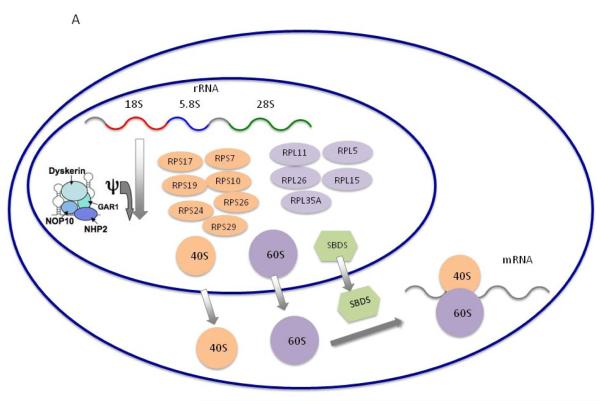
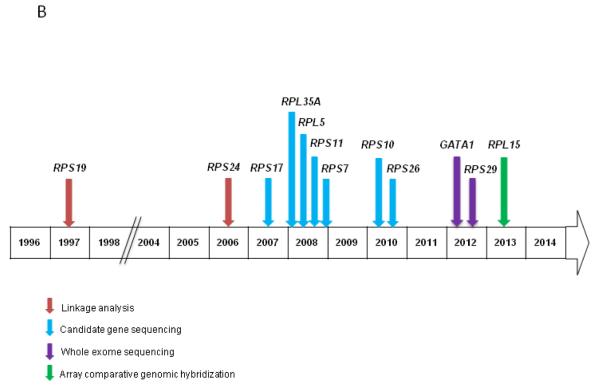
Figure 3. Schematic of the ribosomal biogenesis pathway associated with DBA
A) Ribosomes consist of a small 40S subunit and a large 60S subunit and catalyze protein synthesis. Small and large subunits are composed of four RNA species and approximately 80 structurally distinct proteins. The DBA-associated proteins are in both the small 40S and large 60S ribosomal subunit. They are encoded by RPS19, RPS24, RPS1, RPS15, RPS27A, RPS10, RPS29 and RPS26 which belong to the small ribosomal subunit, and by RPL5, RPL11, RPL35A, RPL15 and RPL36 which are components of the large ribosomal subunit. The DKC1 gene encodes the dyskerin protein, which has been implicated in ribosomal RNA pseudouridylation (Φ). The SBDS protein appears to be involved in the joining of the 40S and 60S ribosomal subunits to form the mature 80S ribosome. AR mutations in SBDS, a key component of ribosomal assembly cause Shwachman-Diamond syndrome (SDS), a disorder of neutropenia and exocrine pancreatic insufficiency. SDS is not discussed herein because NGS studies have not been published in this disorder. Adapted from Shimamura and Alter Blood Reviews 2010;24(3):101-22 B) Approximate timeline and methods of gene discovery in DBA
Figure 3
Figure 3. Schematic of the ribosomal biogenesis pathway associated with DBA
A) Ribosomes consist of a small 40S subunit and a large 60S subunit and catalyze protein synthesis. Small and large subunits are composed of four RNA species and approximately 80 structurally distinct proteins. The DBA-associated proteins are in both the small 40S and large 60S ribosomal subunit. They are encoded by RPS19, RPS24, RPS1, RPS15, RPS27A, RPS10, RPS29 and RPS26 which belong to the small ribosomal subunit, and by RPL5, RPL11, RPL35A, RPL15 and RPL36 which are components of the large ribosomal subunit. The DKC1 gene encodes the dyskerin protein, which has been implicated in ribosomal RNA pseudouridylation (Φ). The SBDS protein appears to be involved in the joining of the 40S and 60S ribosomal subunits to form the mature 80S ribosome. AR mutations in SBDS, a key component of ribosomal assembly cause Shwachman-Diamond syndrome (SDS), a disorder of neutropenia and exocrine pancreatic insufficiency. SDS is not discussed herein because NGS studies have not been published in this disorder. Adapted from Shimamura and Alter Blood Reviews 2010;24(3):101-22 B) Approximate timeline and methods of gene discovery in DBA

References

    1. Shimamura A, Alter BP. Pathophysiology and management of inherited bone marrow failure syndromes. Blood Rev. 2010;24:101–22. - PMC - PubMed
    1. Alter BP, Kupfer G. Fanconi Anemia. In: Pagon RA, Adam MP, Bird TD, Dolan CR, Fong CT, Stephens K, editors. GeneReviews. University of Washington, Seattle; Seattle (WA): 1993. Updated 2013 Feb 7.
    1. Clinton C, Gazda HT. Diamond-Blackfan Anemia. In: Pagon RA, Adam MP, Bird TD, Dolan CR, Fong CT, Stephens K, editors. GeneReviews. University of Washington, Seattle; Seattle (WA): 1993.
    1. Gullapalli RR, Lyons-Weiler M, Petrosko P, Dhir R, Becich MJ, LaFramboise WA. Clinical integration of next-generation sequencing technology. Clinl Lab Med. 2012;32:585–99. - PMC - PubMed
    1. H C. Rare Genetic Disorders: Learning About Genetic Disease Through Gene Mapping, SNPs, and Microarray Data. Nature Education. 2008;1(1)

Publication types

MeSH terms

Supplementary concepts