Randomized Controlled Trial
. 2013 Dec;120(12):2419-2427.
doi: 10.1016/j.ophtha.2013.08.026.

The effect of donor age on penetrating keratoplasty for endothelial disease: graft survival after 10 years in the Cornea Donor Study

Affiliations
Randomized Controlled Trial

The effect of donor age on penetrating keratoplasty for endothelial disease: graft survival after 10 years in the Cornea Donor Study

Writing Committee for the Cornea Donor Study Research Group et al. Ophthalmology. 2013 Dec.

Abstract

Objective: To determine whether the 10-year success rate of penetrating keratoplasty for corneal endothelial disorders is associated with donor age.

Design: Multicenter, prospective, double-masked clinical trial.

Participants: A total of 1090 participants undergoing penetrating keratoplasty at 80 sites for Fuchs' dystrophy (62%), pseudophakic/aphakic corneal edema (34%), or another corneal endothelial disorder (4%) and followed for up to 12 years.

Methods: Forty-three eye banks provided corneas from donors aged 12 to 75 years, using a randomized approach to assign donor corneas to study participants without respect to recipient factors. Surgery and postoperative care were performed according to the surgeons' usual routines.

Main outcome measures: Graft failure defined as a regraft or, in the absence of a regraft, a cloudy cornea that was sufficiently opaque to compromise vision for 3 consecutive months.

Results: In the primary analysis, the 10-year success rate was 77% for 707 corneas from donors aged 12 to 65 years compared with 71% for 383 donors aged 66 to 75 years (difference, +6%; 95% confidence interval, -1 to +12; P = 0.11). When analyzed as a continuous variable, higher donor age was associated with lower graft success beyond the first 5 years (P<0.001). Exploring this association further, we observed that the 10-year success rate was relatively constant for donors aged 34 to 71 years (75%). The success rate was higher for 80 donors aged 12 to 33 years (96%) and lower for 130 donors aged 72 to 75 years (62%). The relative decrease in the success rate with donor ages 72 to 75 years was not observed until after year 6.

Conclusions: Although the primary analysis did not show a significant difference in 10-year success rates comparing donor ages 12 to 65 years and 66 to 75 years, there was evidence of a donor age effect at the extremes of the age range. Because we observed a fairly constant 10-year success rate for donors aged 34 to 71 years, which account for approximately 75% of corneas in the United States available for transplant, the Cornea Donor Study results indicate that donor age is not an important factor in most penetrating keratoplasties for endothelial disease.


Conflict of interest statement

Conflict of Interest: Edward J. Holland, MD is employed by the Cincinnati Eye Bank, and serves as a consultant and receives lecture fees from Bausch & Lomb. Irving M. Raber, MD receives lecture fees from Bausch & Lomb. Robert L. Schultze, MD is employed by Sight Society of Northeastern New York and receives lecture fees from Bausch & Lomb. Monty M. Montoya, MBA is employed by SightLife. Jeffrey G. Penta, MBA is employed by San Diego Eye Bank.

Figures

Figure 1
Figure 1
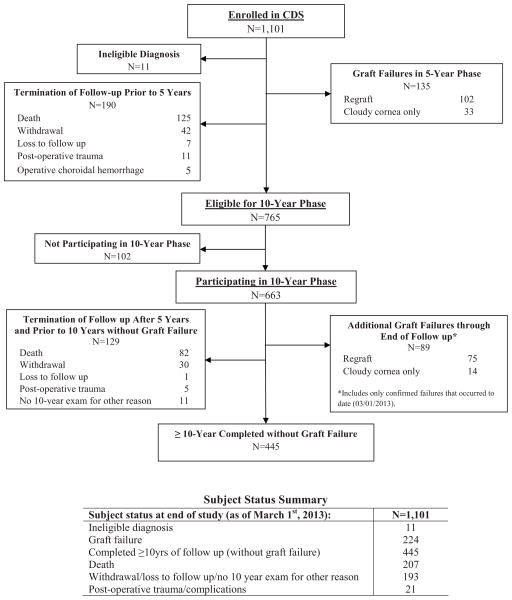
Flow-diagram of Subject Participation and Outcome Status for 5- and 10-Year Phases of the Cornea Donor Study (CDS)
Figure 2
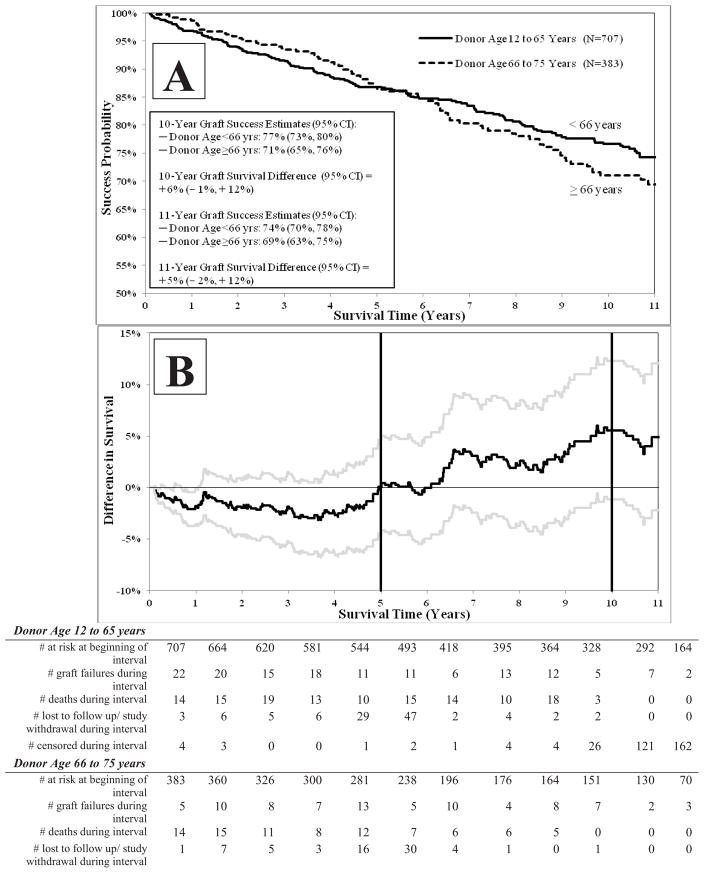
Figure 2. Graft Success in Main Donor Age Groups over Time
In panel A, Kaplan-Meier cumulative probabilities of graft survival are shown for the 12 to 65 and 66 to 75 donor age groups. With a log-rank test, the p value comparing the two donor age groups was 0.26. In panel B, the difference in survival probabilities between the 2 donor age groups are shown, with the middle (solid) curve showing the estimated survival difference and the lighter gray curves denoting the lower and upper bounds of the pointwise 95% confidence interval. A positive difference denotes better graft survival with the younger donor age group and vice versa. At 10-years, the difference in survival probabilities between the 2 donor age groups was +6% (95% confidence interval=−1% to +12%). The table beneath panel B presents the number of subjects at risk in the beginning of each year along with the number of graft failures, deaths, lost to follow up and censored subjects during the year. CI = confidence interval.
Figure 2
Figure 2. Graft Success in Main Donor Age Groups over Time
In panel A, Kaplan-Meier cumulative probabilities of graft survival are shown for the 12 to 65 and 66 to 75 donor age groups. With a log-rank test, the p value comparing the two donor age groups was 0.26. In panel B, the difference in survival probabilities between the 2 donor age groups are shown, with the middle (solid) curve showing the estimated survival difference and the lighter gray curves denoting the lower and upper bounds of the pointwise 95% confidence interval. A positive difference denotes better graft survival with the younger donor age group and vice versa. At 10-years, the difference in survival probabilities between the 2 donor age groups was +6% (95% confidence interval=−1% to +12%). The table beneath panel B presents the number of subjects at risk in the beginning of each year along with the number of graft failures, deaths, lost to follow up and censored subjects during the year. CI = confidence interval.
Figure 4
Figure 4. Graft Success by 4 Donor Age Groups over Time
In panel A, Kaplan-Meier cumulative probabilities of graft survival are shown for 4 donor age groupings. With a log-rank test, the p value comparing the four donor age groups was <0.001. In panel B, the difference in survival probabilities between eyes receiving a cornea from a donor 12 to 33 years old (N=80) and from a donor 34 to 71 year old (N=880) are shown, with the middle (solid) curve showing the estimated survival difference and the lighter gray curves denoting the lower and upper bounds of the pointwise 95% confidence interval. A positive difference denotes better graft survival with the younger donor age grouping and vice versa. At 10 years, the difference was +22% (95% confidence interval=+16% to +27%). In panel C, the difference in survival probabilities between the eyes receiving a cornea from a donor 34 to 71 years old (N=880) and from 72 to 75 years old (N=130) are shown, with the middle (solid) curve showing the estimated survival difference and the lighter gray curves denoting the lower and upper bounds of the pointwise 95% confidence interval. A positive difference denotes better graft survival with the younger donor age grouping and vice versa. At 10 years, the difference was +12% (95% confidence interval=+1% to +23%). The table under panel C presents the number of subjects at risk in the beginning of each interval. CI = confidence interval.

References

    1. Eye Bank Association of America. [Accessed July 26, 2013];Eye Banking Statistical Report. 2012 :65–76. Available at: http://www.restoresight.org/wp-content/uploads/2013/04/2012_Statistical_....
    1. Jones GL, Dekaris I, Hjortdal J, Pels E. European Eye Bank Association: past, present, and future. [Accessed July 26, 2013];Int J Eye Bank. 2012 1(1) serial online. Available at: http://www.eyebankingjournal.org/index.php/ebj/article/view/26.
    1. Van Meter WS, Sheth PH. Potential adverse effects on the cornea donor pool in 2031. [Accessed July 26, 2013];Int J Eye Bank [serial online] 2013 1(2) Available at: http://www.eyebankingjournal.org/index.php/ebj/article/view/28.
    1. Beck RW, Gal RL, Mannis MJ, et al. Is donor age an important determinant of graft survival? Cornea. 1999;18:503–10. - PubMed
    1. Cornea Donor Study Investigator Group. The effect of donor age on corneal transplantation outcome: results of the Cornea Donor Study. Ophthalmology. 2008;115:620–6. - PMC - PubMed

Publication types

MeSH terms