


A rapid gene-based genome-wide association test with multivariate traits
- PMID: 24247328
- PMCID: PMC4228787
- DOI: 10.1159/000356016
A rapid gene-based genome-wide association test with multivariate traits
Abstract
Objectives: A gene-based genome-wide association study (GWAS) provides a powerful alternative to the traditional single single nucleotide polymorphism (SNP) association analysis due to its substantial reduction in the multiple testing burden and possible gain in power due to modeling multiple SNPs within a gene. A gene-based association analysis on multivariate traits is often of interest, but it imposes substantial analytical as well as computational challenges to implement it at a genome-wide level.
Methods: We propose a rapid implementation of the multivariate multiple linear regression (RMMLR) approach in unrelated individuals as well as in families. Our approach allows for covariates. Moreover, the asymptotic distribution of the test statistic is not heavily influenced by the linkage disequilibrium (LD) among the SNPs and hence can be used efficiently to perform a gene-based GWAS. We have developed a corresponding R package to implement such multivariate gene-based GWAS with this RMMLR approach.
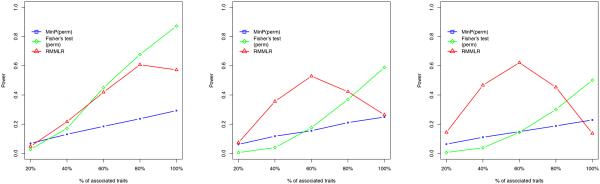
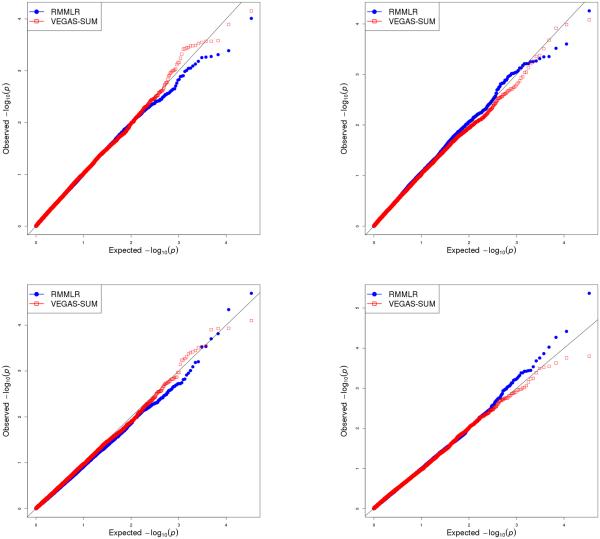
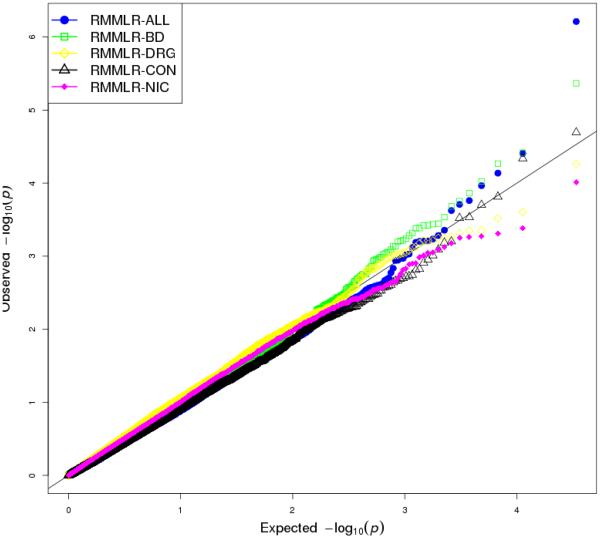
Results: Through extensive simulation, we compared several approaches for both single and multivariate traits. Our RMMLR approach maintained a correct type I error level even for sets of SNPs in strong LD. It also demonstrated a substantial gain in power to detect a gene when it is associated with a subset of the traits. We also studied performances of the approaches on the Minnesota Center for Twin Family Research dataset.
Conclusions: In our overall comparison, our RMMLR approach provides an efficient and powerful tool to perform a gene-based GWAS with single or multivariate traits and maintains the type I error appropriately.
© 2013 S. Karger AG, Basel.
Figures
References
-
- Ferreira MAR, Purcell SM. A multivariate test of association. Bioinformatics. 2009;25:132–133. - PubMed
-
- Golub GH, Van Loan CF. Matrix Computations. The Johns Hopkins University Press; Maryland, USA: 1996.
Publication types
MeSH terms
Grants and funding
LinkOut - more resources
Full Text Sources
Other Literature Sources
Medical
Research Materials
