


Catheter policies for management of long term voiding problems in adults with neurogenic bladder disorders
- PMID: 24249436
- PMCID: PMC11380759
- DOI: 10.1002/14651858.CD004375.pub4
Catheter policies for management of long term voiding problems in adults with neurogenic bladder disorders
Abstract
Background: Management of the neurogenic bladder has the primary objectives of maintaining continence, ensuring low bladder pressure (to avoid renal damage) and avoiding or minimising infection. Options include intermittent urethral catheterisation, indwelling urethral or suprapubic catheterisation, timed voiding, use of external catheter (for men), drug treatment, augmentation cystoplasty and urinary diversion.
Objectives: The primary objective was to determine the effects of different methods of managing long-term voiding problems (persisting after three months) with catheters in patients with neurogenic bladder.Specific hypotheses to be addressed included:1. that intermittent catheterisation is better than indwelling catheterisation;2. that indwelling urethral catheterisation is better than suprapubic catheterisation;3. that external (sheath) catheters are better than indwelling or intermittent urethral catheters;4. that external (sheath) catheters are better than suprapubic catheters;5. that intermittent catheterisation is better than timed voiding.
Search methods: We searched the Cochrane Incontinence Group Specialised Register (searched 3 July 2013), which contains trials identified from the Cochrane Central Register of Controlled Trials (CENTRAL), MEDLINE and MEDLINE in process, and handsearched journals and conference proceedings. We sought additional trials from other sources such as the reference lists of relevant articles and by contacting consultants in Spinal Cord Injury Centres throughout the United Kingdom.
Selection criteria: All randomised and quasi-randomised controlled trials comparing methods of using catheters to manage urinary voiding in people with neurogenic bladder.
Data collection and analysis: Abstracts were independently inspected by the reviewers and full papers were obtained where necessary.
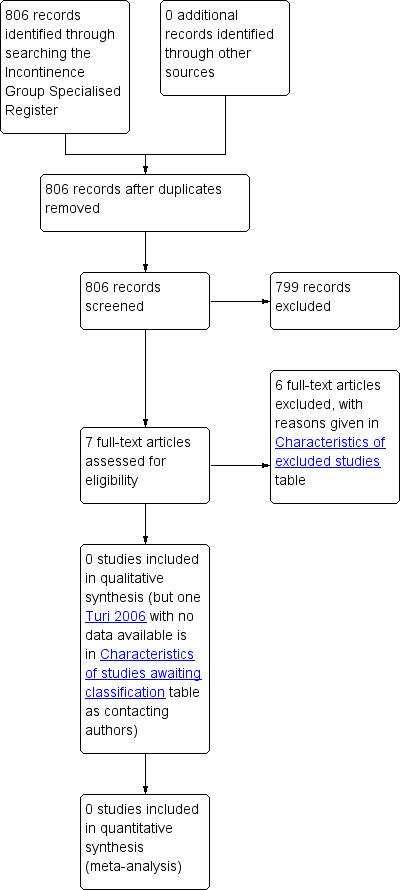
Main results: Approximately 400 studies were scrutinised. No trials were found that met the inclusion criteria, and five studies were excluded from the review.
Authors' conclusions: Despite a comprehensive search no evidence from randomised or quasi-randomised controlled trials was found. It was not possible to draw any conclusions regarding the use of different types of catheter in managing the neurogenic bladder.
Conflict of interest statement
None known
Update of
-
Catheter policies for management of long term voiding problems in adults with neurogenic bladder disorders.Cochrane Database Syst Rev. 2011 Dec 7;(12):CD004375. doi: 10.1002/14651858.CD004375.pub3. Cochrane Database Syst Rev. 2011. Update in: Cochrane Database Syst Rev. 2013 Nov 18;(11):CD004375. doi: 10.1002/14651858.CD004375.pub4. PMID: 22161386 Updated.
References
References to studies excluded from this review
Faure 1980 {published data only}
-
- Faure JJ, Retief PJM, Key AG. Urological management of the patient with spinal cord injury. South African Medical Journal 1980;58(17):682‐6. - PubMed
Grundy 1983 {published data only}
-
- Grundy DJ, Fellows GJ, Gillett AP, Nuseibeh I, Silver JR. A comparison of fine‐bore suprapubic and an intermittent urethral catheterisation regime after spinal cord injury. Paraplegia 1983;21(4):227‐32. - PubMed
Khan 2010 {published data only}
-
- Khan F, Pallant JF, Pallant JI, Brand C, Kilpatrick TJ. A randomised controlled trial: outcomes of bladder rehabilitation in persons with multiple sclerosis. Journal of Neurology, Neurosurgery and Psychiatry 2010;81(9):1033‐8. [SR‐INCONT40030] - PubMed
Piergiovanni 1991 {published data only}
-
- Piergiovanni M, Tschantz P. Urinary catheterization: transurethral or suprapubic approach? [Sondage urinaire: voie transurétrale ou suspubienne?]. Helvetica Chirurgica Acta 1991;58 (1‐2):201‐5. - PubMed
Sethia 1987 {published data only}
-
- Sethia KK, Selkon JB, Berry AR, Turner CM, Kettlewell MG, Gough MH. Prospective randomized controlled trial of urethral versus suprapubic catheterization. British Journal of Surgery 1987;74(7):624‐5. - PubMed
Vandoni 1994 {published data only}
-
- Vandoni RE, Lironi A, Tschantz P. Bacteriuria during urinary tract catheterization: suprapubic versus urethral route: a prospective randomized trial. Acta Chirurgica Belgica 1994;94(1):12‐6. - PubMed
References to studies awaiting assessment
Turi 2006 {published data only}
-
- Turi MH, Hanif S, Fasih Q, Shaikh MA. Proportion of complications in patients practicing clean intermittent self‐catheterization (CISC) vs indwelling catheter. JPMA ‐ Journal of the Pakistan Medical Association 2006;56(9):401‐4. [SR‐INCONT22267] - PubMed
Additional references
Berkowitz 1992
-
- Berkowitz M, Harvey C, Greene CG, Wilson SE. The Economic Consequences of Traumatic Spinal Cord Injury. New York: Demos Medical Publishing, 1992.
Bracken 1981
-
- Bracken MB, Freeman DH, Hellenbrand K. Incidence of acute traumatic spinal cord injury in the United States. American Journal of Epidemiology 1981;133:615‐22. - PubMed
Brosnahan 2004
Clarke 2003
-
- Clarke M, Oxman AD. Analysing and presenting results. Cochrane Reviewers Handbook 4.2.0, Section 8 [updated March 2003] 2003 URL: http://www.cochrane.org/cochrane/hbook.htm.
Higgins 2003
Niel‐Weise 2003a
-
- Niel‐Weise BS, Broek PJ. Urinary catheter policies for short‐term management of voiding in hospitalised adults. Cochrane Database of Systematic Reviews 2003, Issue 2. [DOI: 10.1002/14651858.CD004203] - DOI
Niel‐Weise 2003b
-
- Niel‐Weise BS, Broek PJ. Urinary catheter policies for long‐term management of voiding in adults. Cochrane Database of Systematic Reviews 2003, Issue 2. [DOI: 10.1002/14651858.CD004201] - DOI
Shekelle 1999
-
- Shekelle PG, Morton SC, Clark KA, Pathak M, Vickrey BG. Systematic review of risk factors for urinary tract Infection in adults with spinal cord dysfunction. Journal of Spinal Cord Medicine 1999;22(4):258‐72. - PubMed
Vickrey 1999
Ware 1992
-
- Ware JE, Sherbourne CD. The MOS 36‐item short‐form health survey (SF‐36). I. Conceptual framework and item selection. Medical Care 1992;30(6):473‐83. - PubMed
WHO 2008
-
- World Health Organization, Multiple Sclerosis International Federation. Atlas: Multiple Sclerosis Resources in the World: 2008. Geneva: World Health Organization (WHO), 2008.
Yong 2003
Zigmond 1983
-
- Zigmond AS, Snaith RP. The hospital anxiety and depression scale. Acta Psychiatrica Scandinavica 1983;67(6):361‐70. - PubMed
Publication types
MeSH terms
LinkOut - more resources
Full Text Sources
Other Literature Sources
Medical
Miscellaneous
