. 2014 Apr;109(5):434-9.
doi: 10.1002/jso.23501. Epub 2013 Nov 19.

Chemosaturation with percutaneous hepatic perfusion for unresectable metastatic melanoma or sarcoma to the liver: a single institution experience

Affiliations

Chemosaturation with percutaneous hepatic perfusion for unresectable metastatic melanoma or sarcoma to the liver: a single institution experience

Meghan R Forster et al. J Surg Oncol. 2014 Apr.

Abstract

Background: Patients with unresectable melanoma or sarcoma hepatic metastasis have a poor prognosis with few therapeutic options. Percutaneous hepatic perfusion (PHP), isolating and perfusing the liver with chemotherapy, provides a promising minimally invasive management option. We reviewed our institutional experience with PHP.

Methods: We retrospectively reviewed patients with unresectable melanoma or sarcoma hepatic metastasis treated with PHP from 2008 to 2013 and evaluated therapeutic response, morbidity, hepatic progression free survival (hPFS), and overall survival (OS).

Results: Ten patients were treated with 27 PHPs (median 3). Diagnoses were ocular melanoma (n = 5), cutaneous melanoma (n = 3), unknown primary melanoma (n = 1), and sarcoma (n = 1). Median hPFS was 240 days, 9 of 10 patients (90%) demonstrated stable disease or partial response to treatment. At a median follow up of 11.5 months, 4 of 10 (40%) remain alive. There were no perioperative mortalities. Myelosuppresion was the most common morbidity, managed on an outpatient basis with growth factors. The median hospital stay was 3 days.

Conclusions: Patients with metastatic melanoma and sarcoma to the liver have limited treatment options. Our experience with PHP demonstrates promising results with minimal morbidity and should be considered (pending FDA approval) as a management option for unresectable melanoma or sarcoma hepatic metastasis.

Keywords: liver metastasis; minimally invasive; percutaneous hepatic perfusion.


Figures

Figure 1
Figure 1
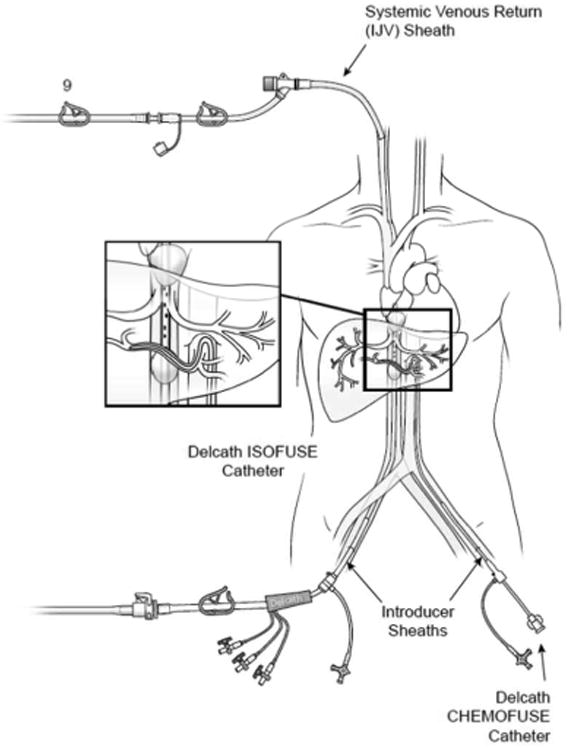
Diagram of the Delcath Hepatic Chemosat Delivery System. The enlarged box shows the double-balloon catheter in place in the inferior vena cava, which by occluding hepatic venous outflow allows for isolation of the liver from the systemic circulation. Also pictured in the enlarged box is the arterial cannula through which the chemotherapeutic agent (melphalan) is delivered into the hepatic artery. Hepatic venous outflow is collected via fenestrations between the two occlusion balloons, and pumped through an extracorporeal filtration system which removes melphalan from the effluent venous blood, then returns the filtered blood to the patient via a 10 French cannula placed into the internal jugular vein, thus completing the veno-veno bypass.
Figure 2
Figure 2
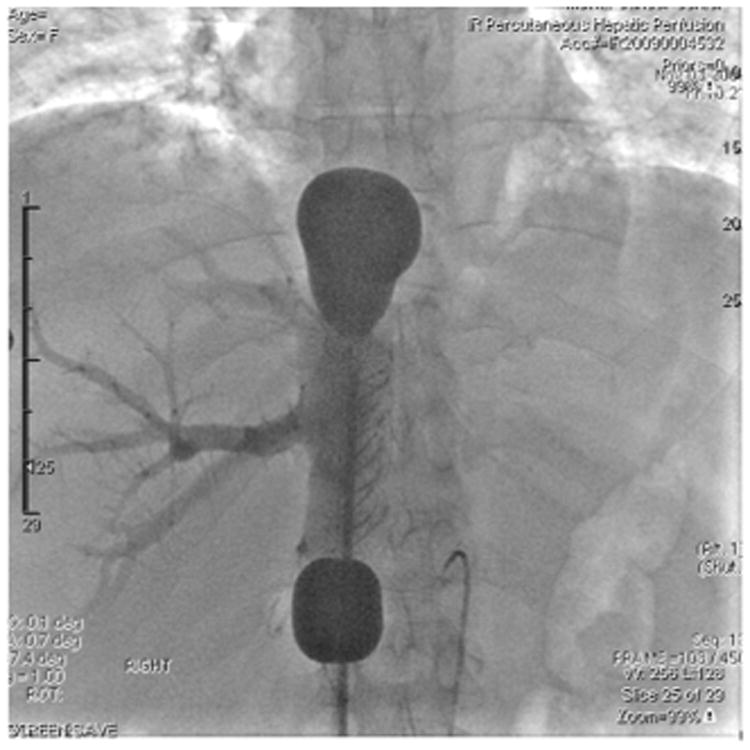
Venogram of the 16 French double-balloon hepatic isolation and aspiration catheter (Delcath Isofuse Isolation Aspiration Catheter) in place in the retrohepatic inferior vena cava with cephalad and caudal balloons inflated with contrast media to verify placement. The mushroom shape of the cephalad balloon verifies proper placement at the cavo-atrial junction. Contrast instilled through the catheter fenestrations between the occlusion balloons shows backfilling of the right hepatic venous system and verifies no leakage of blood around the balloons. Also seen in the image is the arterial infusion cannula in the hepatic artery.
Figure 3
Figure 3
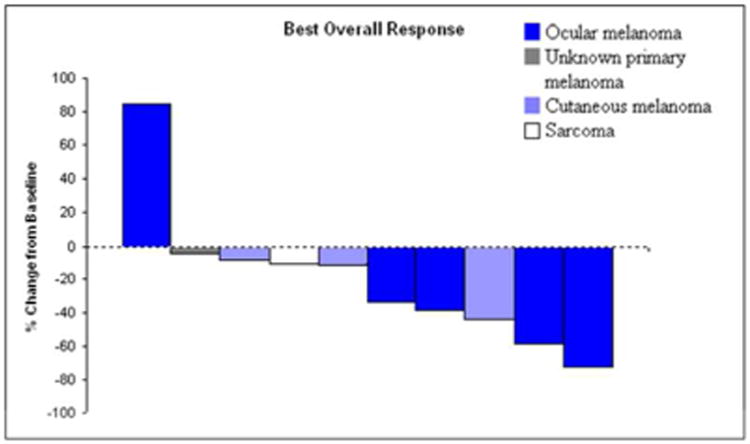
Waterfall plot of maximal tumor response to treatment in percent change from baseline in 10 patients treated with percutaneous hepatic perfusion (PHP). Response percentage was based on change in tumor size on serial imaging, as determined by a radiologist.
Figure 4
Figure 4
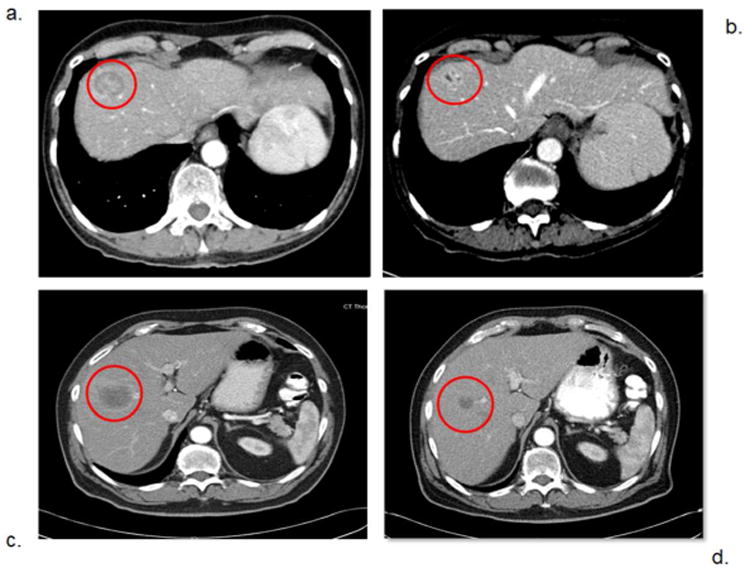
Computed Tomography (CT) images with arterial phase intravenous contrast of patients before and after percutaneous hepatic perfusion (PHP) treatment. Panel a. shows a liver metastasis in patient number 1 (from Table 1.) before treatment, and panel b. shows the same lesion after 3 PHP treatments. Panel c. shows a metastatic lesion in patient number 8 before treatment, and panel d. shows the same metastasis after 3 PHP treatments.
Figure 5
Figure 5
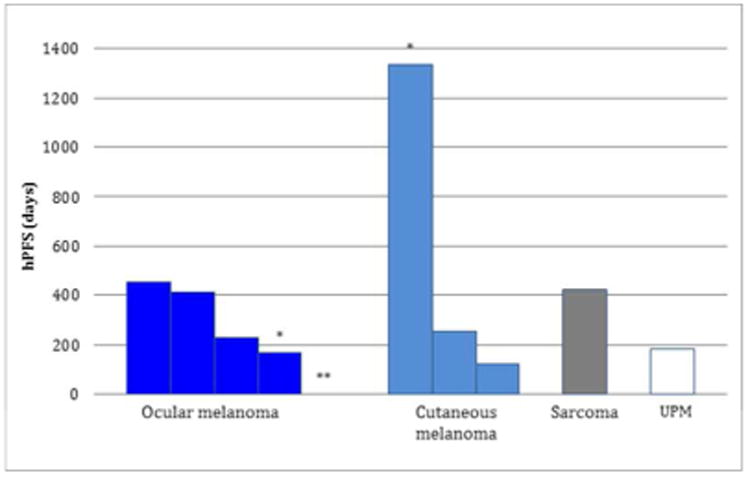
Days of hepatic progression free survival (hPFS) of 10 patients treated with percutaneous hepatic perfusion (PHP). Patients are grouped by primary tumor site. (UPM = unknown primary melanoma). * = patients who have yet to progress in their liver. ** = patient who did not respond to PHP treatment.
Figure 6
Figure 6
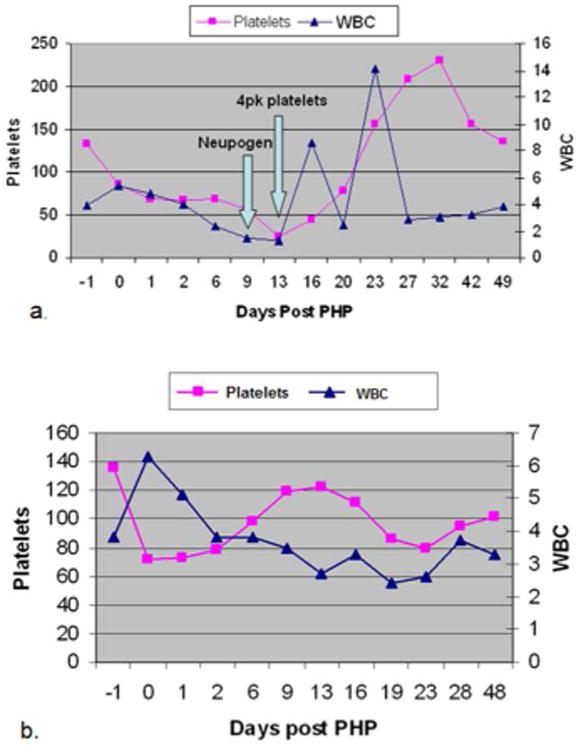
Line graphs showing serum platelet and white blood cell (WBC) levels in patient number 8 (from Table 1) before and after percutaneous hepatic perfusion (PHP) treatment. Panel a. shows levels after the first PHP treatment which utilized the first generation chemofiltration filter. Arrows indicate when platelets were transfused due to thrombocytopenia, and when Neupogen (WBC colony stimulating factor), was started due to leukopenia. Panel b. shows the same patient's serum platelet and WBC levels before and after her second PHP treatment which utilized the second generation chemofiltration filter. Note the levels did not fall below thresholds, and therefore no transfusions or Neupogen were given. (4pk = 4 pack unit of platelets).

References

    1. Adam R, Miller R, Pitombo M, et al. Two-stage hepatectomy: A planned strategy to treat irresectable liver tumors. Ann Surg. 2000;232(6):777–85. - PMC - PubMed
    1. Ruers T, Bleichrodt RP. Treatment of liver metastases, an update on the possibilities and results. Eur J Cancer. 2002;38(7):1023–33. - PubMed
    1. Savier E, Azoulay A, Huguet E, et al. Percutaneous isolated hepatic perfusion for chemotherapy: a phase 1 study. Arch Surg. 2003;138(3):325–32. - PubMed
    1. Deneve JL, Choi J, Gonzalez RJ, et al. Chemosaturation with percutaneous hepatic perfusion for unresectable isolated hepatic metastases from sarcoma. Cardiovasc Intervent Radiol. 2012;35(6):1480–7. - PubMed
    1. Han D, Beasley GM, Tyler DS, et al. Minimally invasive intra-arterial regional therapy for metastatic melanoma: isolated limb infusion and percutaneous hepatic perfusion. Expert Opin Drug Metab Toxicol. 2011;7(11):1383–94. - PMC - PubMed

MeSH terms