Role of fluorine-18-labeled 2-fluoro-2-deoxy-D-glucose positron emission tomography-computed tomography in the evaluation of axillary lymph node involvement in operable breast cancer in comparison with sentinel lymph node biopsy
- PMID: 24250021
- PMCID: PMC3822412
- DOI: 10.4103/0972-3919.119542
Role of fluorine-18-labeled 2-fluoro-2-deoxy-D-glucose positron emission tomography-computed tomography in the evaluation of axillary lymph node involvement in operable breast cancer in comparison with sentinel lymph node biopsy
Abstract
Purpose: Role of (18 [F] fluorine-18-labeled 2-fluoro-2-deoxy-D-glucose [FDG] positron emission tomography-computed tomography [PET-CT]) in the evaluation of axillary lymph node involvement in T1T2N0 breast cancer and compare results with sentinel lymph node biopsy (SLNB).
Methods: A total of 37 patients of proven T1T2N0 breast cancer were included in the study. Patients with past history of breast surgery, T3T4 disease, uncontrolled diabetes mellitus and pregnant patients were excluded from the study. Pre-operative FDG PET-CT was performed followed by sentinel lymph node (SLN) biopsy with blue dye or combined technique.
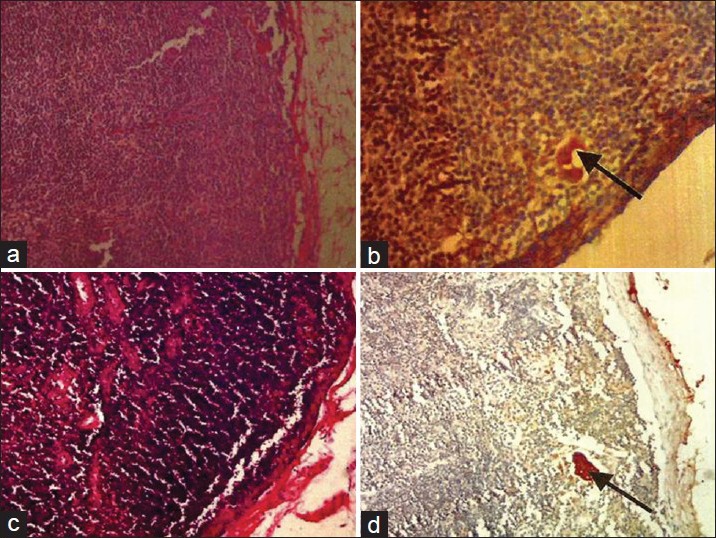
Results: SLN was identified in 32 of 37 patients with an identification rate of 86.48% (32/37). With combined technique SLN identification rate was 100% (6/6) while with blue dye alone; it was 83.8% (26/31). Among 37 patients, 16 had axillary metastases of which 12 had macrometastases and four had micrometastases detected by immunohistochemistry (IHC). Of 12 patients with axillary macrometastases, skip metastases were present in two patients in whom SLN was negative and in two patients SLN was not identified, but axillary dissection showed metastases. PET-CT had shown sensitivity, specificity, negative predictive value and positive predictive value of 56%, 90%, 73%, and 81.8%, respectively. IHC of SLN detected four patients with micrometastases upstaging the disease by 11% (4/37).
Conclusion: Because FDG PET-CT has a high specificity in the evaluation of axillary lymph node involvement in T1T2N0 breast cancer patients according to the results of this study if FDG PET-CT is positive in axillary lymph nodes, axillary lymph node dissection may be considered instead of SLNB.
Keywords: Breast cancer; fluorine-18-labeled 2-fluoro-2-deoxy-D-glucose positron emission tomography-computed tomography; immunohistochemistry; sentinel lymph node biopsy.
Conflict of interest statement
Figures


References
-
- Jemal A, Siegel R, Ward E, Murray T, Xu J, Smigal C, et al. Cancer statistics, 2006. CA Cancer J Clin. 2006;56:106–30. - PubMed
-
- Walls J, Boggis CR, Wilson M, Asbury DL, Roberts JV, Bundred NJ, et al. Treatment of the axilla in patients with screen-detected breast cancer. Br J Surg. 1993;80:436–8. - PubMed
-
- Crane-Okada R, Wascher RA, Elashoff D, Giuliano AE. Long-term morbidity of sentinel node biopsy versus complete axillary dissection for unilateral breast cancer. Ann Surg Oncol. 2008;15:1996–2005. - PubMed
LinkOut - more resources
Full Text Sources
Other Literature Sources
Miscellaneous