. 2013 Oct 1;2(10):e26615.
doi: 10.4161/onci.26615. Epub 2013 Oct 15.

BRAF inhibition is associated with increased clonality in tumor-infiltrating lymphocytes

Affiliations

BRAF inhibition is associated with increased clonality in tumor-infiltrating lymphocytes

Zachary A Cooper et al. Oncoimmunology. .

Abstract

There have been significant advances with regard to BRAF-targeted therapies against metastatic melanoma. However, the majority of patients receiving BRAF inhibitors (BRAFi) manifest disease progression within a year. We have recently shown that melanoma patients treated with BRAFi exhibit an increase in melanoma-associated antigens and in CD8+ tumor-infiltrating lymphocytes in response to therapy. To characterize such a T-cell infiltrate, we analyzed the complementarity-determining region 3 (CDR3) of rearranged T-cell receptor (TCR) β chain-coding genes in tumor biopsies obtained before the initiation of BRAFi and 10-14 d later. We observed an increase in the clonality of tumor-infiltrating lymphocytes in 7 of 8 patients receiving BRAFi, with a statistically significant 21% aggregate increase in clonality. Over 80% of individual T-cell clones detected after initiation of BRAFi treatment were new clones. Interestingly, the comparison of tumor infiltrates with clinical responses revealed that patients who had a high proportion of pre-existing dominant clones after the administration of BRAFi responded better to therapy than patients who had a low proportion of such pre-existing dominant clones following BRAFi. These data suggest that although the inhibition of BRAF in melanoma patients results in tumor infiltration by new lymphocytes, the response to treatment appears to be related to the presence of a pre-existing population of tumor-infiltrating T-cell clones.

Keywords: BRAF; T cells; TILs; melanoma; vemurafenib.


Figures
None
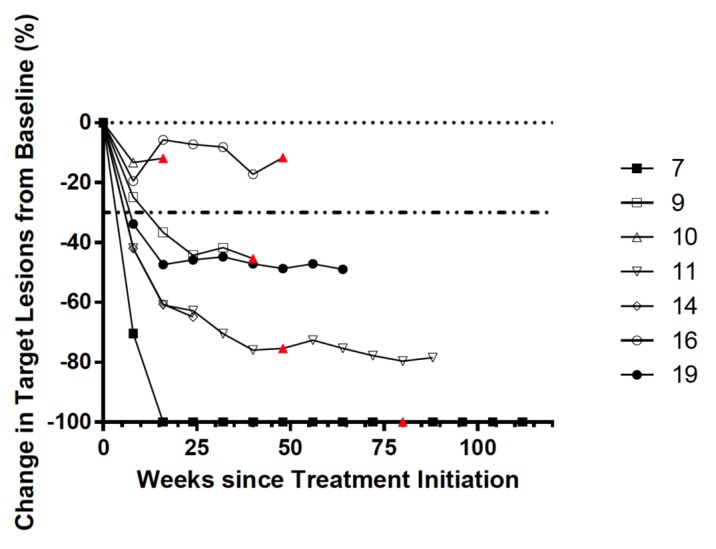
Figure 1. Tumor burden in melanoma patients treated with BRAF inhibitors. The size of neoplastic lesions (assessed the longest linear dimension) in melanoma patients receiving BRAF inhibitors (BRAFi) is plotted against time. The horizontal dashed line indicates a decrease of 30% in target lesion size, which demarks an “objective response” according to the Response Evaluation Criteria in Solid Tumors (RECIST), version 1.1. Solid data points refer to patients who are currently on trial, clear data points to individual that dropped out of the study. Red triangles mark time-to-progression. Patient 24 was on commercial drugs so official assessment of tumor burden were not performed.
None
Figure 2. BRAF inhibitors increase the clonality of tumor-infiltrating lymphocytes. (A) Changes in clonality of tumor-infiltrating lymphocytes (TILs) 10–14 d after the initiation of BRAF inhibitors are shown as fold change as compared with pre-treatment values, as a box and whiskers plot (n = 8 patients). The bottom and top of the box represent the 25th and 75th percentile, respectively, while the bar indicates the median value. (B) Percentage of the total TIL population occupied by the 5%, 2.5%, 1%, and 0.5% dominant TIL clones. Patient samples are sorted along the X-axis based on their maximal response to treatment. CR, complete response; PR, partial response; SD, stable disease.
None
Figure 3. A high proportion of pre-existing clones within the dominant T-cell population after the administration of BRAF inhibitors correlates with improve response to treatment. (A) The percentage of new T-cell clones infiltrating neoplastic lesions after the administration of BRAF inhibitors (BRAFi) was determined by comparing the presence of a tumor-infiltrating lymphocyte (TIL) in biopsies taken before treatment and 10–14 d after the of therapy. Individual patient data are presented with the mean ± SEM for the entire patient cohort (n = 8). (B) Percentage of the top 5%, 2.5%, 1%, and 0.5% dominant TIL clones that were present before the inhibition of therapy. Patient samples are sorted along the X-axis based on their maximal response to treatment. CR, complete response; PR, partial response; SD, stable disease.

References

    1. Flaherty KT, Hodi FS, Bastian BC. Mutation-driven drug development in melanoma. Curr Opin Oncol. 2010;22:178–83. doi: 10.1097/CCO.0b013e32833888ee. - DOI - PMC - PubMed
    1. Davies H, Bignell GR, Cox C, Stephens P, Edkins S, Clegg S, Teague J, Woffendin H, Garnett MJ, Bottomley W, et al. Mutations of the BRAF gene in human cancer. Nature. 2002;417:949–54. doi: 10.1038/nature00766. - DOI - PubMed
    1. Chapman PB, Hauschild A, Robert C, Haanen JB, Ascierto P, Larkin J, Dummer R, Garbe C, Testori A, Maio M, et al. BRIM-3 Study Group Improved survival with vemurafenib in melanoma with BRAF V600E mutation. N Engl J Med. 2011;364:2507–16. doi: 10.1056/NEJMoa1103782. - DOI - PMC - PubMed
    1. Sosman JA, Kim KB, Schuchter L, Gonzalez R, Pavlick AC, Weber JS, McArthur GA, Hutson TE, Moschos SJ, Flaherty KT, et al. Survival in BRAF V600-mutant advanced melanoma treated with vemurafenib. N Engl J Med. 2012;366:707–14. doi: 10.1056/NEJMoa1112302. - DOI - PMC - PubMed
    1. Flaherty KT, Infante JR, Daud A, Gonzalez R, Kefford RF, Sosman J, Hamid O, Schuchter L, Cebon J, Ibrahim N, et al. Combined BRAF; MEK inhibition in melanoma with BRAF V600 mutations. N Engl J Med. 2012;367:1694–703. doi: 10.1056/NEJMoa1210093. - DOI - PMC - PubMed
