Modelling the time course of antimalarial parasite killing: a tour of animal and human models, translation and challenges
- PMID: 24251882
- PMCID: PMC4294080
- DOI: 10.1111/bcp.12288
Modelling the time course of antimalarial parasite killing: a tour of animal and human models, translation and challenges
Abstract
Malaria remains a global public health concern and current treatment options are suboptimal in some clinical settings. For effective chemotherapy, antimalarial drug concentrations must be sufficient to remove completely all of the parasites in the infected host. Optimized dosing therefore requires a detailed understanding of the time course of antimalarial response, whilst simultaneously considering the parasite life cycle and host immune elimination. Recently, the World Health Organization (WHO) has recommended the development of mathematical models for understanding better antimalarial drug resistance and management. Other international groups have also suggested that mechanistic pharmacokinetic (PK) and pharmacodynamic (PD) models can support the rationalization of antimalarial dosing strategies. At present, artemisinin-based combination therapy (ACT) is recommended as first line treatment of falciparum malaria for all patient groups. This review summarizes the PK-PD characterization of artemisinin derivatives and other partner drugs from both preclinical studies and human clinical trials. We outline the continuous and discrete time models that have been proposed to describe antimalarial activity on specific stages of the parasite life cycle. The translation of PK-PD predictions from animals to humans is considered, because preclinical studies can provide rich data for detailed mechanism-based modelling. While similar sampling techniques are limited in clinical studies, PK-PD models can be used to optimize the design of experiments to improve estimation of the parameters of interest. Ultimately, we propose that fully developed mechanistic models can simulate and rationalize ACT or other treatment strategies in antimalarial chemotherapy.
Keywords: antimalarial chemotherapy; malaria; mechanism based model; pharmacodynamic; pharmacokinetics.
© 2013 The British Pharmacological Society.
Figures
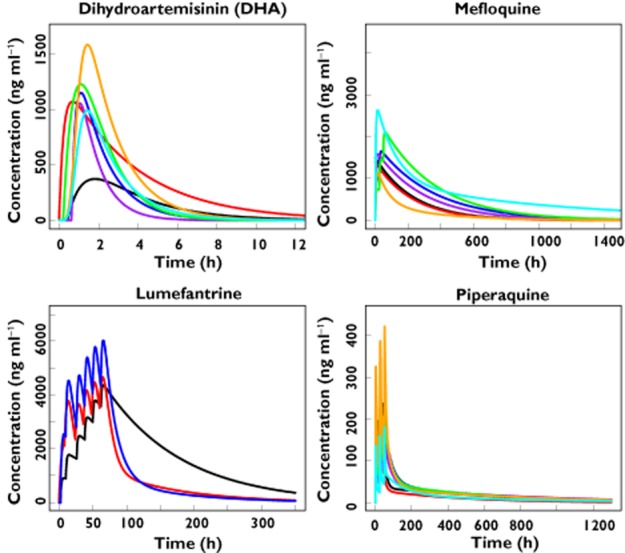
 , McGready et al. [70], pregnant women;
  , Stepniewska et al. [72], children;
  , Morris et al. [71], non-pregnant women;
  , Morris et al. [71], pregnant women;
  , Jamsen et al. [69], non-pregnant adults;
  , Tarning et al. [74], non-pregnant women;
  , Tarning et al. [74], pregnant women); mefloquine [75,77,80,108] (
 , Nabangchang et al. [108], non-pregnant women;
  , Nabangchang et al. [108], pregnant women;
  , Simpson et al. [77], split dose;
  , Simpson et al. [77], single dose;
  , Ashley et al. [75], non-pregnant adults;
  , Svensson et al. [80], non-pregnant adults RS;
  , Svensson et al. [80], non-pregnant adults SR), lumefantrine [76,79,81] (
  , Hietala et al. [76], children;
  , Ezzet et al. [79], non-pregnant adults;
  , Tarning et al. [81], pregnant women) and piperaquine [,–85]. (
 , Hung et al. [82], non-pregnant adults;
  , Hung et al. [82], children;
  , Tarning et al. [83], non-pregnant adults;
  , Tarning et al. [85], non-pregnant women;
  , Tarning et al. [85], pregnant women;
  , Tarning et al. [85], children;
  , Hoglund et al. [84], pregnant and non-pregnant women)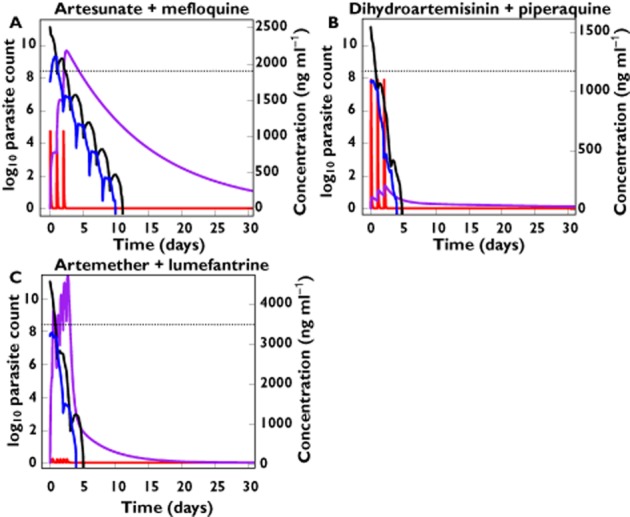
 , log10 circulating parasite count;
  , log10 sequestered parasite count;
  , DHA;
  , MQ;
, MQ;  , limit of detection. B)
  , log10 circulating parasite count;
  , log10 sequestered parasite count;
  , DHA;
  , PQ
, PQ  , limit of detection. C)
  , log10 circulating parasite count;
  , log10 sequestered parasite count;
  , ART;
  , LF
, LF  , limit of detection
References
-
- World Health Organization. Global Malaria Programme: World Malaria Report. Geneva, Switzerland: World Health Organization; 2012.
-
- Wells TN, Alonso PL, Gutteridge WE. New medicines to improve control and contribute to the eradication of malaria. Nat Rev Drug Discov. 2009;8:879–891. - PubMed
-
- Baird JK. Effectiveness of antimalarial drugs. N Engl J Med. 2005;352:1565–1577. - PubMed
-
- Barnes KI, Watkins WM, White NJ. Antimalarial dosing regimens and drug resistance. Trends Parasitol. 2008;24:127–134. - PubMed
Publication types
MeSH terms
Substances
LinkOut - more resources
Full Text Sources
Other Literature Sources