. 2014 Feb;42(4):2270-81.
doi: 10.1093/nar/gkt1174. Epub 2013 Nov 18.

DNA secondary structures are associated with recombination in major Plasmodium falciparum variable surface antigen gene families

Affiliations

DNA secondary structures are associated with recombination in major Plasmodium falciparum variable surface antigen gene families

Adam F Sander et al. Nucleic Acids Res. 2014 Feb.

Abstract

Many bacterial, viral and parasitic pathogens undergo antigenic variation to counter host immune defense mechanisms. In Plasmodium falciparum, the most lethal of human malaria parasites, switching of var gene expression results in alternating expression of the adhesion proteins of the Plasmodium falciparum-erythrocyte membrane protein 1 class on the infected erythrocyte surface. Recombination clearly generates var diversity, but the nature and control of the genetic exchanges involved remain unclear. By experimental and bioinformatic identification of recombination events and genome-wide recombination hotspots in var genes, we show that during the parasite's sexual stages, ectopic recombination between isogenous var paralogs occurs near low folding free energy DNA 50-mers and that these sequences are heavily concentrated at the boundaries of regions encoding individual Plasmodium falciparum-erythrocyte membrane protein 1 structural domains. The recombinogenic potential of these 50-mers is not parasite-specific because these sequences also induce recombination when transferred to the yeast Saccharomyces cerevisiae. Genetic cross data suggest that DNA secondary structures (DSS) act as inducers of recombination during DNA replication in P. falciparum sexual stages, and that these DSS-regulated genetic exchanges generate functional and diverse P. falciparum adhesion antigens. DSS-induced recombination may represent a common mechanism for optimizing the evolvability of virulence gene families in pathogens.


Figures
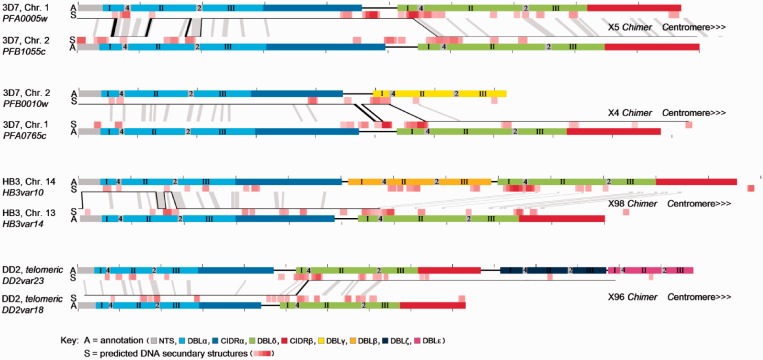
Figure 1.
Figure 1.
Schematic diagram of the origin of four novel var chimeric genes. The verified sequences from four chimeric var genes (exon 1) from two 3D7 × HB3 progeny (X5 and X4) and two HB3 × DD2 progeny (X98 and X96) are shown as continuous black lines crossing between domain-annotated parental genes. These are all upsB type var genes, i.e. telomeric genes being transcribed towards the centromere. PfEMP1 are composed of the N-terminal segment (NTS) and different sub-classes of DBL and CIDR domains (coloured). DBL domains contain three structural elements, sub-domains 1–3 (marked I–III) (42,43). Both DBL and CIDR domains can be described as being composites selected from a repertoire of 628 different short semi-conserved homology blocks (HB) (31). Six breakpoints occurred at the boundaries of the structural DBL sub-domains 1–3 marked by HB4 and HB2 (grey boxes ‘2’ and ‘4’) and two breakpoints occurred in low-complexity sequence inter-domain regions. The quasi-palindromes with highest potential to form DSS shown in red (S) are frequently found near recombination breakpoints. Predicted DSS are identified by calculations of folding free energy in 50-mer windows (Supplementary Figure S2) and coloured increasingly intense red with decreasing folding free energy levels from −6.27 kcal/mol. Regions of donor sequence identity of at least 90% over 20 bp are shown in grey shades between genes. 500-bp intervals are marked.
Figure 2.
Figure 2.
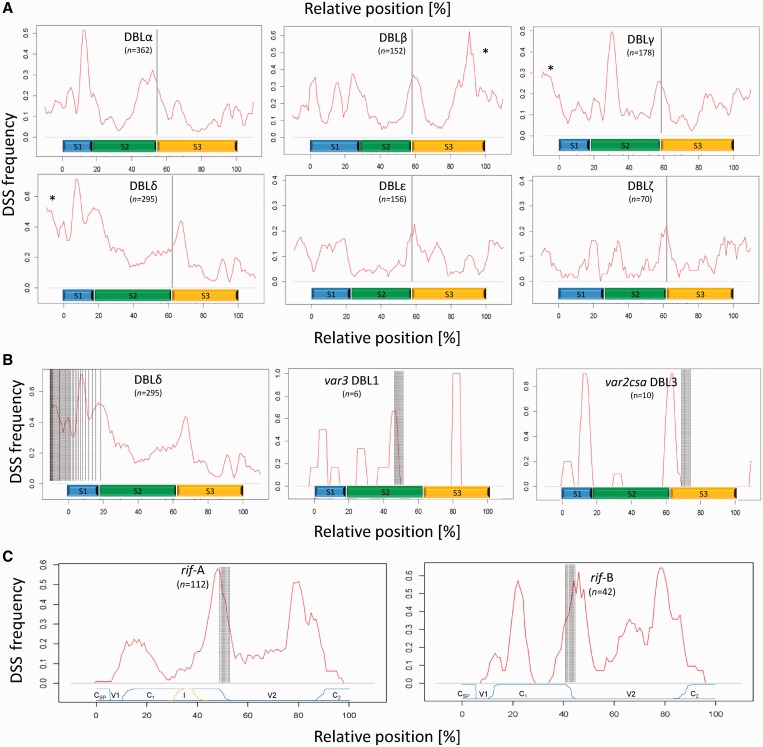
Relative location of DSS in selected var gene domains and rif genes. (A) The frequency of predicted DSS (red graph) is shown relative to the position in the PfEMP1 domain types DBLα–ζ. The relative position of DBL sub-domains S1–S3 (blue, green and orange bars) and the previously defined recombination hotspot in DBL domains (vertical grey lines) (31) is shown. In general, peaks in DSS frequency are observed at the recombination hotspot located at the boundary of DBL S2 and S3 and at the end of the domains (indicated by asterisk). The frequency of DSS at the DBL S2–S3 recombination hotspot was found to be significantly higher than expected by chance (Table 1). (B) The association between DSS localization and the ‘mid var’ recombination region (marked by vertical punctuated lines) is particularly evident in the DSS frequency plot of DBLδ domains (left plot). The recombination hotspots (vertical grey lines) defined in var3 DBL1 sub-domain 2 (31) and var2csa DBL3 (47) also co-localize with peaks in DSS frequency (middle and right plots). (C) The frequency of predicted DSS (red graphs) is shown relative to their position in annotated rif-A and B genes. Blue line indicates the relative positions of conserved (Csp = conserved signal peptide, C1 and C2) and variable (V1 and V2) regions. Yellow line indicates position of the 75-bp insert (I) unique to rif-A. In both rif-A and B genes, the highest DSS frequency peaks are found at the border between major conserved (C1) and variable (V2) regions (grey shadow), previously defined as a hotspot for recombination (48).
Figure 3.
Figure 3.
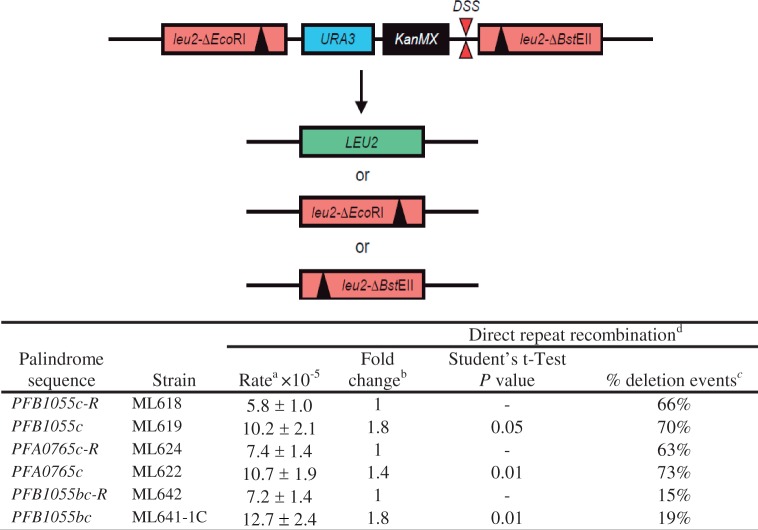
Effects of predicted DNA secondary structure sequences on mitotic leu2 direct-repeat recombination. The schematic illustrates the assay for spontaneous direct-repeat recombination between two non-functional leu2-ΔEcoRI and leu2-ΔBstEII alleles showing the position of the inserted DSS sequences (DSS). Recombination between the leu2 alleles to produce a functional LEU2 allele leads to prototrophy for leucine (Leu+). The assay scores for Leu+ recombinants generated by single-strand annealing, replication slippage or gene conversion between the leu2 alleles. Single-strand annealing leads to loss of the URA3 gene and uracil autotrophy. The fraction of URA3 deletion events were the same for the pair-wise combinations of strains and their scrambled counterpart, indicating that the 50-mer with the lowest folding free energy stimulated the different types of recombination equally well. aRecombination rate is presented as events per cell per generation ± standard deviation, as described in ‘Materials and Methods’ section. bRelative to a randomized sequence (R). cPercentage of deletion events among Leu+ recombinants. dStrains harbouring the palindrome sequences PFB1055c (ML619: 5′-TGGTGCCACTGGCAAAAGTGGTGATAAGGGTGCCATTTGTGTGCCACCCA), PFA0765c (ML622: 5′-CAAACACCTGGTGAGAAAACCACCCCACCTAGTGGTACTAACCAGGGTGC) and PFB1055bc (ML641-1C: 5′-GTAAGGACGAAAACGGCAAAAAGCCCGGCTCAAATGCCGACCAAGTCCCC) or their randomized counterparts PFB1055c-R (ML618: 5′-CCTGAAATTGCTGGCTAGGGGTCCTAGATGTGCCCGGGGTAGACCTATAA), PFA0765c-R (ML624: 5′-GCACTGATATGCAAGGAAGCCCCAGCAATCCTCAAAGACGCGAAGCCTCT) and PFB1055bc-R (ML642: 5′-GTATAAGCCTGGAAACCAACAGCGAAAGGCCGAAACCCGCCTACCAAGCG), respectively, were analysed for mitotic direct-repeat recombination at 30°C, as described (49).

References

    1. Su X, Heatwole VM, Wertheimer SP, Guinet F, Herrfeldt JA, Peterson DS, Ravetch JA, Wellems TE. The large diverse gene family var encodes proteins involved in cytoadherence and antigenic variation of Plasmodium falciparum-infected erythrocytes. Cell. 1995;82:89–100. - PubMed
    1. Rowe JA, Claessens A, Corrigan RA, Arman M. Adhesion of Plasmodium falciparum-infected erythrocytes to human cells: molecular mechanisms and therapeutic implications. Exp. Rev. Mol. Med. 2009;11:e16. - PMC - PubMed
    1. Bull PC, Lowe BS, Kortok M, Molyneux CS, Newbold CI, Marsh K. Parasite antigens on the infected red cell are targets for naturally acquired immunity to malaria. Nat. Med. 1998;4:358–360. - PMC - PubMed
    1. Barry AE, Leliwa-Sytek A, Tavul L, Imrie H, Migot-Nabias F, Brown SM, McVean GA, Day KP. Population genomics of the immune evasion (var) genes of Plasmodium falciparum. PLoS. Pathog. 2007;3:e34. - PMC - PubMed
    1. Kyes S, Taylor H, Craig A, Marsh K, Newbold C. Genomic representation of var gene sequences in Plasmodium falciparum field isolates from different geographic regions. Mol. Biochem. Parasitol. 1997;87:235–238. - PubMed

Publication types

MeSH terms

Substances