


Long-term survival and biomarker correlates of tasquinimod efficacy in a multicenter randomized study of men with minimally symptomatic metastatic castration-resistant prostate cancer
- PMID: 24255071
- PMCID: PMC4251453
- DOI: 10.1158/1078-0432.CCR-13-1581
Long-term survival and biomarker correlates of tasquinimod efficacy in a multicenter randomized study of men with minimally symptomatic metastatic castration-resistant prostate cancer
Abstract
Purpose: Tasquinimod (Active Biotech) is an oral immunomodulatory, anti-angiogenic, and anti-metastatic agent that delayed metastatic disease progression in a randomized placebo-controlled phase II trial in men with metastatic castration-resistant prostate cancer (mCRPC). Here, we report long-term survival with biomarker correlates from this trial.
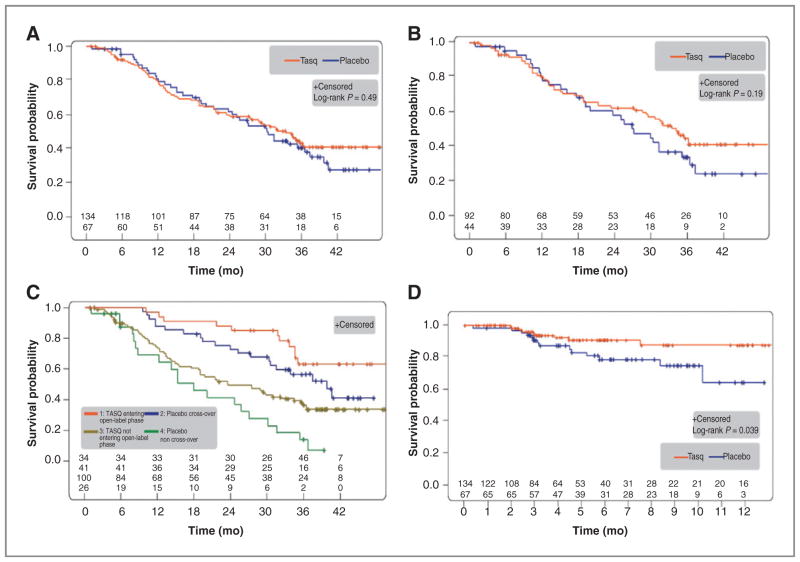
Experimental design: Two hundred and one (134 tasquinimod and 67 placebo) men with mCRPC were evaluated. Forty-one men randomized to placebo crossed over to tasquinimod. Survival data were collected with a median follow-up time of 37 months. Exploratory biomarker studies at baseline and over time were collected to evaluate potential mechanism-based correlates with tasquinimod efficacy including progression-free survival (PFS) and overall survival (OS).
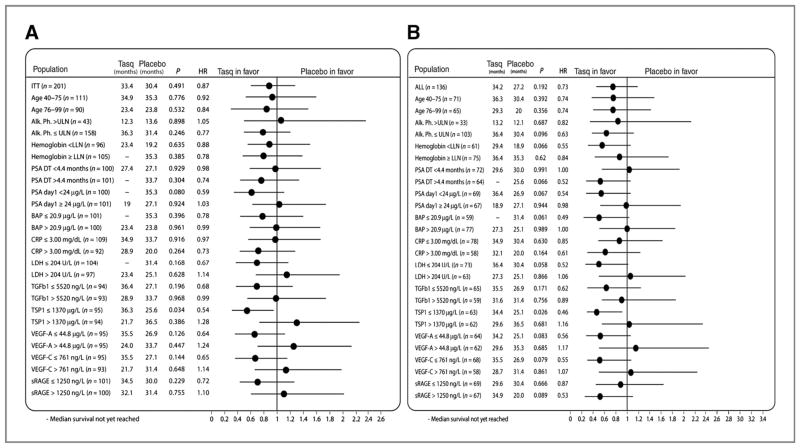
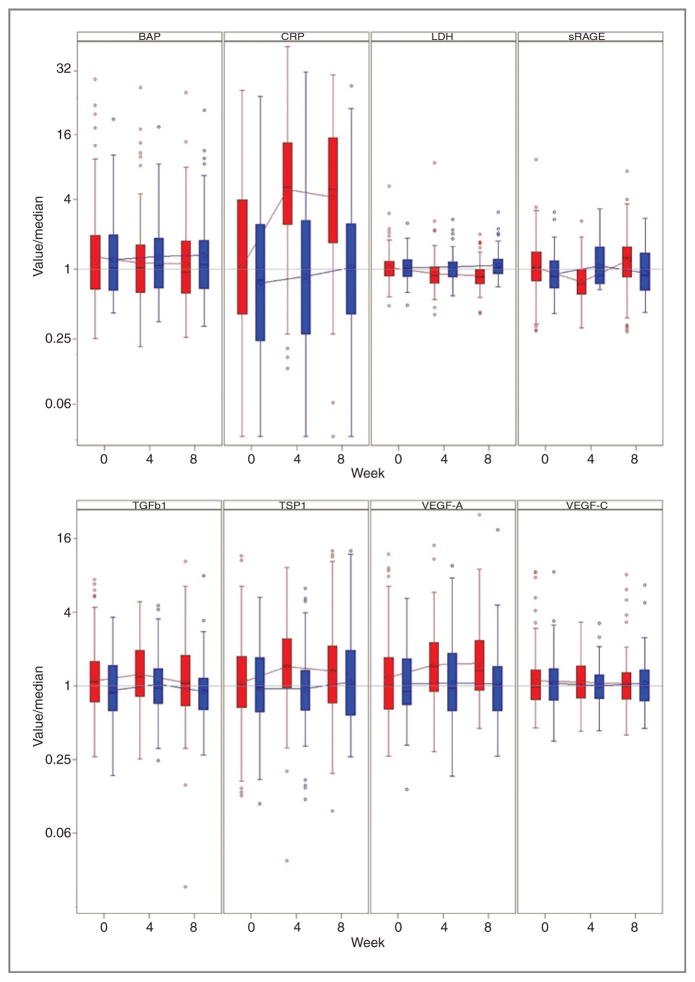
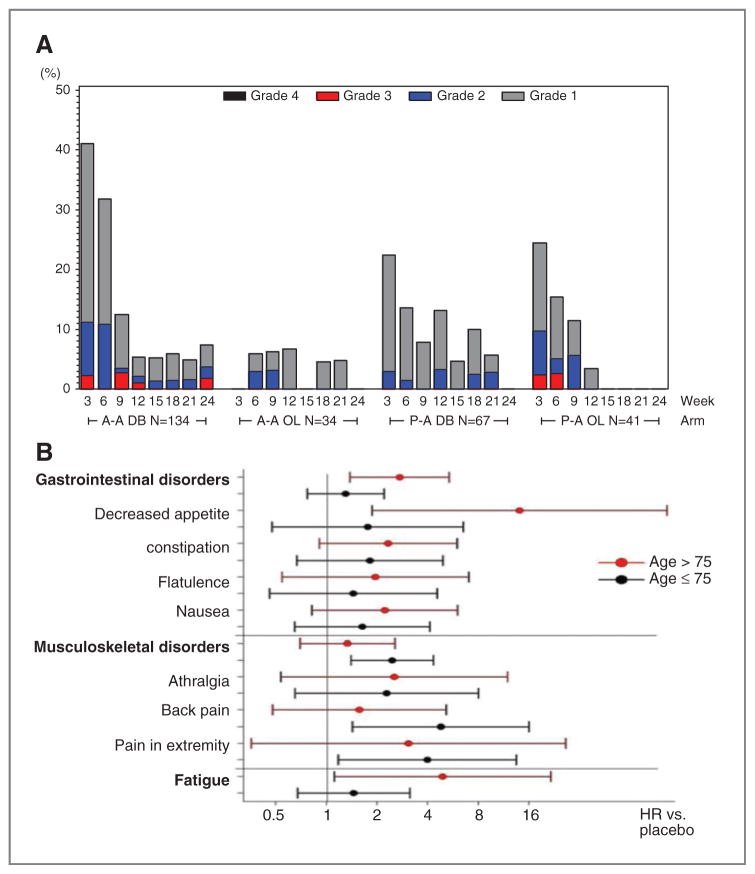
Results: With 111 mortality events, median OS was 33.4 months for tasquinimod versus 30.4 months for placebo overall, and 34.2 versus 27.1 months in men with bone metastases (n = 136), respectively. Multivariable analysis demonstrated an adjusted HR of 0.52 [95% confidence interval (CI), 0.35-0.78; P = 0.001] for PFS and 0.64 (95% CI, 0.42-0.97; P = 0.034) for OS, favoring tasquinimod. Time-to-symptomatic progression was improved with tasquinimod (P = 0.039, HR = 0.42). Toxicities tended to be mild in nature and improved over time. Biomarker analyses suggested a favorable impact on bone alkaline phosphatase and lactate dehydrogenase (LDH) over time and a transient induction of inflammatory biomarkers, VEGF-A, and thrombospondin-1 levels with tasquinimod. Baseline levels of thrombospondin-1 less than the median were predictive of treatment benefit.
Conclusions: The survival observed in this trial of men with minimally symptomatic mCRPC suggests that the prolongation in PFS with tasquinimod may lead to a survival advantage in this setting, particularly among men with skeletal metastases, and has a favorable risk:benefit ratio.
©2013 AACR.
Conflict of interest statement
Ö. Nordle and G. Forsberg are employees and shareholders of Active Biotech. A.J. Armstrong has received commercial research funding from Active Biotech and is consultant/advisory board member for Ipsen. A.J. Armstrong has received commercial research funding from Active Biotech, Dendreon, Medivation, Janssen, and Sanofi Aventis; A.J. Armstrong holds a consultant/advisory board position with Active Biotech, Dendreon, Medivation, Janssen, and Bayer. M. Häggman is a consultant for Active Biotech. W.M. Stadler has received commercial research funding from Active Biotech. V. Assikis has received honoraria from the Speakers Bureau of Astellas, Janssen, and Dendreon and is a consultant/advisory board member for Astellas, Dendreon, and Janssen. JE Damber receives research funding from Active Biotech and is a consultant to Ipsen. M.A. Carducci is a consultant/advisory board member for Active Biotech. R. Pili receives research funding from Active Biotech. No potential conflicts of interest were disclosed by the other authors.
Figures
References
-
- de Bono JS, Oudard S, Ozguroglu M, Hansen S, Machiels JP, Kocak I, et al. Prednisone plus cabazitaxel or mitoxantrone for meta-static castration-resistant prostate cancer progressing after docetaxel treatment: a randomised open-label trial. Lancet. 2010;376:1147–54. - PubMed
-
- Kantoff PW, Higano CS, Shore ND, Berger ER, Small EJ, Penson DF, et al. Sipuleucel-T immunotherapy for castration-resistant prostate cancer. N Engl J Med. 2010;363:411–22. - PubMed
-
- Tannock IF, de WR, Berry WR, Horti J, Pluzanska A, Chi KN, et al. Docetaxel plus prednisone or mitoxantrone plus prednisone for advanced prostate cancer. N Engl J Med. 2004;351:1502–12. - PubMed
-
- Parker C, Nilsson S, Heinrich D, Helle SI, O’Sullivan JM, Fossa SD, et al. Alpha emitter radium-223 and survival in metastatic prostate cancer. N Engl J Med. 2013;369:213–23. - PubMed
Publication types
MeSH terms
Substances
Grants and funding
LinkOut - more resources
Full Text Sources
Other Literature Sources
Medical
