


Circulating 25-hydroxyvitamin D, IRS1 variant rs2943641, and insulin resistance: replication of a gene-nutrient interaction in 4 populations of different ancestries
- PMID: 24255076
- PMCID: PMC4026060
- DOI: 10.1373/clinchem.2013.215251
Circulating 25-hydroxyvitamin D, IRS1 variant rs2943641, and insulin resistance: replication of a gene-nutrient interaction in 4 populations of different ancestries
Abstract
Background: Associations of either insulin receptor substrate 1 (IRS1) variants or circulating 25-hydroxyvitamin D [25(OH)D] with type 2 diabetes (T2D) and insulin resistance (IR) are inconsistent. This study sought to determine whether circulating 25(OH)D modulates the association of a potentially functional variant at IRS1 (rs2943641) with insulin resistance.
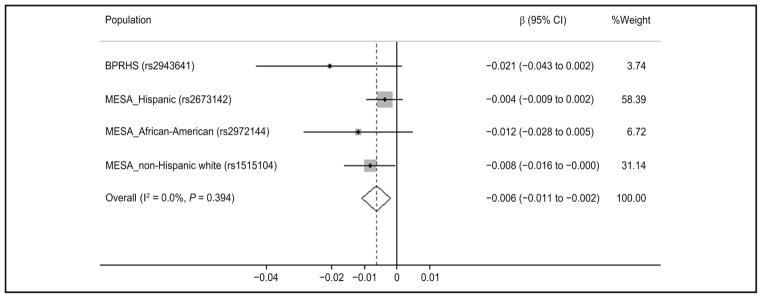
Method: Interaction between IRS1 rs2943641 and circulating 25(OH)D on homeostasis model assessment for IR (HOMA-IR) was examined in the Boston Puerto Rican Health Study (BPRHS) (n = 1144). Replication was performed in the African-American (n = 1126), non-Hispanic white (n = 1967), and Hispanic (n = 1241) populations of the Multi-Ethnic Study of Atherosclerosis (MESA) with genotypes of 3 IRS1 variants, rs2972144, rs1515104, and rs2673142, which are tag single nucleotide polymorphisms (SNPs) and in strong linkage disequilibrium with rs2943641.
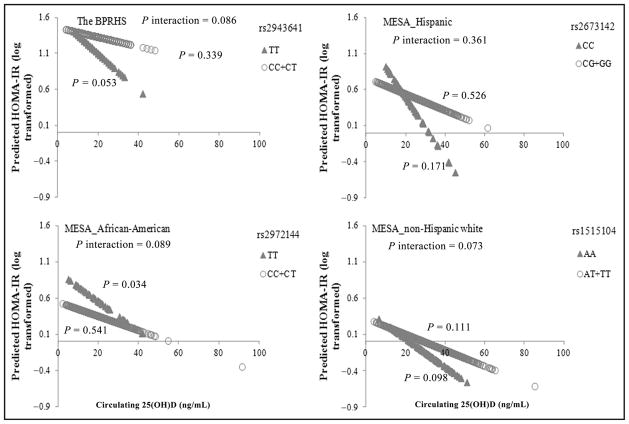
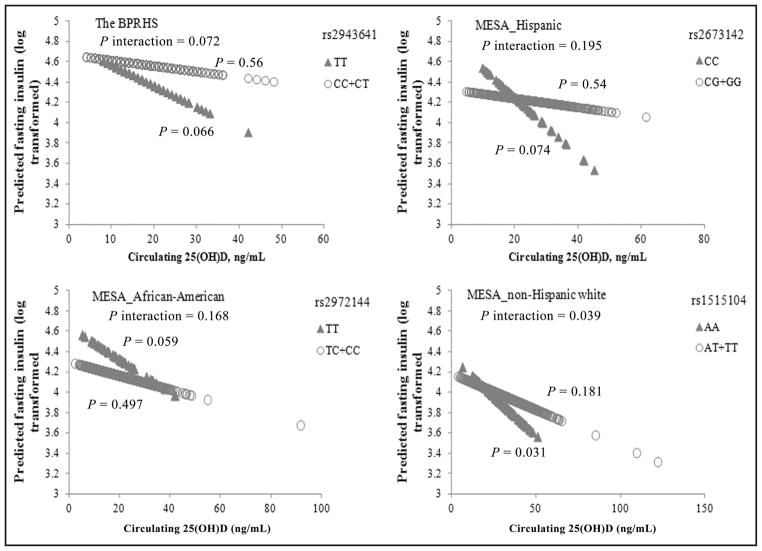
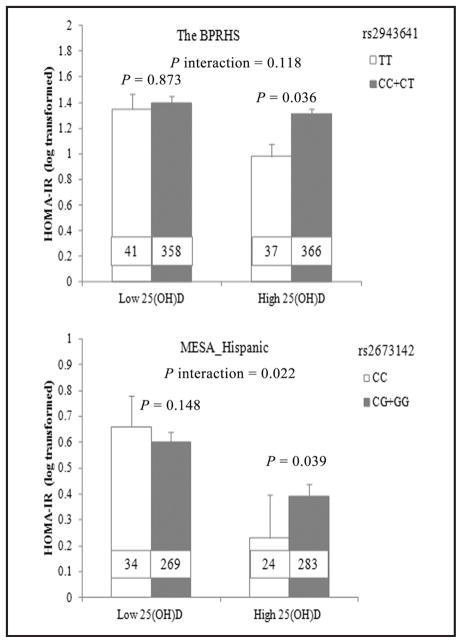
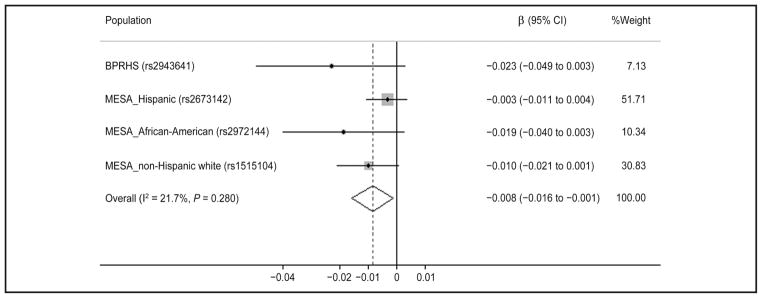
Results: Higher circulating 25(OH)D was associated with lower risk of T2D and IR in BPRHS women homozygous for minor allele rs2943641T. Consistently, in each of 3 MESA populations, HOMA-IR and insulin decreased more evidently with higher circulating 25(OH)D in women of the rs2943641TT genotype than in carriers of the major allele (rs2943641C). Metaanalysis indicated significant and consistent interactions between circulating 25(OH)D and IRS1 variants on HOMA-IR (log transformed) [pooled β = -0.008, 95% CI: -0.016 to -0.001, P interaction = 0.004] and insulin (log transformed) (pooled β = -0.006, 95% CI: -0.011 to -0.002, P interaction = 0.023) in 3065 women of the 4 populations.
Conclusions: Participants with different genotypes of IRS1 rs2943641 exhibit differential benefit from high circulating 25(OH)D for the reduction of insulin resistance and T2D risk. This gene-nutrient interaction, which appears to be limited to women, warrants further examination in randomized controlled trials of vitamin D supplementation.
Conflict of interest statement
Employment or Leadership: None declared.Consultant or Advisory Role: None declared.Stock Ownership: None declared.Honoraria: None declared.Research Funding: This study was supported by the National Basic Research Program of China (973 Program: 2011CB504002); National Heart, Lung, and Blood Institute (NHLBI) grant numbers HL54776 and HL078885; and contracts 53-K06-5-10 and 58-1950-9-001 from the US Department of Agriculture, Agriculture Research Service.Expert Testimony: None declared.Patents: None declared.
Figures
References
-
- Florez JC. Newly identified loci highlight beta cell dysfunction as a key cause of type 2 diabetes: where are the insulin resistance genes? Diabeto-logia. 2008;51:1100–10. - PubMed
-
- Tamemoto H, Kadowaki T, Tobe K, Yagi T, Sakura H, Hayakawa T, et al. Insulin resistance and growth retardation in mice lacking insulin receptor substrate-1. Nature. 1994;372:182–6. - PubMed
-
- Rung J, Cauchi S, Albrechtsen A, Shen L, Roche-leau G, Cavalcanti-Proenca C, et al. Genetic variant near IRS1 is associated with type 2 diabetes, insulin resistance and hyperinsulinemia. Nat Genet. 2009;41:1110–5. - PubMed
Publication types
MeSH terms
Substances
Grants and funding
LinkOut - more resources
Full Text Sources
Other Literature Sources
Medical
