


Association between obesity and ECG variables in children and adolescents: A cross-sectional study
- PMID: 24255675
- PMCID: PMC3829738
- DOI: 10.3892/etm.2013.1337
Association between obesity and ECG variables in children and adolescents: A cross-sectional study
Abstract
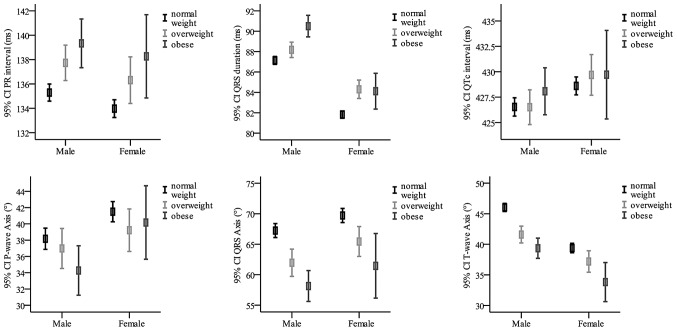
Obesity exhibits a wide variety of electrocardiogram (ECG) abnormalities in adults, which often lead to cardiovascular events. However, there is currently no evidence of an association between obesity and ECG variables in children and adolescents. The present study aimed to explore the associations between obesity and ECG intervals and axes in children and adolescents. A cross-sectional observational study of 5,556 students aged 5-18 years was performed. Anthropometric data, blood pressure and standard 12-lead ECGs were collected for each participant. ECG variables were measured manually based on the temporal alignment of simultaneous 12 leads using a CV200 ECG Work Station. Overweight and obese groups demonstrated significantly longer PR intervals, wider QRS durations and leftward shifts of frontal P-wave, QRS and T-wave axes, while the obese group also demonstrated significantly higher heart rates, compared with normal weight groups within normotensive or hypertensive subjects (P<0.05). Abdominal obesity was also associated with longer PR intervals, wider QRS duration and a leftward shift of frontal ECG axes compared with normal waist circumference (WC) within normotensive or hypertensive subjects (P<0.05). Gender was a possible factor affecting the ECG variables. Furthermore, the ECG variables, including PR interval, QRS duration and frontal P-wave, QRS and T-wave axes, were significantly linearly correlated with body mass index, WC and waist-to-height ratio adjusted for age, gender, ethnicity and blood pressure. However, there was no significant association between obesity and the corrected QT interval (P>0.05). The results of the current study indicate that in children and adolescents, general and abdominal obesity is associated with longer PR intervals, wider QRS duration and a leftward shift of frontal P-wave, QRS and T-wave axes, independent of age, gender, ethnicity and blood pressure.
Keywords: abdominal obesity; adolescents; axes; children; electrocardiography; intervals; obesity.
Figures
References
-
- O’Neil BJ, Hoekstra J, Pride YB, et al. Incremental benefit of 80-lead electrocardiogram body surface mapping over the 12-lead electrocardiogram in the detection of acute coronary syndromes in patients without ST-elevation myocardial infarction: Results from the Optimal Cardiovascular Diagnostic Evaluation Enabling Faster Treatment of Myocardial Infarction (OCCULT MI) trial. Acad Emerg Med. 2010;17:932–939. - PubMed
-
- Okamura T, Hayakawa T, Kadowaki T, et al. Resting heart rate and cause-specific death in a 16.5-year cohort study of the Japanese general population. Am Heart J. 2004;147:1024–1032. - PubMed
-
- Palatini P, Casiglia E, Julius S, Pessina AC. High heart rate: a risk factor for cardiovascular death in elderly men. Arch Intern Med. 1999;159:585–592. - PubMed
LinkOut - more resources
Full Text Sources
Other Literature Sources
Research Materials