


Prevalence of metabolic syndrome and its components among Chinese professional athletes of strength sports with different body weight categories
- PMID: 24255714
- PMCID: PMC3821854
- DOI: 10.1371/journal.pone.0079758
Prevalence of metabolic syndrome and its components among Chinese professional athletes of strength sports with different body weight categories
Abstract
Background: There is an increasing concern on cardiometabolic health in young professional athletes at heavy-weight class.
Objective: Our cross-sectional survey aimed to evaluate the prevalence of metabolic syndrome and clustering of metabolic risk factors in a population of young and active professional athletes of strength sports in China.
Methods: From July 2006 to December 2008, a total of 131 male and 130 female athletes of strength sports were enrolled. We used two criteria provided by the Chinese Diabetes Society (2004) and the National Cholesterol Education Program's Adult Treatment Panel III (2002) to define the metabolic syndrome and its individual components, respectively.
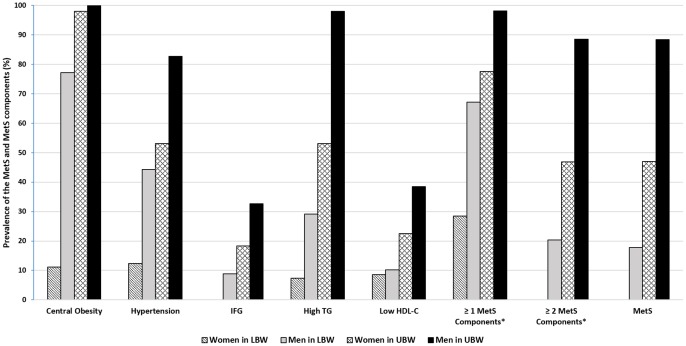
Results: Regardless of their similar ages (mean: 21 years) and exercise levels, athletes in the heaviest-weight-class with unlimited maximum body weight (UBW) boundaries (mean weight and BMI: 130 kg and 38 kg/m(2) for men, 110 kg and 37 kg/m(2) for women) had significantly higher prevalence of metabolic syndrome than did those in all other body-weight-class with limited body weight (LBW) boundaries (mean weight and BMI: 105 kg and 32 kg/m(2) for men, 70 kg and 26 kg/m(2) for women). Prevalence of metabolic syndrome using CDS criteria (UBW vs. LBW: 89% vs. 18% for men, 47% vs. 0% for women) and its individual components, including central obesity, hypertension, hypertriglyceridemia, low high-density lipoprotein-cholesterol levels, and impaired fasting glucose, were all significantly higher in athletes at the heaviest weight group with UBW than all other weight groups with LBW.
Conclusions: Our study suggests that professional athletes of strength sports at the heaviest-weight-class are at a significant increased risk of cardiometabolic disease compared with those at all other weight categories. The findings support the importance of developing and implementing the strategy of early screening, awareness, and interventions for weight-related health among young athletes.
Conflict of interest statement
Figures
References
-
- Berge HM, Andersen TE, Solberg EE, Steine K (2013) High ambulatory blood pressure in male professional football players. Br J Sports Med 47: 521–525. - PubMed
-
- Kyle JM, Walker RB, Riales RR, Petty GJ, Thomas JA, et al. (1991) Student athlete cholesterol screening during routine precompetition examination. J Fam Pract 33: 172–176. - PubMed
-
- Batista C, Soares JM (2013) Are former elite athletes more protected against metabolic syndrome? J Cardiol 61: 440–445. - PubMed
-
- Tucker AM, Vogel RA, Lincoln AE, Dunn RE, Ahrensfield DC, et al. (2009) Prevalence of cardiovascular disease risk factors among National Football League players. JAMA 301: 2111–2119. - PubMed
Publication types
MeSH terms
LinkOut - more resources
Full Text Sources
Other Literature Sources
Medical
