


Work stress and depressive symptoms in older employees: impact of national labour and social policies
- PMID: 24256638
- PMCID: PMC4222833
- DOI: 10.1186/1471-2458-13-1086
Work stress and depressive symptoms in older employees: impact of national labour and social policies
Abstract
Background: Maintaining health and work ability among older employees is a primary target of national labour and social policies (NLSP) in Europe. Depression makes a significant contribution to early retirement, and chronic work-related stress is associated with elevated risks of depression. We test this latter association among older employees and explore to what extent indicators of distinct NLSP modify the association between work stress and depressive symptoms. We choose six indicators, classified in three categories: (1) investment in active labour market policies, (2) employment protection, (3) level of distributive justice.
Methods: We use data from three longitudinal ageing studies (SHARE, HRS, ELSA) including 5650 men and women in 13 countries. Information on work stress (effort-reward imbalance, low work control) and depressive symptoms (CES-D, EURO-D) was obtained. Six NLSP indicators were selected from OECD databases. Associations of work stress (2004) with depressive symptoms (2006) and their modification by policy indicators were analysed using logistic multilevel models.
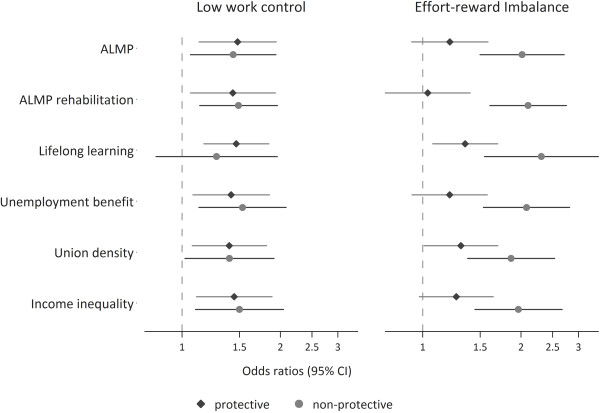
Results: Risk of depressive symptoms at follow-up is higher among those experiencing effort-reward imbalance (OR: 1.55 95% CI 1.27-1.89) and low control (OR: 1.46 95% CI 1.19-1.79) at work. Interaction terms indicate a modifying effect of a majority of protective NLSP indicators on the strength of associations of effort - reward imbalance with depressive symptoms.
Conclusions: Work stress is associated with elevated risk of prospective depressive symptoms among older employees from 13 European countries. Protective labour and social policies modify the strength of these associations. If further supported findings may have important policy implications.
Figures
References
-
- Suhrcke M, Fumagalli E, Hancock R. Is there a wealth dividend of aging societies? Public Health Rev. 2010;32:377–400.
-
- Bromet E, Andrade LH, Hwang I, Sampson NA, Alonso J, de Girolamo G, de Graaf R, Demyttenaere K, Hu C, Iwata N, Karam AN, Kaur J, Kostyuchenko S, Lepine J, Levinson D, Matschinger H, Medina Mora ME, Oakley Browne M, Posada-Villa J, Viana MC, Williams DR, Kessler RC. Cross-national epidemiology of DSM-IV major depressive episode. BMC Med. 2011;9:90. doi: 10.1186/1741-7015-9-90. - DOI - PMC - PubMed
Publication types
MeSH terms
LinkOut - more resources
Full Text Sources
Other Literature Sources
Medical
Molecular Biology Databases
