


A comprehensive comparison study of three different planar IMRT QA techniques using MapCHECK 2
- PMID: 24257283
- PMCID: PMC5714623
- DOI: 10.1120/jacmp.v14i6.4398
A comprehensive comparison study of three different planar IMRT QA techniques using MapCHECK 2
Abstract
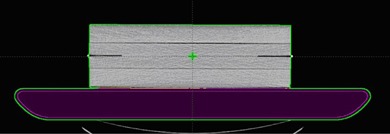
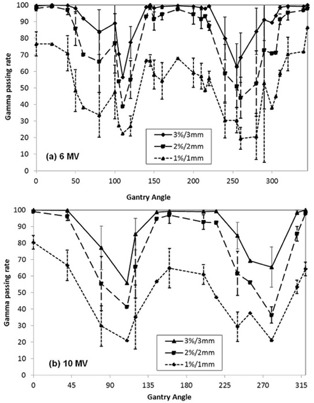
The purpose of this study is to determine comparability of three different planar IMRT QA techniques: patient gantry angle composite (PGAC), single gantry angle composite (SGAC), and field by field (FBF), using MapCHECK 2 device and the γ test as performance metrics; and to assess the dependency of these techniques on intensity modulation, couch attenuation, and detector position (angular dependency). Ten highly modulated head and neck (H&N) and ten moderately modulated prostate IMRT validation plans were delivered using different techniques and were intercompared using the Student's t-test. The IMRT QA measurements were evaluated by percentage of points passing the γ test for three different criteria: 1% (dose difference)/1 mm (distance to agreement (DTA)) (C1), 2%/2 mm (C2), and 3%/3 mm (C3). To investigate dependency of the IMRT validation on treatment couch, ionization chamber measurements, as well as the conventional MapCHECK 2 QAs, were performed with PGAC and PGAC-WOC (without couch; using an extended tennis racket-type insert with negligible attenuation assumed). To determine angular dependency of the MapCHECK 2, patient gantry field-by-field (PG-FBF) technique was delivered and evaluated separately for each field. The differences of γ passing rates between SGAC and FBF were statistically insignificant, while these were statistically significant when compared to PGAC. SGAC and FBF techniques showed statistically insignificant differences between different levels of intensity modulation (H&N vs. Prostate) at C2 and C3 criteria, while PGAC could not for any criteria. The treatment couch has a significant impact on γ passing rates (PGAC vs. PGAC-WOC), but an ionization chamber-based IMRT validations showed clinically insignificant dose errors (< 2%) in all cases. This study showed that the MapCHECK 2 device has large angular dependency, especially at gantry angles of 90° and 270°, which dramatically affected the γ passing rates of PGAC. With proper consideration of couch attenuation and beam arrangement, the MapCHECK 2 will produce clinically comparable QA results using the three different planar IMRT QA techniques.
Figures



References
-
- Low DA, Harms WB, Mutic S, Purdy JA. A technique for the quantitative evaluation of dose distributions. Med Phys. 1998;25(5):656–61. - PubMed
-
- Harms WB, Sr. , Low DA, Wong JW, Purdy JA. A software tool for the quantitative evaluation of 3D dose calculation algorithms. Med Phys. 1998;25(10):1830–36. - PubMed
-
- Ezzell GA, Burmeister JW, Dogan N, et al. IMRT commissioning: multiple institution planning and dosimetry comparisons, a report from AAPM Task Group 119. Med Phys. 2009;36(11):5359–73. - PubMed
-
- Stock M, Kroupa B, Georg D. Interpretation and evaluation of the gamma index and the gamma index angle for the verification of IMRT hybrid plans. Phys Med Biol. 2005;50(3):399–411. - PubMed
Publication types
MeSH terms
LinkOut - more resources
Full Text Sources
Other Literature Sources
Miscellaneous
