


Digoxin use and lower 30-day all-cause readmission for Medicare beneficiaries hospitalized for heart failure
- PMID: 24257326
- PMCID: PMC3929967
- DOI: 10.1016/j.amjmed.2013.08.027
Digoxin use and lower 30-day all-cause readmission for Medicare beneficiaries hospitalized for heart failure
Abstract
Background: Heart failure is the leading cause for hospital readmission, the reduction of which is a priority under the Affordable Care Act. Digoxin reduces 30-day all-cause hospital admission in chronic systolic heart failure. Whether digoxin is effective in reducing readmission after hospitalization for acute decompensation remains unknown.
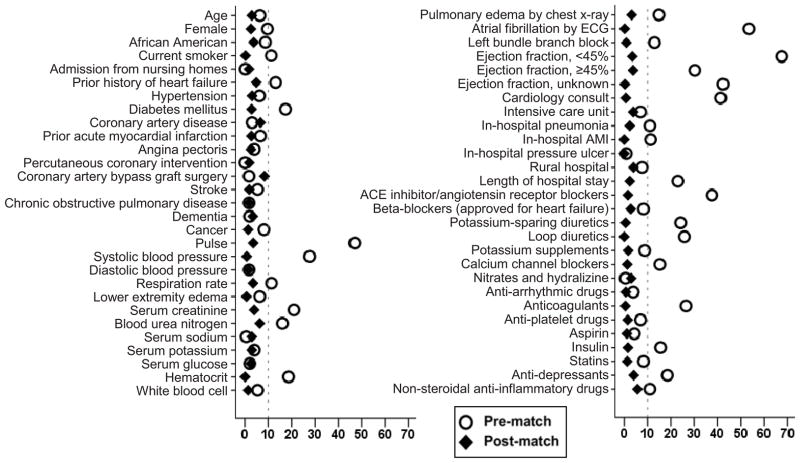
Methods: Of the 5153 Medicare beneficiaries hospitalized for acute heart failure and not receiving digoxin, 1054 (20%) received new discharge prescriptions for digoxin. Propensity scores for digoxin use, estimated for each of the 5153 patients, were used to assemble a matched cohort of 1842 (921 pairs) patients (mean age, 76 years; 56% women; 25% African American) receiving and not receiving digoxin, who were balanced on 55 baseline characteristics.
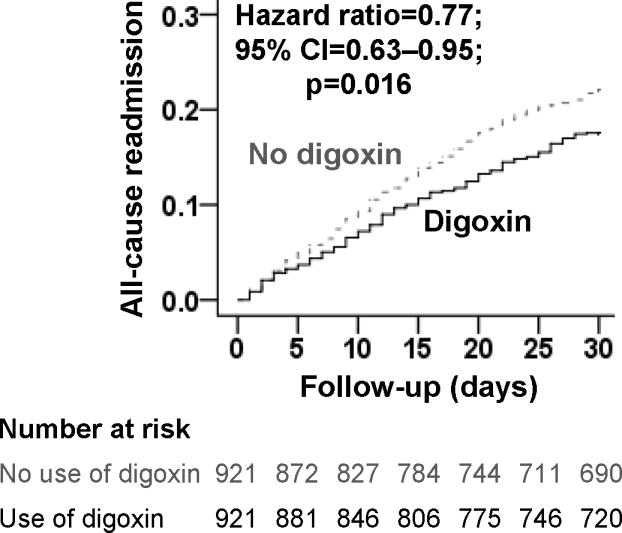
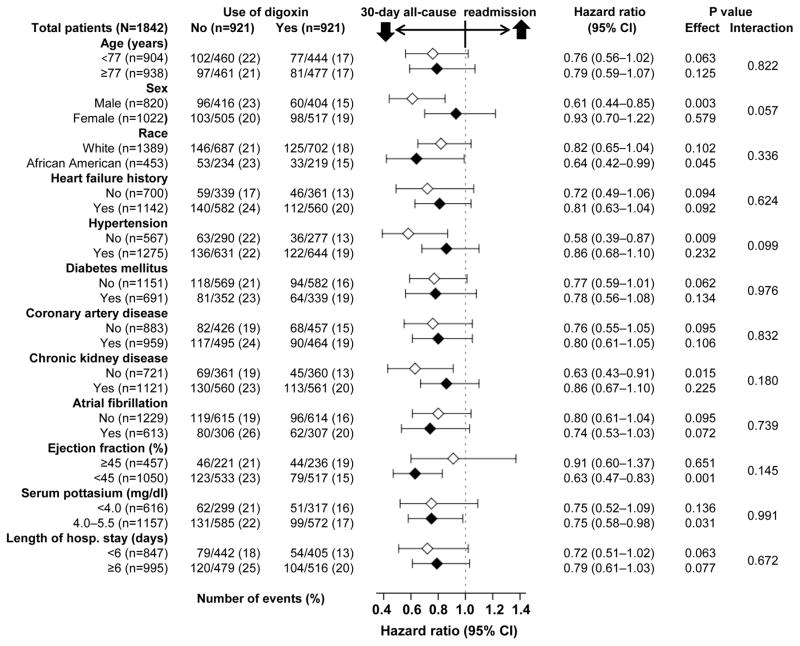
Results: Thirty-day all-cause readmission occurred in 17% and 22% of matched patients receiving and not receiving digoxin, respectively (hazard ratio [HR] for digoxin, 0.77; 95% confidence interval [CI], 0.63-0.95). This beneficial association was observed only in those with ejection fraction <45% (HR 0.63; 95% CI, 0.47-0.83), but not in those with ejection fraction ≥ 45% (HR 0.91; 95% CI, 0.60-1.37; P for interaction, .145), a difference that persisted throughout the first 12 months postdischarge (P for interaction, .019). HRs (95% CIs) for 12-month heart failure readmission and all-cause mortality were 0.72 (0.61-0.86) and 0.83 (0.70-0.98), respectively.
Conclusions: In Medicare beneficiaries with systolic heart failure, a discharge prescription of digoxin was associated with lower 30-day all-cause hospital readmission, which was maintained at 12 months, and was not at the expense of higher mortality. Future randomized controlled trials are needed to confirm these findings.
Keywords: Digoxin; Heart failure; Hospital readmission.
Copyright © 2014 Elsevier Inc. All rights reserved.
Conflict of interest statement
Figures
Comment in
-
Digoxin initiation is associated with lower risk of all-cause readmission after hospitalisation for heart failure.Evid Based Med. 2014 Aug;19(4):153. doi: 10.1136/eb-2014-101743. Epub 2014 Mar 17. Evid Based Med. 2014. PMID: 24639395 No abstract available.
References
-
- Jencks SF, Williams MV, Coleman EA. Rehospitalizations among patients in the Medicare fee-for-service program. The New England journal of medicine. 2009;360:1418–1428. - PubMed
-
- Rau J. The New York Times. New York: 2012. [Access date: December 2, 2012]. Hospitals Face Pressure to Avert Readmissions. http://www.nytimes.com/2012/11/27/health/hospitals-face-pressure-from-me....
-
- Stone J, Hoffman GJ. Prepared for Members and Committees of Congress, ed. , editor. Congressional Research Service Report for Congress. Washington, DC: 2010. [Access date: September 7, 2012]. Medicare Hospital Readmissions: Issues, Policy Options and PPACA. http://www.ncsl.org/documents/health/Medicare_Hospital_Readmissions_and_....
-
- Sommers C, Cunningham PJ. Physician Visits After Hospital Discharge: Implications for Reducing Readmissions. The National Institute for Health Care Reform; Washington, DC: 2011. [Access date: May 9, 2012]. http://www.nihcr.org/Reducing_Readmissions.pdf.
-
- Konstam MA. Heart Failure in the Lifetime of Musca Domestica (The Common Housefly) JACC: Heart Failure. 2013;1:178–180. - PubMed
Publication types
MeSH terms
Substances
Grants and funding
LinkOut - more resources
Full Text Sources
Other Literature Sources
Medical
