


The societal and economic value of rotator cuff repair
- PMID: 24257656
- PMCID: PMC3821158
- DOI: 10.2106/JBJS.L.01495
The societal and economic value of rotator cuff repair
Abstract
Background: Although rotator cuff disease is a common musculoskeletal problem in the United States, the impact of this condition on earnings, missed workdays, and disability payments is largely unknown. This study examines the value of surgical treatment for full-thickness rotator cuff tears from a societal perspective.
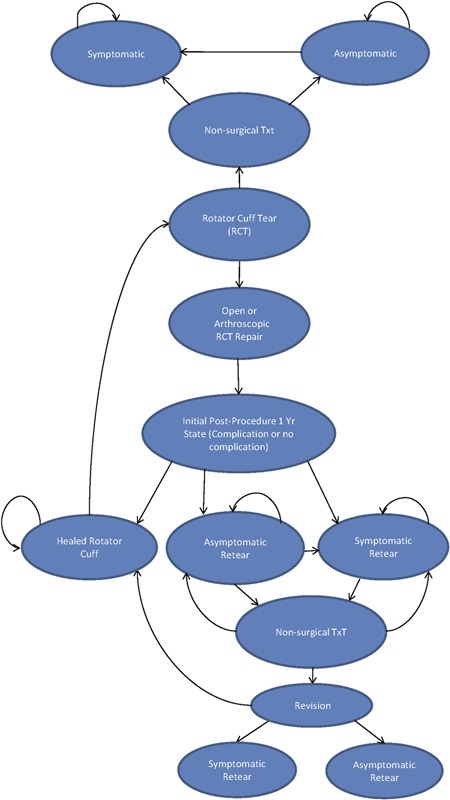
Methods: A Markov decision model was constructed to estimate lifetime direct and indirect costs associated with surgical and continued nonoperative treatment for symptomatic full-thickness rotator cuff tears. All patients were assumed to have been unresponsive to one six-week trial of nonoperative treatment prior to entering the model. Model assumptions were obtained from the literature and data analysis. We obtained estimates of indirect costs using national survey data and patient-reported outcomes. Four indirect costs were modeled: probability of employment, household income, missed workdays, and disability payments. Direct cost estimates were based on average Medicare reimbursements with adjustments to an all-payer population. Effectiveness was expressed in quality-adjusted life years (QALYs).
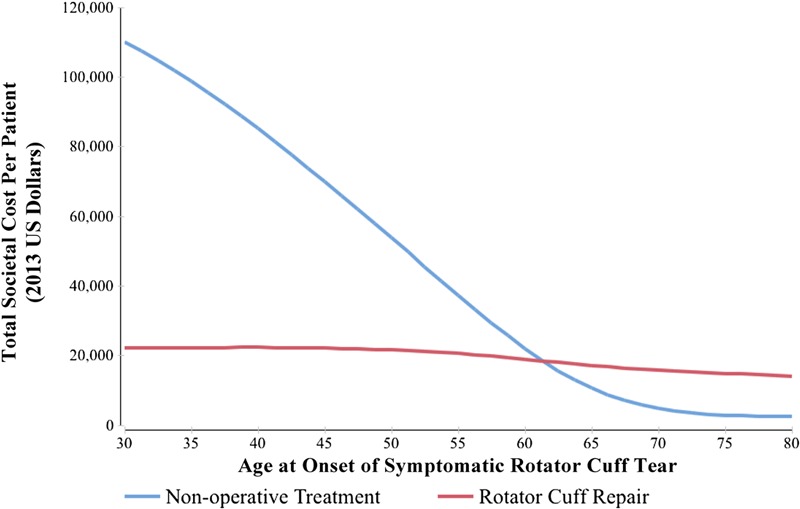
Results: The age-weighted mean total societal savings from rotator cuff repair compared with nonoperative treatment was $13,771 over a patient's lifetime. Savings ranged from $77,662 for patients who are thirty to thirty-nine years old to a net cost to society of $11,997 for those who are seventy to seventy-nine years old. In addition, surgical treatment results in an average improvement of 0.62 QALY. Societal savings were highly sensitive to age, with savings being positive at the age of sixty-one years and younger. The estimated lifetime societal savings of the approximately 250,000 rotator cuff repairs performed in the U.S. each year was $3.44 billion.
Conclusions: Rotator cuff repair for full-thickness tears produces net societal cost savings for patients under the age of sixty-one years and greater QALYs for all patients. Rotator cuff repair is cost-effective for all populations. The results of this study should not be interpreted as suggesting that all rotator cuff tears require surgery. Rather, the results show that rotator cuff repair has an important role in minimizing the societal burden of rotator cuff disease.
Figures
Comment in
-
Repair of symptomatic rotator cuff tears after failed nonoperative treatment is cost-effective: commentary on an article by Richard C. Mather III, MD, et al.: "The societal and economic value of rotator cuff repair".J Bone Joint Surg Am. 2013 Nov 20;95(22):e178. doi: 10.2106/JBJS.M.01223. J Bone Joint Surg Am. 2013. PMID: 24257678 Free PMC article. No abstract available.
References
-
- Oh LS, Wolf BR, Hall MP, Levy BA, Marx RG. Indications for rotator cuff repair: a systematic review. Clin Orthop Relat Res. 2007 Feb;455:52-63 - PubMed
-
- Praemer A, Furner S, Rice DP. Musculoskeletal conditions in the United States. 2nd ed. Rosemont, IL: American Academy of Orthopaedic Surgeons; 1999
-
- Seida JC, LeBlanc C, Schouten JR, Mousavi SS, Hartling L, Vandermeer B, Tjosvold L, Sheps DM. Systematic review: nonoperative and operative treatments for rotator cuff tears. Ann Intern Med. 2010 Aug 17;153(4):246-55 Epub 2010 Jul 05 - PubMed
-
- HCUP State Ambulatory Surgery Databases. Healthcare Cost and Utilization Project (HCUP). 2007-2009. Agency for Healthcare Research and Quality, Rockville, MD. www.hcup-us.ahrq.gov/sasdoverview.jsp.
-
- Yamamoto A, Takagishi K, Osawa T, Yanagawa T, Nakajima D, Shitara H, Kobayashi T. Prevalence and risk factors of a rotator cuff tear in the general population. J Shoulder Elbow Surg. 2010 Jan;19(1):116-20 - PubMed
Publication types
MeSH terms
Grants and funding
LinkOut - more resources
Full Text Sources
Other Literature Sources
Medical
