A prognostic test to predict the risk of metastasis in uveal melanoma based on a 15-gene expression profile
- PMID: 24258991
- PMCID: PMC4476294
- DOI: 10.1007/978-1-62703-727-3_22
A prognostic test to predict the risk of metastasis in uveal melanoma based on a 15-gene expression profile
Abstract
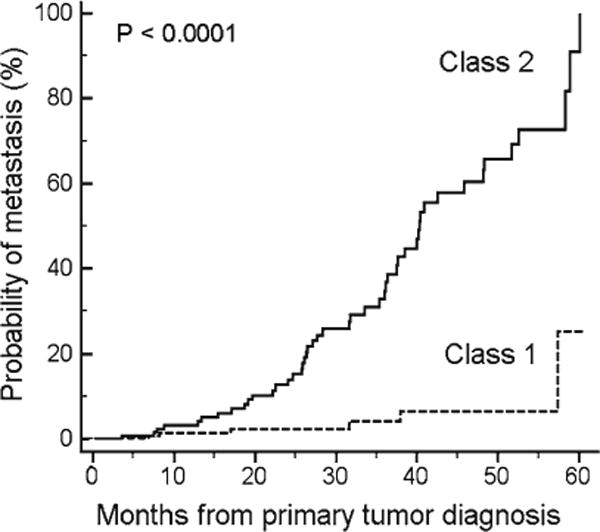
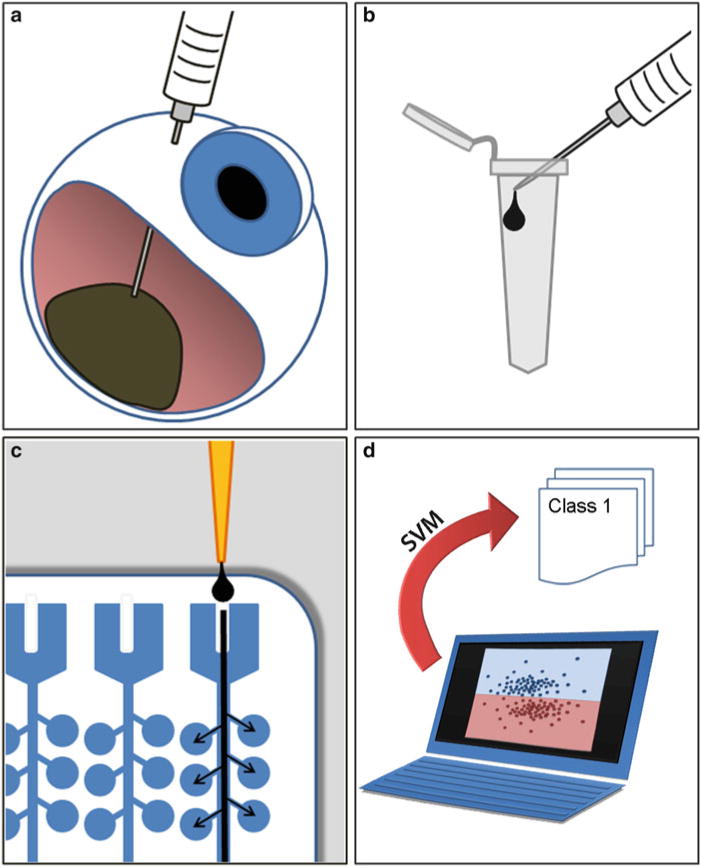
Uveal (ocular) melanoma is an aggressive cancer that metastasizes in up to half of patients. Uveal melanoma spreads preferentially to the liver, and the metastatic disease is almost always fatal. There are no effective therapies for advanced metastatic disease, so the most promising strategy for improving survival is to detect metastasis at an earlier stage or to treat high-risk patients in an adjuvant setting. An accurate test for identifying high-risk patients would allow for such personalized management as well as for stratification of high-risk patients into clinical trials of adjuvant therapy.We developed a gene expression profile (GEP) that distinguishes between primary uveal melanomas that have a low metastatic risk (class 1 tumors) and those with a high metastatic risk (class 2 tumors). We migrated the GEP from a high-density microarray platform to a 15-gene, qPCR-based assay that is now performed in a College of American Pathologists (CAP)-accredited Clinical Laboratory Improvement Amendments (CLIA)-certified laboratory on a routine clinical basis on very small samples obtained by fine needle aspiration and on archival formalin-fixed specimens. We collaborated with several centers to show that our specimen collection protocol was easily learned and performed and that it allowed samples to be safely and reliably transported from distant locations with a very low failure rate. Finally, we showed in a multicenter, prospective study that our GEP assay is highly accurate for predicting which patients will develop metastatic disease, and it was significantly superior to the previous gold standard, chromosome 3 testing for monosomy 3. This is the only prognostic test in uveal melanoma ever to undergo such extensive validation, and it is currently being used in a commercial format under the trade name DecisionDx-UM in over 100 centers in the USA and Canada.
Figures
References
-
- Harbour JW. Clinical overview of uveal melanoma: introduction to tumors of the eye. In: Albert DM, Polans A, editors. Ocular oncology. Marcel Dekker; New York: 2003. pp. 1–18.
-
- Egan KM, Seddon JM, Glynn RJ, Gragoudas ES, Albert DM. Epidemiologic aspects of uveal melanoma. Surv Ophthalmol. 1988;32:239–251. - PubMed
-
- Ramaiya KJ, Harbour JW. Current management of uveal melanoma. Exp Rev Ophthalmol. 2007;2:939–946.
-
- Diener-West M, Reynolds SM, Agugliaro DJ, Caldwell R, Cumming K, Earle JD, Hawkins BS, Hayman JA, Jaiyesimi I, Jampol LM, Kirkwood JM, Koh WJ, Robertson DM, Shaw JM, Straatsma BR, Thoma J. Development of metastatic disease after enrollment in the COMS trials for treatment of choroidal melanoma: Collaborative Ocular Melanoma Study Group Report No. 26. Arch Ophthalmol. 2005;123:1639–1643. - PubMed
MeSH terms
Substances
Grants and funding
LinkOut - more resources
Full Text Sources
Other Literature Sources
Medical
Miscellaneous