Treatment of peripheral neuropathic pain by topical capsaicin: Impact of pre-existing pain in the QUEPP-study
- PMID: 24259265
- PMCID: PMC4238838
- DOI: 10.1002/j.1532-2149.2013.00415.x
Treatment of peripheral neuropathic pain by topical capsaicin: Impact of pre-existing pain in the QUEPP-study
Abstract
Background: This study evaluates the impact of the duration of pre-existing peripheral neuropathic pain on the therapeutic response to the capsaicin 8% cutaneous patch.
Methods: The non-interventional QUEPP (QUTENZA - safety and effectiveness in peripheral neuropathic pain) study evaluated the effectiveness of Qutenza(TM) in 1044 non-diabetic patients with peripheral neuropathic pain, who received a single application. Follow-up visits were scheduled at weeks 1-2, 4, 8 and 12. A pre-defined co-analysis of changes in average pain intensity was performed based on the duration of pre-existing pain.
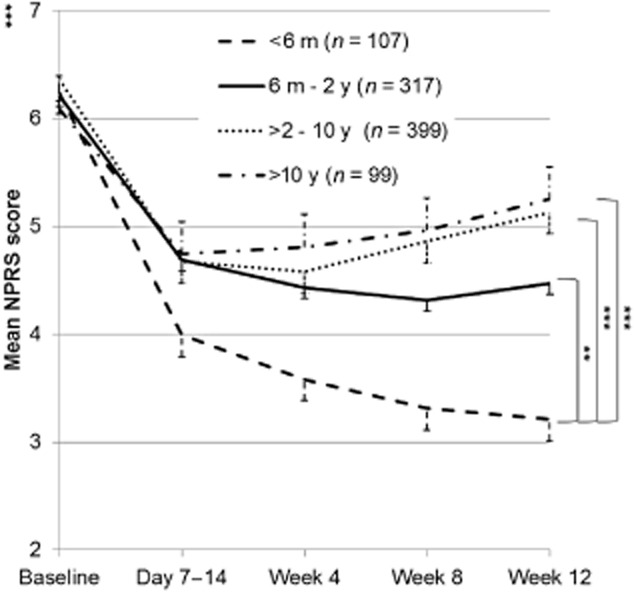
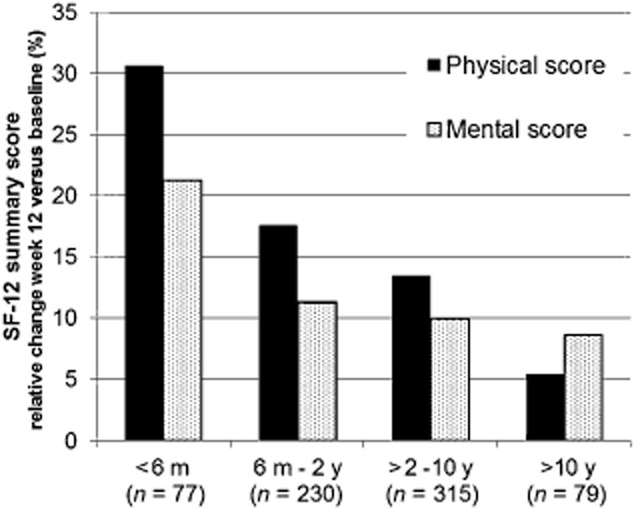
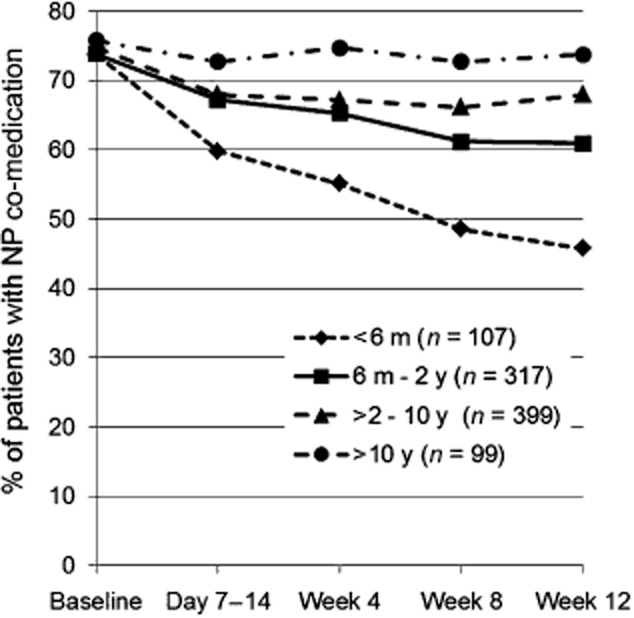
Results: In patients with pre-existing pain for <6 months, the mean relative change of the numeric pain rating scale score on days 7-14 to week 12 versus baseline was -36.6% [4.6 standard error of the mean (SEM); n = 105], -25.1% (1.9 SEM; n = 311) in patients with pain duration of 6 months to 2 years, -22.3% (1.6 SEM; n = 391) in patients with pain for >2-10 years, and -19.2% (2.6 SEM; n = 99) in patients with pain for >10 years. Thirty percent and 50% responder rates were 61.7% and 39.3% in patients with pre-existing pain for <6 months, 42.3% and 23.3% in patients with pain for 6 months to 2 years, 40.9% and 21.6% in patients with pain for >2-10 years, and 32.3% and 14.1% in patients with pain for >10 years.
Conclusions: The highest treatment response to the capsaicin 8% cutaneous patch was observed in patients with a history of pre-existing peripheral neuropathic pain of less than 6 months, suggesting that early initiation of topical treatment might be indicated.
© 2013 The Authors. European Journal of Pain published by John Wiley & Sons Ltd on behalf of European Pain Federation - EFIC®.
Figures
References
-
- Backonja MM, Irving G, Webster L, Tobias J, Vanhove G. Efficacy of NGX-4010, a prescription strength capsaicin 8% patch for the treatment of postherpetic neuralgia, across a range of patient populations. Neurology. 2011;76(9, S4):A110.
-
- Brown S, Simpson DM, Moyle G, Brew B, Schifitto G, Larbalestier N, Orkin C, Fisher M, Vanhove GF, Tobias JK. NGX-4010, a capsaicin 8% patch, for the treatment of painful HIV-associated distal sensory polyneuropathy: Integrated analysis of two phase III, randomized, controlled trials. AIDS Res Ther. 2013;10:5. - PMC - PubMed
-
- Burgmer M, Pfleiderer B, Maihofner C, Gaubitz M, Wessolleck E, Heuft G, Pogatzki-Zahn E. Cerebral mechanisms of experimental hyperalgesia in fibromyalgia. Eur J Pain. 2012;16:636–647. - PubMed
-
- Cochrane-Glossar. 2013. Das Deutsche Cochrane Zentrum. Available at: http://www.cochrane.de/de/cochrane-glossar (Accessed 14 June 2013)
-
- Deumens R, Steyaert A, Forget P, Schubert M, Lavand’homme P, Hermans E, De Kock M. Prevention of chronic postoperative pain: Cellular, molecular, and clinical insights for mechanism-based treatment approaches. Prog Neurobiol. 2013;104:1–37. - PubMed
Publication types
MeSH terms
Substances
LinkOut - more resources
Full Text Sources
Other Literature Sources